Contractor Net 30 Accounts: Keep Cash 30 Days, Ask If Vendor Reports
O'Leary Development GroupOctober 6, 2026
Learn how Net 30 conserves cash for contractors, how to qualify, what to ask vendors about commercial credit reporting, and invoicing practices that speed...
San Antonio’s Go-To Material Supplier
Get a Free Per-Load Quote Today
Same-day delivery available · Transparent pricing · Licensed & insured
A contractor Net 30 account lets you receive materials or services now and pay the invoice within 30 days, which conserves cash during active jobs when you pay on time. The real benefit shows up in short-term cash flow, not automatically in your credit file: a vendor only helps you build business credit if it actually reports your payments. Before applying, gather basic documentation and ask every vendor directly whether they report to a commercial bureau.
TL;DR:
Many vendors start Net 30 countdown from the invoice date, while others use end-of-month terms, affecting payment due dates.
Approval relies more on business organization and references than credit scores, and vendors must report activity to build your credit file.
Net 30 best suits recurring orders or multi-week projects where client payments are predictable; it is less reliable for one-off or new vendor orders.
Vendors often report payment data infrequently, with some submitting only once per year, limiting how quickly Net 30 accounts can build business credit.
Always verify whether a vendor reports to credit bureaus before relying on Net 30 to improve your business credit score.
Olearydevelopmentgroup
Plan Your Next Material Delivery
O’Leary Development Group provides dump truck hauling and material delivery for construction, landscaping, and industrial projects in San Antonio.
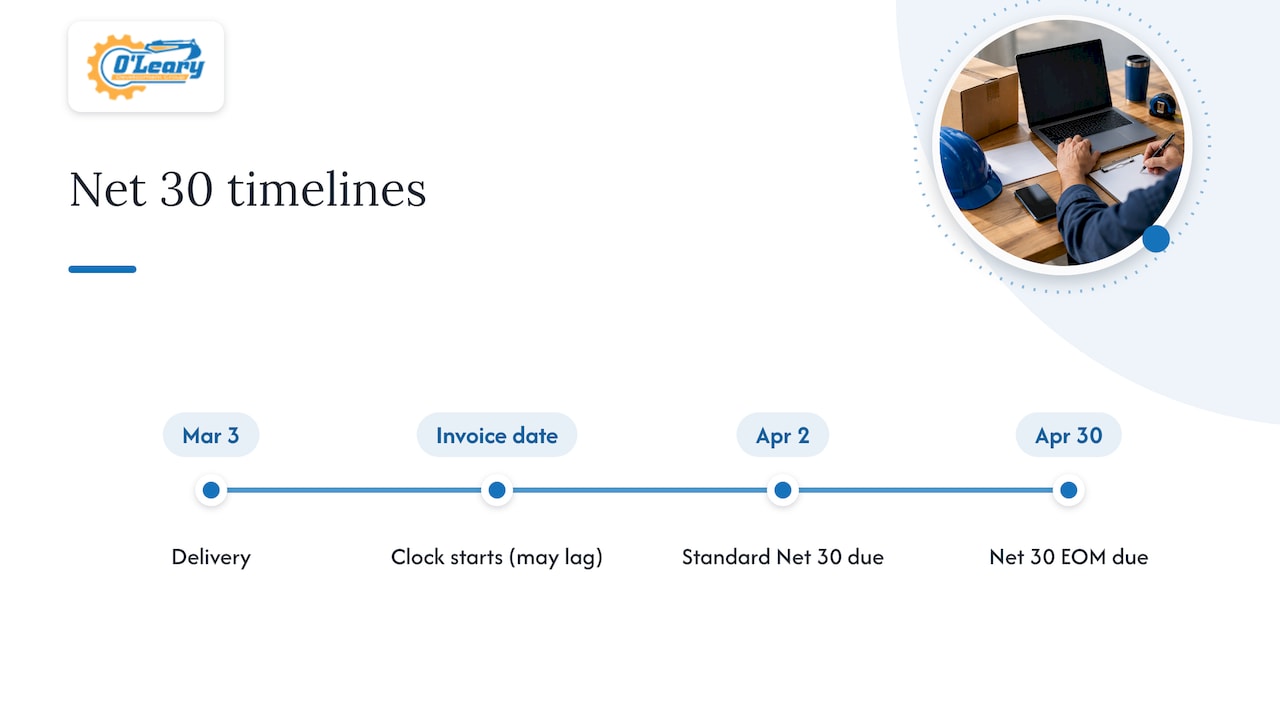
Net 30 sounds simple, but the start date for the countdown varies by vendor, and that variation catches contractors off guard more often than the payment amount does Most suppliers start the clock on the invoice date, which may lag a few days behind the actual delivery or purchase order date. Others use “EOM” terms, shorthand for end of month, where the 30 days begins on the last day of the month the invoice was issued rather than on the invoice date itself. A delivery on March 3 under standard Net 30 is due around April 2, but the same delivery under Net 30 EOM could stretch the due date to April 30.
That structure rewards contractors who have the cash on hand early but still offers the full 30-day cushion when they don’t. SBA guidance notes that businesses can often negotiate even longer windows, including net 45, 60, or 90 day terms, once a payment history is established. Read the invoice terms line every time. A misread start date turns a comfortable 30-day window into a late payment and a possible fee.
Benefits of Net 30 for contractors handling cash flow
The core advantage of Net 30 is straightforward: it lets you receive materials, equipment rentals, or subcontracted labor now while holding onto cash for payroll, deposits, or fuel until the invoice is actually due. According to the Small Business Administration, Net 30 accounts function as short-term trade credit that conserves cash flow specifically when invoices are paid on time, which makes the terms a planning tool rather than free money.
Net 30 tends to matter most in a few recurring situations:
Ordering a full materials load for a job before the client’s deposit clears.
Renting equipment for a multi-day job without tying up a credit line.
Coordinating subcontractor costs on a project that bills the general contractor in stages.
Consider a 45-day remodeling job where a contractor orders $8,000 in materials on day 1 under Net 30 terms. Instead of paying that $8,000 upfront, the contractor has until roughly day 30 to pay it, by which point the client’s first progress payment has typically arrived. That timing gap, not a discount or a rebate, is the entire value of the account.
How to get approved for contractor Net 30 accounts
Approval for a Net 30 account depends less on your credit score and more on whether your business looks established and organized. Vendors want to see a real, separate business, not a sole proprietor buying on a personal card.
Get an EIN from the IRS and open a dedicated business checking account before you apply.
Register your business name and address consistently across your website, invoices, and any licensing paperwork.
Pull together two or three trade references, ideally other vendors who already extend you credit.
Fill out the vendor’s application with your EIN, business address, bank reference, and trade references; most ask for a completed W-9 as well.
If asked, provide a sample purchase order or recent purchase history to show you buy regularly and at predictable volumes.
When speaking with a vendor’s credit department, ask directly for their longest standard term and whether they report payment experiences to a commercial credit bureau.
If declined, build a short history of on-time COD (cash on delivery) purchases with that vendor, then reapply in 60 to 90 days.
Pro Tip:Ask every vendor the same direct question before applying: “Do you report payment experiences to commercial credit bureaus?” A vendor that doesn’t report won’t help your credit file no matter how long you’ve paid on time.
Ready to Order?
Call Now: 210-983-8005
Same-day delivery available on most orders in San Antonio and surrounding cities
Keep your invoices, purchase orders, and bank statements in one organized system. The IRS recommends orderly recordkeeping for exactly this reason: it supports both tax compliance and any billing dispute that comes up later.
How Net 30 accounts affect business credit
Net 30 accounts can contribute to a business credit file, but only when the vendor actually reports the payment activity, and plenty of vendors simply don’t. Commercial credit bureaus including Dun & Bradstreet, Experian, and Equifax each run their own scoring models, and they pull from different pools of reported trade data, so a strong file with one bureau doesn’t guarantee a strong file with another.
Vendors are under no obligation to report payment data to any bureau, so confirm this before relying on an account to build credit.
Dun & Bradstreet’s own trade-data documentation states that a single vendor often submits only one payment experience per 12-month cycle, so one account rarely moves your score on its own.
Experian recommends opening multiple trade accounts and paying consistently, noting it can take about a year for commercial bureaus to generate a meaningful score for a new business.
A vendor’s own reporting cadence limits how fast one account can build your file: Dun & Bradstreet notes that a single reporting vendor typically produces just one payment experience annually, so contractors need several reporting vendors, not more payments to the same one, to build a usable trade history.
That caution is reinforced by enforcement history. The Federal Trade Commission finalized an order against Dun & Bradstreet after finding deceptive practices in its business-credit products, resulting in required changes and refunds. That history is a reasonable basis for skepticism toward any vendor who promises guaranteed credit-building results from a single Net 30 account.
Managing risks and slow payers on Net 30 terms
Net 30 protects your cash flow only if your own clients pay you on a predictable schedule, so the contract you sign with your client matters as much as the terms you get from a vendor. Build in protections before the job starts, not after a payment is late.
Require a deposit before ordering materials, especially on larger jobs where a Net 30 account is funding the first delivery.
Write retainage and late-payment interest into the contract so slow payment carries a defined cost.
Set a clear scope of work with a written change-order process so extra work doesn’t become a dispute at invoicing time.
Send a friendly payment reminder a few days before the due date, then a formal written notice if payment slips past 10 days late.
For large jobs, bill in stages with progress payments tied to completed milestones, rather than waiting for one lump payment at the end.
Pro Tip:Photograph every delivery or completed phase before you leave the site. Proof-of-delivery photos and signed change orders resolve more billing disputes than any follow-up call.
Stop-work clauses and conditional lien releases are worth building into contracts for larger jobs, since they give you formal leverage before a payment problem becomes a cash-flow problem of your own.
Invoice and contract practices that speed payment
A clean invoice gets paid faster, and under Net 30 terms, ambiguity is what causes the delay. Spell out the invoice date, the due date, and the payment terms in plain language rather than assuming the client knows how to count 30 days from a delivery date.
State the exact due date on the invoice itself, not just the terms, so there’s no room for miscounting.
Reference the purchase order or job number on every invoice line so it matches the client’s own paperwork.
Attach proof-of-delivery documentation and any signed change orders as part of the invoice package.
Use accounting software to schedule automatic reminders a few days before and after the due date.
Reconcile delivered loads against invoiced amounts weekly rather than waiting until month end.
A one-calendar scheduling approach that tracks load counts alongside delivery dates keeps billing accurate from the start, which matters more for Net 30 cash flow than any single collections tactic.
Alternatives when Net 30 isn’t available or too risky
Not every vendor offers Net 30, and even when one does, the terms aren’t always the right fit for every job. A few other short-term financing paths serve the same purpose: keeping cash available while work is in progress.
Invoice factoring advances cash against unpaid invoices for a fee, useful when you’re waiting on a slow-paying client rather than a vendor.
Business credit cards offer a short float window but typically carry higher interest than trade credit once a balance rolls over.
Progress draws staged against project milestones reduce the need for any financing at all on larger jobs.
Short-term lines of credit or vendor financing programs, including extended freight terms some logistics partners offer, such as USI Ship’s freight consolidation approach, can stretch payment windows beyond standard Net 30.
How O’Leary Development Group applies contractor account practices
We built our contractor account workflow around the same principles that make Net 30 work anywhere: clear pricing, documented deliveries, and fast reconciliation. Our online booking system lets contractors schedule hauling and material deliveries without back-and-forth calls, and our per-load pricing is stated upfront so there’s no surprise on the invoice.
We photograph proof of delivery on every load to help reduce billing disputes.
We use a single scheduling calendar paired with load-count tracking, so invoiced quantities match what actually arrived at the site.
We keep pricing transparent on our load-pricing page, which shortens the back-and-forth that normally delays reconciliation.
These are the same habits any contractor can apply to vendor relationships generally: document everything, price clearly, and reconcile often.
Schedule Delivery in Minutes
Get Your Free Quote Today
Tell us your location, access, and estimated yardage — we’ll handle the rest
Operator perspective: when Net 30 earns its place
Net 30 earns its place on recurring material orders and multi-week jobs where cash timing is predictable. It earns a lot less trust on a one-off order from a new vendor, or on a client whose payment history you haven’t seen yet. Before applying for or extending Net 30 terms, check three things: the size of the job relative to your cash reserves, whether the client has a track record of paying on time, and whether the vendor actually reports payment data. If any one of those is shaky, ask for a deposit, bill in stages, or wait until you’ve built a short payment history first.
— BRIAN
Request a contractor account with O’Leary Development Group
Getting materials delivered on terms that match your billing cycle saves you from fronting cash on every job. We offer contractor account features built around the same documentation habits that make Net 30 work: online booking, transparent per-load pricing, and proof-of-delivery photos on every haul.
Feature
What it does for your billing
Online booking
Schedules deliveries without phone tag, timestamps the order
Per-load pricing
Sets the invoice amount before the truck arrives
Proof-of-delivery photos
Documents each load to prevent disputes later
Net-30 invoicing
Lets you pay after delivery instead of upfront
Book a delivery and see per-load pricing before you commit.
Request a contractor account to set up Net 30 invoicing on future orders.
Request your contractor account and quote to get your next load scheduled on terms that fit your project’s cash flow.
FAQ
What are normal payment terms when paying an invoice?
Common terms include Net 30, Net 45, and Net 60, with Net 30 being widespread among B2B vendors and service providers. The SBA notes that longer terms like net 45, 60, or 90 days can often be negotiated once a payment history is established.
Is Net 30 or Net 45 better?
Neither term is inherently better; the right choice depends on how long your own cash takes to arrive from clients. A longer term like Net 45 gives more breathing room but is harder to negotiate without an established payment history, while Net 30 is the more commonly offered starting point.
What should a contractor invoice include?
A contractor invoice should state the exact due date, reference the purchase order or job number, and include proof-of-delivery documentation or signed change orders. Keeping organized records of invoices and supporting documents, as the IRS recommends, also helps resolve any billing dispute quickly.
What does “contractor net” mean?
“Contractor net” generally refers to Net terms, such as Net 30, applied to a contractor’s vendor or client invoices, meaning payment is due a set number of days after the invoice date. The exact start date and any variants, like EOM terms, depend on the specific vendor’s invoice language.