Three Things Contractors Must Have Before Wet Ground Deliveries
O'Leary Development GroupOctober 7, 2026
Contractors: follow OSHA‑aligned checks and confirm a stabilized entrance, an ITCP, and a trained spotter before sending trucks onto wet ground.
San Antonio’s Go-To Material Supplier
Get a Free Per-Load Quote Today
Same-day delivery available · Transparent pricing · Licensed & insured
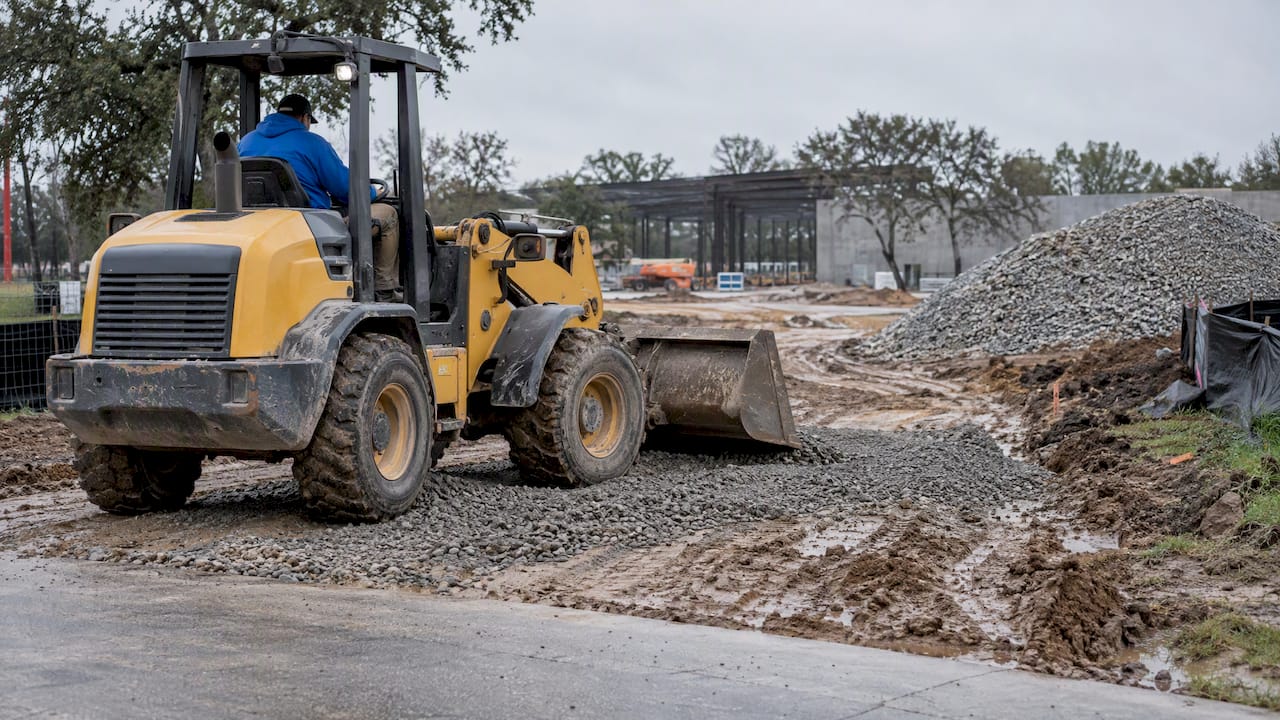
Whether to accept a truck on wet ground comes down to one question: has a competent person confirmed the ground will hold, and are the required controls already in place? If a stabilized entrance, an Internal Traffic Control Plan (ITCP), and a trained spotter are ready, the delivery can proceed. If any of those pieces are missing, the right call is to stabilize the site first or push the delivery to a drier window.
TL;DR:
Ensure a competent person confirms the ground can support trucks and that stabilization, traffic control, and spotting controls are in place before delivery.
Conduct pre-shift inspections and proof rolling to verify ground stability, logging findings to support decision-making on whether to proceed or delay.
Use geotextile and coarse rock pads, timber mats, or stabilization methods for muddy routes, replacing surface fixes if subgrades are significantly failing.
Short-dumping into firm areas and maintaining visual berms reduces risk near slopes, with immediate halt required if cracks, water, or instability are detected during unloading.
A well-planned, updated traffic control plan and site assessments, including pre-delivery photos, help coordinate safe wet-weather deliveries and prevent accidents.
Olearydevelopmentgroup
olearydevelopmentgroup.com
Plan Reliable Material Deliveries
O’Leary Development Group delivers bulk materials for construction, landscaping, and industrial projects across San Antonio and surrounding cities.
What OSHA, NIOSH, EPA and FHWA say about deliveries on unstable or wet ground
The regulatory baseline is consistent across agencies: ground has to be firm, well-drained, and graded to support equipment before a loaded truck crosses it. OSHA’s standard on ground conditions places that duty on the controlling entity, which must coordinate fixes like mats, blocking, or grading rather than let a crew guess at conditions.
NIOSH guidance adds the operational layer. Its dump truck safety report recommends pre-shift inspections, written ITCPs, and staging that minimizes backing, since narrow roads and unstable ground are repeat causes of tip-overs. Stormwater rules matter here too: the EPA’s Construction General Permit requires a SWPPP, stabilized entrances, and track-out controls that directly shape where and how trucks move on a wet site.
Ground must be firm, drained, and graded before equipment crosses it.
Pre-shift inspections and ITCPs reduce backing-related incidents.
Stormwater permits require stabilized entrances and track-out controls.
NIOSH ties narrow roads, unstable ground, and improper loading to a recurring pattern of dump truck tip-overs, and recommends spotter training as a direct countermeasure.
Checking the site before you wave a truck in
A competent person, someone with the authority and training to spot hazards and stop work, needs to walk the delivery route and dump zone before the first truck arrives and again before each subsequent load if rain continues. That inspection looks for soft spots, rutting, standing water, cracked edges near slopes, and any sign that the ground moved since the last pass.
Walk the full route and dump zone, checking for standing water, rutting, and visible deflection.
Proof roll the area with a loaded vehicle to confirm the subgrade holds without pumping or rutting beyond an inch or two, a method FHWA’s geotechnical guidance treats as a standard check before hauling continues.
Log the findings in the site record or SWPPP, note the time and weather, and pass the result to drivers and schedulers before trucks are dispatched.
Decide: proceed as planned, stabilize first, reroute to firmer ground, or postpone until conditions improve.
Pro Tip:Keep a simple pass/fail log at the site trailer. A one-line entry each morning gives you a paper trail if conditions are ever questioned later.
Field fixes for muddy access routes and dump zones
A stabilized construction entrance is the first thing worth building if deliveries will continue through wet weather. The standard design pairs a geotextile fabric base with at least six inches of coarse rock, which keeps the pad from disappearing into the subgrade after a few passes.
A geotextile-and-rock pad holds up better than raw gravel dumped straight onto saturated soil.
Timber or composite mats work well for short-term access across soft spots where excavation isn’t practical.
Topping with coarse aggregate extends a pad’s life but doesn’t fix a subgrade that’s already failing underneath it.
Chemical, lime, or cement stabilization can work, but it usually needs engineering approval and permit updates before it’s applied.
FHWA’s chapter on hauling and stabilization draws a clear line between topical fixes and undercut-and-replace work: when deflection under a proof roll is more than minor, surface treatments alone won’t hold, and the subgrade likely needs to come out and be replaced with better material. Rotating truck traffic across the width of an access road, rather than always running the same wheel path, also extends the life of any stabilized route. Our site access checklist for dump trucks covers route planning in more detail for crews managing multiple trucks a day.
Pro Tip:Keep a stockpile of coarse gravel near the site entrance during wet months. Topping the transition zone from pavement to dirt is routine maintenance, not an emergency fix, and it’s far cheaper than repairing a washed-out pad.
Ready to Order?
Call Now: 210-983-8005
Same-day delivery available on most orders in San Antonio and surrounding cities
Unloading and dumping safely once the truck is on site
Short-dumping, where material drops short of the edge and gets pushed into place with a dozer, is the safer default any time the dump zone shows signs of softness or slope instability. Edge-dumping concentrates the truck’s full weight right where ground failure is most likely.
Confirm the dump zone with the spotter before backing in, and avoid parking a loaded truck closer to a slope or excavation edge than the equipment manufacturer or site plan allows.
Build berms as a visual guide for drivers, not as a safety guarantee; a berm alone won’t stop a truck if the ground underneath it gives way.
Load and unload evenly, set the brake or park gear before raising the bed, and keep the seat belt fastened throughout the cycle.
Lower the bed fully before pulling away, and never work underneath a raised bed without proper bed supports engaged.
Stop immediately if the ground shifts, cracks, or softens mid-unload, and report the change before any more trucks are sent to that spot.
A NIOSH FACE investigation into a fatal dump truck rollover found the proximate cause was backing too close to an unsupported embankment edge, with inadequate berms and a missed signal both named as contributing factors. The lesson holds broadly: edge failure happens fast, and the margin for error near a slope is thin.
Building a traffic control plan that actually works in mud
A written ITCP sets out designated haul routes, staging areas, and crossing points before the first truck shows up, and it gets updated the same day conditions change, not at the next weekly meeting. Daily briefings that cover the current weather and ground status keep drivers and spotters working from the same picture.
Spotters should stand where they have a clear line of sight to the driver and the hazard, never in the truck’s blind path.
Standardized hand signals or radio calls, agreed on before the shift starts, cut down on miscommunication during backing.
Backup alarms and cameras help, but OSHA’s field guidance is clear that they supplement a trained spotter rather than replace one.
Daily ITCP checks and any incident, even a near miss, belong in the site log.
Pro Tip:Assign one person each morning to confirm the ITCP still matches ground reality. Plans written for dry conditions stop working the moment the site turns to mud.
When to stop deliveries and how to fix the ground
Some conditions call for an immediate stop rather than a judgment call: visible cracking near an edge, a failed proof roll, standing water sitting right in the dump zone, or a geotechnical engineer flagging the area as unsafe. Any one of those is reason enough to hold trucks until the issue is addressed.
Move the dump zone to firmer ground nearby if one is available and already assessed.
Deploy temporary matting or a stabilized entrance pad over the worst section rather than continuing to drive through it.
Bring in dewatering pumps if standing water is the main problem and drainage alone will clear it in a reasonable time.
For deeper subgrade failure, undercut and replace the material or add underdrains, work that calls for a geotechnical engineer’s input rather than a field guess.
Chemical stabilizers fall into that last category too: they typically require permit approval and SWPPP updates before use, per FHWA’s guidance on chemical treatment systems, so they’re a planned fix, not something to try on short notice.
How a hauling partner should handle a wet-site job
A hauler that’s organized for wet-weather work should be able to answer a short set of questions before the first truck leaves the yard: how many loads are planned, what route the trucks will take, who’s spotting, and whether insurance documentation is current. Site photos sent ahead of time let a dispatcher flag an access problem before a truck is already en route.
Request a pre-delivery site photo so the hauler can flag access concerns before dispatch.
Confirm the number of loads and preferred route up front to avoid repeated trips over the same soft ground.
Ask who’s assigned as spotter and whether the ITCP has been reviewed for current conditions.
Keep proof of insurance on file so it’s never a last-minute scramble.
Online booking and contractor account features, the kind our own scheduling tools support, cut down on truck queueing at a single access point, which matters most when every extra pass over wet ground deepens the ruts.
What the research actually tells us about wet-ground deliveries
The conventional advice in this space leans heavily on equipment: get bigger tires, rent better mats, buy a tracked machine. That’s not wrong, but it treats a judgment problem like an equipment problem. The sites that get into trouble usually had someone who suspected the ground wasn’t ready and sent the truck anyway, because the schedule was tight or nobody wanted to be the one who called it.
What the regulatory guidance actually supports is a much simpler priority: inspection and the authority to stop work beat any stabilization technique. A pad or a mat buys you access to ground that’s already been checked. It doesn’t substitute for the check itself, and no amount of gravel fixes a subgrade that’s failing six inches down.
Schedule Delivery in Minutes
Get Your Free Quote Today
Tell us your location, access, and estimated yardage — we’ll handle the rest
If there’s one habit worth building, it’s giving the competent person on site real authority to hold trucks, in writing, before the season turns wet. That costs nothing and prevents more incidents than any single piece of equipment.
— BRIAN
Request a site evaluation before your next wet-weather delivery
We haul various bulk materials across job sites that don’t always cooperate with the weather, and we plan around that rather than around ideal conditions. Scheduling options, GPS-tracked trucks, and contractor account features help coordinate deliveries around your access windows instead of forcing one truck after another over ground that needs a break.
Share site photos of the access route and dump zone so we can flag concerns before dispatch.
Tell us the number of loads you expect and your preferred route or staging area.
Note any access restrictions, slopes, or soft spots our drivers should know about ahead of time.
Request a quote through our dump truck hauling services page, and we’ll work out a delivery plan that fits your site as it actually is this week.
FAQ
Can a dump truck legally be sent onto muddy ground?
There’s no blanket ban, but OSHA’s standard requires the controlling entity to confirm ground is firm and graded enough to support the equipment before work proceeds. If a competent person hasn’t verified that, holding the delivery is the compliant choice.
What’s the biggest safety risk during wet-ground deliveries?
Backing incidents and edge failures near slopes account for a recurring share of serious dump truck injuries, according to NIOSH’s safety guidance. A written ITCP and a trained spotter address both risks directly.
Do I need a permit to stabilize a muddy site entrance?
Basic measures like geotextile and gravel pads generally don’t need special permits, but chemical or cement stabilization usually does, per FHWA guidance on treatment systems. Your stormwater permit may also require SWPPP updates when site conditions or controls change.
How much does dump truck delivery cost when site access is difficult?
Pricing depends on material, distance, and access conditions rather than a single flat rate; our dump truck cost guide outlines typical ranges for contractors. Demolition haul-off service is listed at $275 per truck load on our shop page.
What should I ask a hauling company before booking a wet-weather delivery?
Ask how many loads they’re planning, what route the trucks will take, and who’s assigned to spot during backing maneuvers. Confirming current insurance and requesting a pre-delivery site photo review also helps catch access problems before a truck leaves the yard.