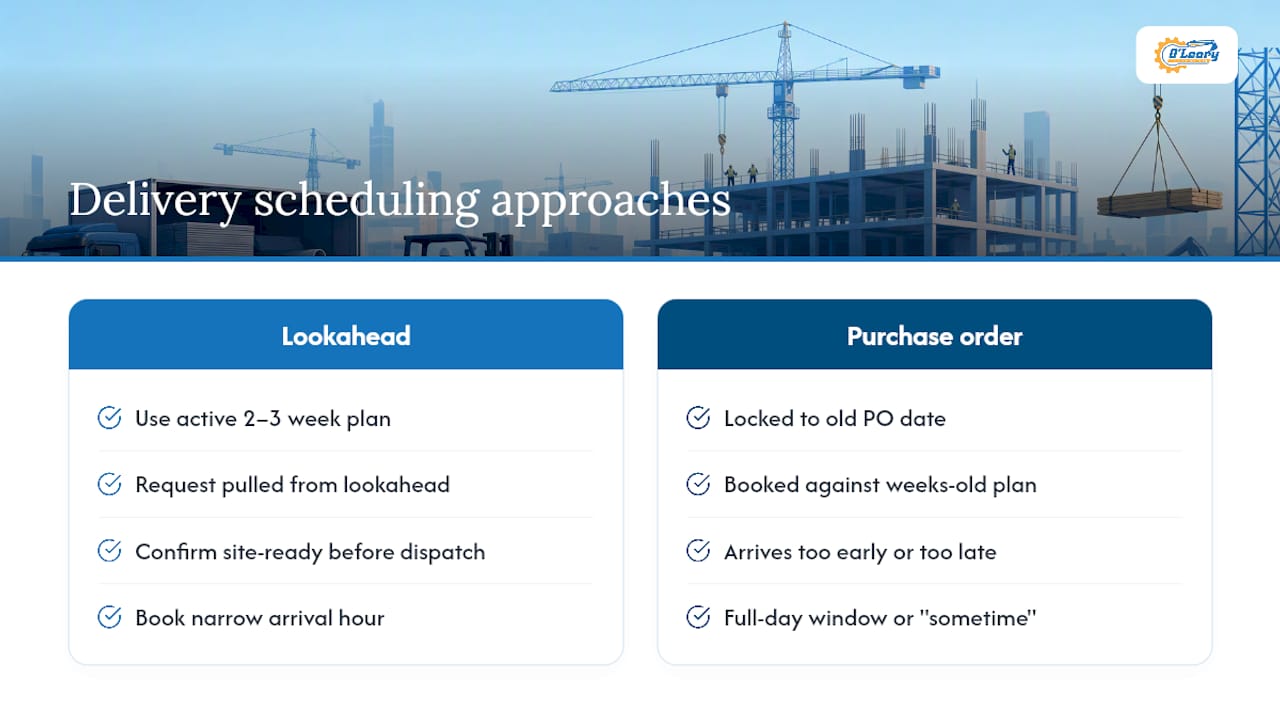
Field tested playbook for contractors. Use a five minute pre booking checklist, lock slots to your 2 to 3 week lookahead, and reconfirm 24 to 48 hours...
San Antonio’s Go-To Material Supplier
Get a Free Per-Load Quote Today
Same-day delivery available · Transparent pricing · Licensed & insured
Jobsite delivery scheduling means booking the material against your current install date, not the date the supplier processed your order. Reserve a narrow arrival window, confirm the truck can physically reach the drop point, and clear a laydown space before you hang up the phone. Reconfirm 24 to 48 hours before arrival, and once more the morning of if the site is tight or urban. Skip any of these four steps and you’re gambling with crew downtime.
TL;DR:
Booking delivery slots based on current install dates rather than original purchase orders prevents delays caused by shifting site conditions.
Confirm the actual installation schedule from the lookahead plan and reserve narrow arrival windows with clear access constraints to avoid site access issues.
Always reconfirm delivery details 24 to 48 hours before arrival, especially for urban or restricted sites, and verify on-site upon the truck’s arrival.
Conduct a site walk beforehand to identify access problems like low branches or soft ground that could block trucks, and mark laydown zones clearly.
Assign one dedicated on-site contact with a mobile number and send a photo of entry points to ensure consistent, clear communication for delivery day.
Olearydevelopmentgroup
Keep Materials Moving On Site
O’Leary Development Group delivers bulk materials across San Antonio and surrounding cities for construction, landscaping, and industrial projects.
A site-ready delivery schedule means the truck shows up exactly when your crew needs the material and can physically get it there without a second trip. That sounds obvious until you look at how most delivery delays actually happen: someone booked the order against a purchase order date weeks earlier, not against what the current schedule actually needs. Jobsite conditions shift daily. A crew that was two days ahead on Monday can be a day behind by Thursday, and if your delivery was locked to last week’s plan, the truck either arrives too early with nowhere to put the load or too late to keep trades moving.
The fix is straightforward: pull every delivery request from your active 2 to 3 week lookahead schedule instead of the original procurement paperwork. That single habit change eliminates most of the “why is this here already” and “where’s my dirt” calls that eat up a foreman’s morning.
Booking a narrow time slot instead of a full-day window matters just as much. A supplier who confirms a specific arrival hour rather than “sometime Tuesday” keeps multiple trucks from converging on your gate at once, which is exactly how small sites end up with three haulers idling on the street waiting for their turn to back in.
Pre-Booking Checklist to Run Before You Call Your Hauler
Run through this list before you pick up the phone. It takes five minutes and saves you a wasted trip.
Pull the task from your lookahead. Confirm the install date is still current, not the date you originally ordered the material.
Calculate truckloads needed. Know your cubic yardage and match it to standard load sizes so you’re not guessing on the call.
Choose just-in-time or buffer stock. If your laydown area is small, order tighter and more often; if space allows, a buffer pile absorbs minor schedule slips without stalling the crew.
Check access constraints. Turn radius, gate height, weight limits on any bridge or easement, and gate operating hours all need a yes before you book.
Mark and protect the laydown zone. Flag where the load lands and where any early-arriving trucks should stage instead.
Name one delivery contact. Give the hauler a single mobile number, not a general office line, so the driver has someone to call from the truck.
Pro Tip:Text the driver a phone photo of your gate and drop point the day before. A five-second glance at the actual entrance prevents more aborted deliveries than any written instruction ever will.
Grouping deliveries by material type and destination also cuts down on handling. If gravel and topsoil are both going to the same corner of the site, book them close together so equipment operators aren’t repositioning machinery twice for what could have been one pass.
Step-by-Step Scheduling Workflow From Order to Sign-Off
Booking a delivery isn’t a single phone call. It’s a short sequence, and skipping a step is usually where the delay starts.
Ready to Order?
Call Now: 210-983-8005
Same-day delivery available on most orders in San Antonio and surrounding cities
Identify the task. Name the material, the exact quantity, and the install date pulled straight from your active lookahead, not the original PO.
Convert quantity to truckloads. A standard dump truck runs 10 to 16 cubic yards depending on the material and the hauler’s fleet, so know your number before you call.
Request the slot. Give the hauler your vehicle access constraints, unloading instructions, and preferred window, then ask for a written confirmation covering both the arrival time and the driver’s unloading procedure.
Clear special equipment. If the drop needs a crane, a pump truck, or a conveyor for a hard-to-reach area, confirm that equipment is scheduled before the truck ever leaves the yard.
Reconfirm 24 to 48 hours out. For tight urban lots or sites with restricted access, add a same-morning check too. This single habit prevents most no-show and wrong-day headaches.
Verify on arrival. Check the delivery ticket against what you ordered, inspect the material for contamination or moisture issues, sign off, and note anything unusual directly on the ticket.
A few things are worth holding onto through that whole sequence:
Never let a driver leave the yard without a confirmed unloading plan. Backing up blind on an unfamiliar site is how equipment gets damaged.
Keep documentation of the delivery ticket. It’s important proof of quantity and condition if a dispute arises later.
If a permit or crane is required and it slips, push the delivery. Don’t let a truck sit on-site burning hours waiting for equipment that isn’t ready.
Long-lead materials should be flagged against your master schedule months in advance, then locked to a firm slot only once the lookahead confirms the install date is holding.
How to Prepare Your Site for a Successful Bulk-Material Drop
Most aborted deliveries trace back to something the office never checked: a low branch, a soft shoulder, or a gate that’s narrower than it looks on a site plan. A quick walk of the entry route with the vehicle’s dimensions in mind, done before you ever book the slot, catches nearly all of it.
Walk the actual path the truck will take, not the shortest line on the drawing. Look for turning radius at every corner, overhead clearance under wires or trees, and whether the ground will hold a fully loaded truck after a rain. Confirming these access points before you confirm the slot is the single biggest lever you have against a wasted trip.
Check width, turn radius, and overhead clearance along the entire entry route, not just at the gate.
Lay temporary boards or geotextile fabric over finished surfaces, buried utilities, or soft ground the truck has to cross.
Reserve and clearly mark a laydown area sized for the full load, plus room for equipment to keep working around it later.
Pull any permits needed if the drop will block a lane or sidewalk, or arrange off-site staging if the site truly has nowhere to put the material.
If your laydown space is genuinely too tight for the full load, off-site staging with shuttle runs is a legitimate option rather than forcing a single oversized drop into a space that can’t hold it.
Communication Rules and Templates for Delivery Day
Every person touching the delivery, from the dispatcher to the gate guard, needs the same four pieces of information before the truck leaves the yard: the confirmed time slot, the on-site contact’s mobile number, the exact drop location, and any gate code or permit number required to get in.
Send it as a short text with a photo of the entrance and a simple hand-drawn or phone-mapped route, not a paragraph of written directions. Ambiguity is what turns a five-minute unload into a 45-minute phone tag session between a confused driver and a foreman who’s three tasks deep into something else.
Confirm the slot, contact, drop point, and vehicle specs with the supplier before dispatch, not after the truck is already rolling.
Set the reconfirmation cadence explicitly: 48 hours out, again at 24 hours, and a quick morning-of check for anything urban or access-constrained.
Name who owns rescheduling. If a slot needs to move, one person, not three, should be authorized to make that call.
Log every confirmation in one shared place, whether that’s a spreadsheet, a booking platform, or the project group chat, so subs aren’t working off stale information.
Pro Tip:If you’re juggling multiple vendors on one site the same week, a shared coordination sheet like the kind outlined in a commercial vendor coordination checklist keeps every hauler’s slot visible in one place instead of buried in separate email threads.
Common Delivery Failures and How to Fix Them Fast
Most blocked deliveries trace back to the same handful of causes, and most of them have a fast workaround if you catch the problem early.
Soft ground or a locked gate. Reroute to an alternate entrance if one exists, or call for a smaller truck that can navigate the original path.
Low-hanging branches or tight overhead clearance. Trim before the delivery date, not on the morning of, since a driver won’t risk equipment damage on a guess.
No laydown space when the truck arrives. Shift the load to off-site staging or a shuttle-run schedule until the crew clears room.
Repeated access failures at the same site. Escalate this. Document what went wrong and extend your lead time on future orders for that address.
Soft ground, overhanging limbs, and gated entrances remain the three most common reasons trucks get turned away on arrival, which is exactly why the site walk described earlier pays for itself every time you skip a callback. Track which suppliers hit their windows consistently and adjust your booking lead time accordingly. A hauler with a strong on-time record earns a tighter window; one that’s been late twice gets padded.
What Contractors Get Wrong About Delivery Timing
Most scheduling advice treats the delivery slot as the finish line. It isn’t. The slot is just the moment the risk starts. Everything that happens in the ten minutes before and after that truck arrives, whether the gate is actually open, whether the laydown zone is actually clear, determines whether the delivery was worth booking in the first place.
Confirmed slots and simple online booking cut idle crew time more than any other single change we’ve made to how deliveries get scheduled. When a hauler commits to a real window instead of a vague day, foremen stop building 90 minutes of slack into their morning “just in case.” That’s real labor cost recovered, not a scheduling nicety.
Schedule Delivery in Minutes
Get Your Free Quote Today
Tell us your location, access, and estimated yardage — we’ll handle the rest
The other underrated piece is contractor account tools: GPS-tracked fleets, per-load pricing you can see in advance, and net-30 invoicing that doesn’t require a purchase order fight before a truck can move. None of that replaces a good site walk or a clear delivery contact. It just removes the friction around booking so your team can focus on the parts of the job that actually need a human decision.
— BRIAN
Book a Delivery Slot Without the Guesswork
Some hauling companies offer online systems that let you lock a narrow delivery window instead of a vague day, and GPS-tracked trucks allow you to see exactly where your load is instead of calling dispatch for an update.
Some contractors receive net-30 invoicing so deliveries don’t stall waiting on a purchase order, and some scheduling options include same-day or next-day service for jobs that can’t wait on a full-week lead time. Whether you need to fill dirt for a foundation pour or crushed limestone for a driveway base, the materials catalog shows per-load pricing up front so you can calculate truckloads before you ever pick up the phone. Ready to lock a slot instead of guessing at one? Get a same-day dump truck quote and reserve your delivery window today.
How Far in Advance Should I Schedule a Bulk-Material Delivery?
Book long-lead or specialty materials against your master schedule months out, but lock the actual delivery slot once your 2 to 3 week lookahead confirms the install date is holding, then reconfirm 24 to 48 hours before arrival.
What’s the Difference Between Just-in-Time and Buffer Stock Ordering?
Just-in-time delivery brings material right before it’s needed and works best when laydown space is tight, while buffer stock means ordering extra ahead of schedule to absorb minor delays without stalling the crew.
Who Should Be the Delivery Contact on Site?
Assign one person with a mobile number the driver can call directly. Splitting that responsibility across multiple crew members is one of the most common causes of missed access and confused drivers.
What Should I Do if a Truck Can’t Access the Site?
Reroute to an alternate gate or a smaller truck if one is available, shift the load to off-site staging, or request crew assistance, then document the failure so you can extend the lead time on future orders to that address.