Contractors’ Copy Ready Template to Order Bulk Materials Online
O'Leary Development GroupSeptember 14, 2026
Contractor playbook to order bulk materials online: exact cubic yard math, a paste ready checklist you can drop into quote forms, delivery cost ranges,...
San Antonio’s Go-To Material Supplier
Get a Free Per-Load Quote Today
Same-day delivery available · Transparent pricing · Licensed & insured
Yes, you can order delivered bulk dirt, gravel, sand, topsoil, mulch, or stone online, and most contractors have it dialed in within one phone call or form submission. Do these five things first: calculate your cubic yards, pick the correct material grade, confirm your site can handle a loaded truck, submit a detailed online quote request, and lock in a delivery window. O’Leary Development Group and similar haulers built their booking systems around this exact sequence, plus a material calculator to handle the math for you.
TL;DR:
Ordering in quarter-yard increments with additional 10-20% for settling and waste ensures enough material and avoids extra delivery fees.
Specific material grades like #57 washed stone or screened topsoil should be clearly specified to prevent misdelivery and ensure suitability for your project.
Verify access, overhead clearance, and surface firmness before delivery day to prevent delays or damage during unloading.
Confirm delivery details in writing and recheck in advance to avoid scheduling issues caused by weather, equipment, or site obstacles.
Build a buffer into your schedule and communicate with the supplier if delays or issues arise to ensure smooth receipt and proper site safety during unloading.
Olearydevelopmentgroup
Get Bulk Materials Delivered
O’Leary Development Group delivers dirt, gravel, limestone, topsoil, and landscape stones across San Antonio and surrounding cities.
How Do You Calculate Bulk Material Volume for an Online Order?
Every bulk material order starts with the same formula: area in square feet, multiplied by depth in feet, divided by 27. That last number matters because one cubic yard equals 27 cubic feet, and suppliers price and load by the yard, not the square foot.
A 20 by 30 foot patio base at 4 inches (0.33 feet) deep works out to 600 square feet times 0.33, divided by 27, or about 7.3 cubic yards.
Round up. Suppliers sell in quarter-yard increments, and compacted or settled material always eats into your coverage. Add a waste and compaction allowance on top of the raw math:
Crushed stone and gravel: 5–10% extra for settling
Road base: 10–20% extra since it compacts hard under vehicle weight
Topsoil and mulch: 10–15% extra for settling and grading loss
Pro Tip:Round your final number up to the nearest quarter-yard, then add your waste percentage. Ordering short means a second delivery fee; ordering a little heavy rarely costs you anything since most yard material gets used eventually.
Tonnage complicates things because density varies by material. Gravel runs roughly 1.4 to 1.7 tons per cubic yard, while topsoil sits closer to 1 to 1.3 tons. Before you submit an order, confirm whether the supplier quotes per yard or per ton. A landscape material calculator can convert between the two so you are not comparing mismatched numbers.
Which Material Grade Should You Order?
Ordering “gravel” without a grade name is how contractors end up with the wrong pile in the driveway. Suppliers stock dozens of variations, and each one serves a different structural purpose.
Road base: compactable crushed stone with fines, used under driveways and slabs
#57 crushed stone: clean, washed aggregate with no fines, ideal for drainage layers and French drains
Pea gravel: smooth, rounded stone for walkways, playgrounds, and drainage beds
Screened topsoil: fine, debris-free soil for planting beds and finish grading
Fill dirt: unscreened bulk soil used to raise grade, not for planting
Mulch: varies by type and intended depth around plants versus play areas
Clean or washed stone has no fines, which means better drainage but less compaction strength. Material “with fines” packs tighter and holds shape under a driveway, but drains poorly. These distinctions change how a structure performs for years, so get specific in your online form. Instead of writing “gravel,” write something like: “Need #57 washed stone for a French drain, 12 cubic yards, driveway access on the south side. Would accept 3/8 inch clean chip as a substitute if #57 is unavailable.” That level of detail eliminates guesswork on the supplier’s end, and vague product names are one of the most common causes of mis-delivered loads.
What Should You Check Before the Truck Arrives?
Delivery day complications almost always trace back to something that could have been checked from a phone screen the week before. Walk your access route the way a loaded truck would.
Measure entrance width and turning radius. A single-axle dump truck needs roughly 10 to 12 feet of clearance; tandem-axle trucks need more room to maneuver.
Check overhead clearance. Tree limbs, power lines, and low carports can strike a raised dump bed even though the truck itself clears fine.
Test surface firmness. Soft, wet, or freshly graded ground can rut under a fully loaded truck that weighs 25,000 pounds or more.
Confirm slope. Steep driveways can cause a load to shift or a truck to lose traction while backing in.
Check for street dumping permits if the drop location sits in a public right of way.
On-site prep matters just as much. Clear the drop area completely, mark the exact spot with paint, cones, or stakes, and lay down a tarp or plywood if you want to protect a driveway surface underneath the pile. Drivers need a clear, marked unloading zone to avoid repositioning mid-delivery, which slows down the whole route.
If access is blocked when the truck shows up, most drivers will curbside the load rather than wait around or reschedule on the spot. That is why staying reachable by phone during your delivery window is non-negotiable. A driver who cannot reach you defaults to the safest option, which is usually dropping the material wherever the truck can legally and safely stop.
What Happens When You Place an Online Order?
The process follows six steps, and skipping any one of them is what causes the back-and-forth phone tag that eats a whole afternoon.
Calculate your yardage using the area times depth divided by 27 formula.
Choose your exact material grade, not just a general category.
Check your ZIP code against the supplier’s service area before filling out anything else.
Request a quote with full project details, including access notes.
Confirm the all-in delivered price and lead time before approving the order.
Prepare your site and payment method ahead of the scheduled window.
Most online quote forms ask for the same core fields: material type and grade, quantity in yards or tons, delivery ZIP code, exact drop location on the property, gate codes or access instructions, vehicle restrictions, and a preferred arrival window. Include notes on:
Overhead obstacles or narrow gates
Whether the site has a locked gate or keypad
Whether you need tailgate spreading or driver-assisted placement
A backup contact number if you will be on another part of the job site
After you submit, expect a confirmation email with your order details and delivery date. On the day of delivery, drivers typically call 30 to 60 minutes before arrival so you can meet them or clear last-minute obstacles. Same-day and next-day availability is common for standard materials in-market, though larger specialty orders sometimes need a few days of lead time. Timing your delivery to match the exact phase of work when you will use the material, rather than ordering weeks early, keeps piles from sitting in the way of other trades on the job site schedule.
How Much Should Bulk Material Delivery Cost?
Pricing structures vary by supplier, but two models dominate: per-yard pricing for lighter materials like mulch and topsoil, and per-ton pricing for heavier aggregates like gravel and road base. The number that actually matters is the all-in delivered price, since a low per-unit rate can hide a steep flat delivery fee.
Ready to Order?
Call Now: 210-983-8005
Same-day delivery available on most orders in San Antonio and surrounding cities
Delivery fees scale down as order size scales up; understanding these details can be easier with a reliable road freight transport management system designed for optimized bulk deliveries. Typical bands look like this:
Under 3 tons: $75 to $150 delivery fee, since small loads still require a full truck run
3 to 10 tons: $50 to $100 delivery fee, as the fixed cost spreads across more material
10 or more tons (full loads): delivery fees are often reduced or waived entirely, since the freight cost is absorbed into a full-truck rate
A handful of scenarios add cost on top of the base quote: splitting one order into two drop locations, requesting tailgate spreading instead of a single dump pile, driver-assisted placement in tight spots, municipal permits for street dumping, and narrow-access surcharges when a driver has to make extra passes. Ask about every one of these before you approve a quote, not after the truck leaves.
Your Copy-Ready Online Order Checklist
Paste this template into any supplier’s quote form and adjust the specifics:
Before you submit:
Confirm quantity in yards or tons, not just a general amount
Specify grade and intended use, not a generic material name
Note whether you need driver-assisted spreading (usually an added fee)
List any acceptable substitutes to avoid a stalled order
Pro Tip:Snap a photo of your drop zone and access route, and attach it to the quote request if the form allows uploads. It settles gate code and clearance questions before the driver is already en route.
How Do You Verify a Delivery Schedule Once It’s Booked?
A confirmed order is not the same as a guaranteed arrival window, so verify it in writing. Most suppliers send a confirmation email or text immediately after you approve a quote, and that message should list the material, quantity, delivery address, and scheduled date. Read it closely. A wrong ZIP code or mistyped quantity at this stage is far easier to fix than after a truck is already loaded.
Two or three days before your scheduled delivery, call or message the supplier to reconfirm the date and window, especially for larger commercial orders or anything scheduled more than a week out. Weather delays, truck maintenance, and scheduling conflicts happen, and a quick check-in surfaces problems before they become a wasted morning waiting on a truck that got rescheduled without your knowledge.
On delivery day, the driver call 30 to 60 minutes before arrival functions as your real-time tracking system. Bulk material haulers generally do not offer GPS tracking links the way parcel carriers do, since a single truck is usually making a handful of stops in sequence rather than hundreds. That call is your cue to do a final walk of the drop zone, move any vehicles, and make sure the gate or access point is unlocked.
If you have not heard from the supplier by the start of your delivery window, call them directly rather than waiting. Dispatch delays happen, and a two-minute call usually gets you an updated estimated time rather than an open-ended wait.
What Do You Do When a Delivery Runs Late or Hits a Snag?
Delays happen for reasons entirely outside your control: a truck breaks down, a prior job runs long, or a storm shuts down a quarry for the day. How you handle it matters more than the delay itself.
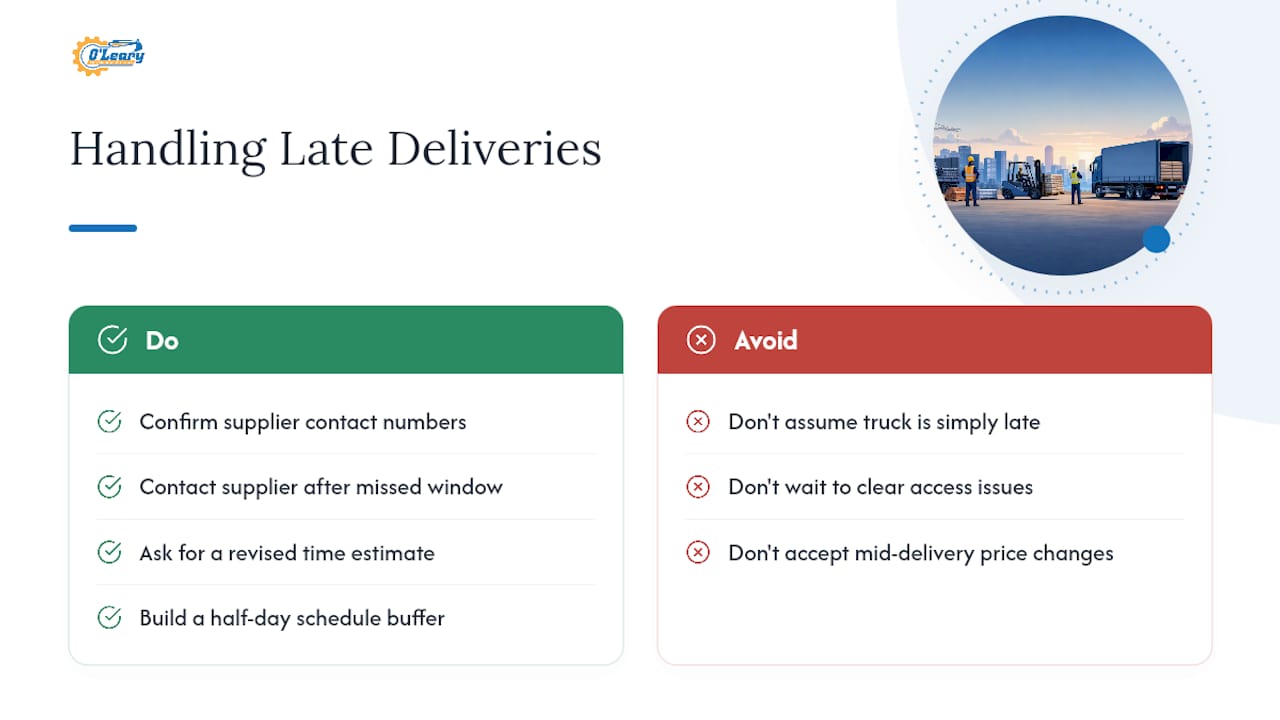
Start by confirming the supplier has your correct contact number and an alternate one if you will be moving around the site. If a delivery window passes without a driver call, contact the supplier immediately rather than assuming the truck is simply running behind. Ask for a revised time estimate, not just an apology.
Build a little slack into your own project schedule when possible. If concrete crews or landscaping teams are waiting specifically on that delivery, a half-day buffer prevents one missed window from cascading into idle labor costs. This matters most on tight commercial timelines where multiple trades are staged back to back.
If access problems caused the delay, meaning the truck showed up but could not get in, fix the obstruction immediately and call the supplier back to ask about a same-day return trip rather than waiting for the next available slot. Many haulers will circle back later in the day if the fix is quick.
Keep your original quote confirmation handy. If a supplier tries to change pricing or material specs mid-delivery, having the written confirmation in hand resolves the disagreement fast. This is also where clear, specific ordering language pays off. Vague requests create more room for miscommunication when something already went sideways.
What Safety Steps Matter During Unloading?
Bulk material unloading involves a fully loaded truck, a hydraulic dump bed, and often several tons of material moving fast. A few basic precautions prevent the most common injuries and property damage.
Keep people and pets well clear of the drop zone while the truck is backing in and dumping. A raised dump bed can strike overhead obstacles, and a shifting load can spill wider than expected, especially on uneven ground. Stand off to the side, never directly behind the truck.
Schedule Delivery in Minutes
Get Your Free Quote Today
Tell us your location, access, and estimated yardage — we’ll handle the rest
Watch for dust, particularly with dry materials like crushed limestone or road base. A simple dust mask or standing upwind handles most of it, and it matters more on windy days or when the delivery lands near an open window or HVAC intake.
Once the pile is down, do not climb or let kids climb on it. Loose gravel and dirt piles shift underfoot and can bury a foot or leg faster than people expect, and stone piles hide sharp edges. If you are hand-moving material afterward, use proper lifting form and take breaks. A cubic yard of wet topsoil weighs over a ton, and repetitive shoveling adds up fast on the body.
If the driver offers tailgate spreading, stay clear of the truck’s path the entire time it is moving, since visibility from the cab is limited in reverse. Finally, check the drop area for any surface damage or ruts afterward, particularly on asphalt or a soft lawn, so you can address it before it becomes a bigger repair.
Order Bulk Materials Online Through a Reliable Hauler
A trusted bulk material delivery service runs on the same principles covered in this guide: accurate quantities, clear material specs, and a delivery process that does not leave you guessing. Request a quote online for fill dirt, gravel, limestone, topsoil, mulch, or landscape stone, and get an all-in delivered price before you commit to a date.
Every delivery is insured, and contractor accounts get features like net-30 invoicing for teams managing multiple job sites across a billing cycle rather than paying per load. Run your numbers through the material calculator before you request pricing, since a confirmed yardage speeds up the whole quote process on both ends. Homeowners tackling a single driveway or planting bed use the same booking form as contractors ordering for a multi-phase build. If you are ready to move forward, visit the dump truck hauling page to request same-day or next-day delivery across Greater San Antonio and the surrounding area.
Practitioner Notes From Brian at O’Leary Development Group
Most delivery problems trace back to three things: no photo of the drop zone, no gate code on file, and no one answering the phone during the window. Fix those three and most jobs go smoothly.
Weight limits catch people off guard the most. A decorative paver driveway or a soft gravel apron was never built to hold a loaded tandem-axle truck, and cracking it after the fact is an expensive lesson. Low tree limbs and narrow side gates are the next most common surprise, usually because nobody measured before booking.
None of this is complicated. It just takes five minutes of walking your site before you submit the order.
It depends on the truck, but a standard tandem-axle dump truck typically hauls around 10 cubic yards per load, while single-axle trucks carry less.
Do I Need a Permit to Have Materials Dumped on My Street?
Some municipalities require a permit for street dumping, so check with your local public works department before scheduling a curbside drop if your driveway cannot accommodate the load.
Is There a Minimum Order for Online Bulk Delivery?
Most suppliers set a minimum order size since delivery fees scale poorly on very small loads, so confirm the minimum yardage or tonnage when you request your quote.
Will the Driver Spread the Material for Me?
Tailgate spreading and driver-assisted placement are usually available for an added fee, so mention it upfront in your online order if you want the load leveled rather than dumped in a pile.
How Far in Advance Should I Schedule Delivery?
Same-day and next-day delivery is common for standard materials in most local markets, though larger or specialty orders benefit from booking a few days ahead to guarantee your preferred window.