Stabilized Decomposed Granite: What It Is and How to Use It
O'Leary Development GroupOctober 22, 2026
Stabilized decomposed granite explained: how it differs from loose DG, how to install it for paths and patios, and how to order the right grade in San Antonio.
San Antonio’s Go-To Material Supplier
Get a Free Per-Load Quote Today
Same-day delivery available · Transparent pricing · Licensed & insured
Stabilized decomposed granite (stabilized DG) is regular decomposed granite blended with a binder, then wetted and compacted so the fines lock into a firm, walkable surface. It suits walkways, patios and garden paths, and it handles light vehicle traffic when the base is built right. Loose DG is a decorative gravel that migrates and ruts. Stabilized DG is a surface you can roll a wheelbarrow over.
This guide covers how the two differ, what goes into the mix, how to install a path or patio, where projects fail, and what to tell your supplier when you order in the San Antonio area.
Olearydevelopmentgroup
Get Decomposed Granite Delivered
O’Leary Development Group delivers decomposed granite in bulk across Greater San Antonio for paths, patios, and other projects.
Stabilized DG is DG mixed with a binder (a dry powder or a liquid) that bonds the particles after water activates it. Loose DG has no binder and shifts under traffic.
A compacted aggregate base of about 3 to 4 inches goes under the DG. Skipping or thinning the base is a common reason surfaces fail.
Watering to full depth before compaction matters most. Too dry and it will not bond. Too wet and it separates.
Permanent edging keeps path edges from crumbling.
Tell your supplier the project type and the grade you want. We deliver DG in bulk across Greater San Antonio.
Decomposed granite is granite that has weathered into sand-sized particles and fines. On its own it is loose. Stabilized DG adds a binding agent so the particles stick together once the material is moistened and compacted.
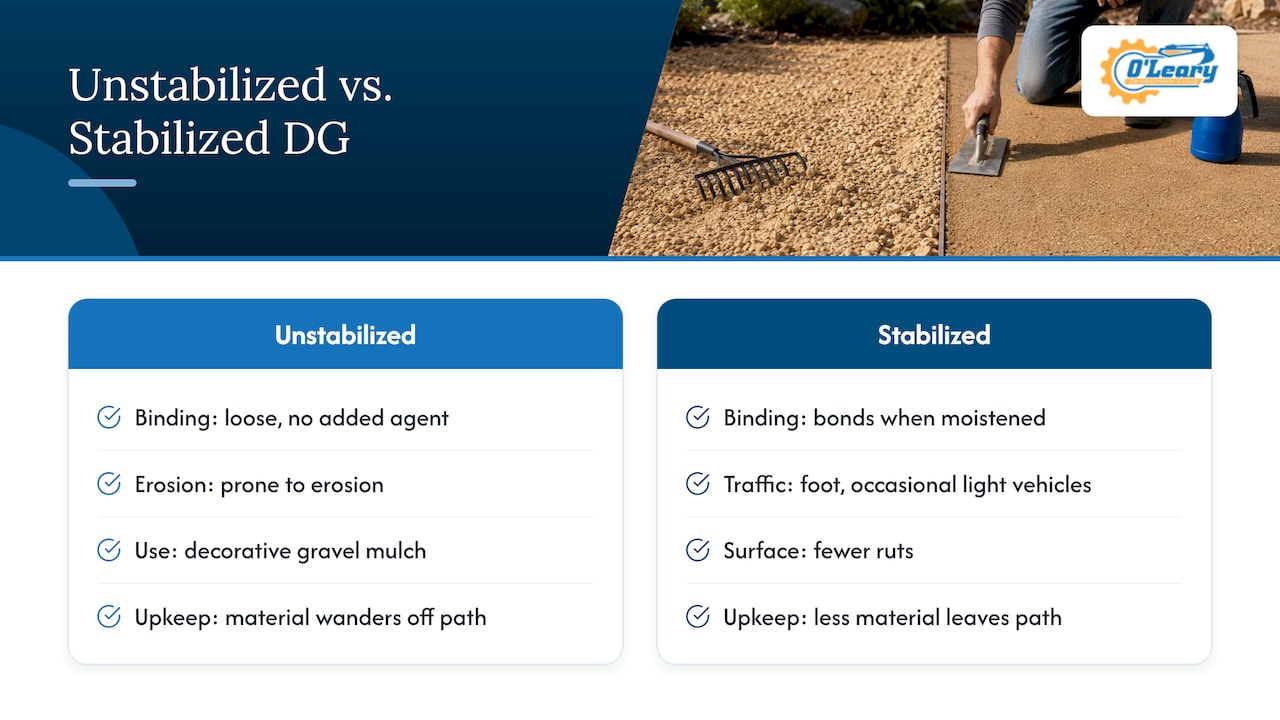
The practical difference is traffic capacity and upkeep. Per Acme Sand’s preparation guidance for stabilizer binder, unstabilized DG is loose and prone to erosion, which makes it best as decorative gravel mulch. Stabilized DG gives a bonded surface that supports pedestrians and occasional light vehicles, with fewer ruts and less material wandering off the path.
Another point from public specifications: Caltrans’ construction manual describes DG as used much like gravel mulch, but harder to build as a solid surface because it needs solidifying emulsions and layered construction. So this is a built surface, not something you rake out and walk away from.
Stabilized vs. unstabilized DG
Unstabilized DG
Stabilized DG
Surface
Loose, shifts underfoot
Firm, bonded
Best use
Decorative areas, mulch-style beds
Walkways, patios, garden paths, light-duty drives
Water
Erodes where water concentrates
Resists washout better, still needs drainage planning
Maintenance
Regular raking and topping up
Less regrading, occasional repair
Install effort
Spread and rake
Base, blend, water, compact
Unstabilized DG is not recommended where water concentrates, per the same Acme Sand guidance. If your yard channels runoff across the path, fix the drainage first, whatever surface you choose.
What binds the granite
Stabilizers come in two broad forms:
Dry powders blended into the aggregate before water is added. Organic psyllium-based products are common.
Liquid bonding agents that hold the granite together. SRW’s Path Stabilizer data sheet describes one example as a liquid-bonding agent for decomposed granite.
Follow the manufacturer’s rate for the product you buy. As one example, Acme Sand’s guidance for its powder calls for 15 lbs of stabilizer per ton of DG. Other products use different rates, so do not apply that number to a different binder.
Ready to Order?
Call Now: 210-983-8005
Same-day delivery available on most orders in San Antonio and surrounding cities
A binder can only lock onto what is there. Stabilized DG needs enough fines to form a matrix, and the gradation is typically 3/8 inch minus. Without the right gradation, even a good binder will not give a solid, traffic-ready surface. For public work, the Elbert County landscape standard shows how a spec lays out a DG gradation by sieve size.
Dry-blend the binder into the DG, preferably in a mechanical mixer, before you add any water. Hand-turning a pile leaves weak spots.
Walkways, patios and drives: what to expect
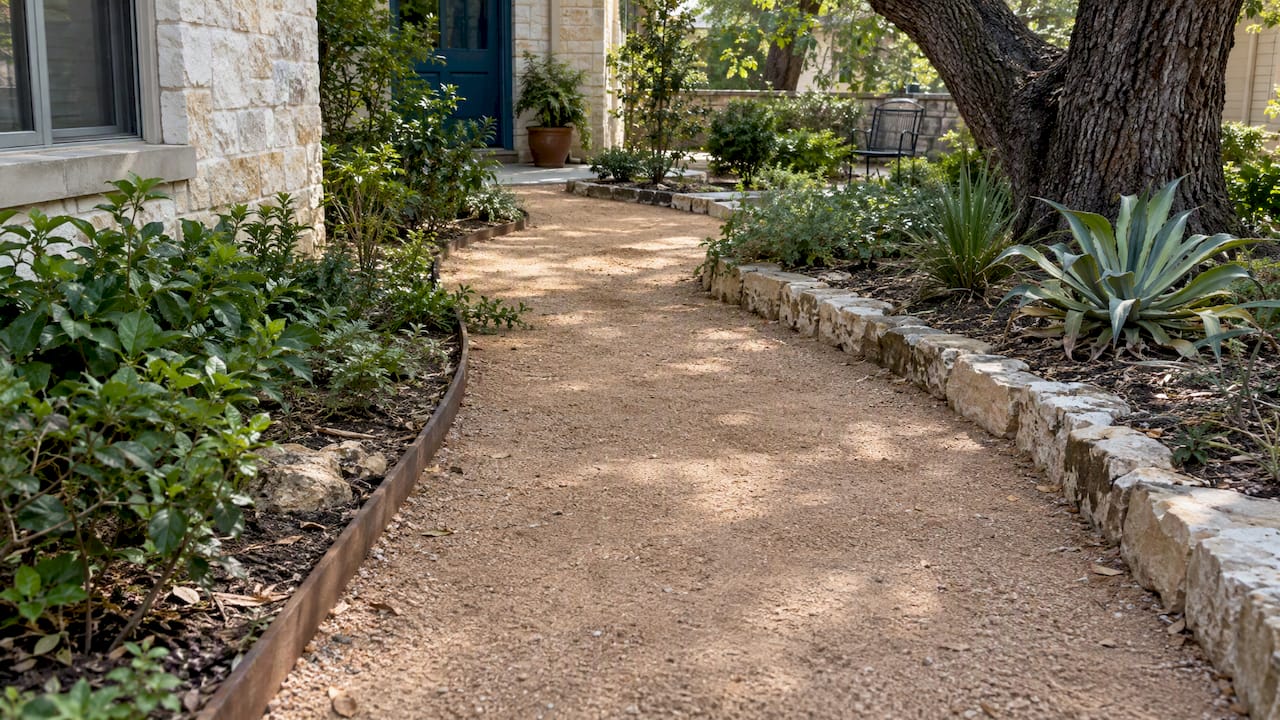
Walkways and garden paths. This is the sweet spot. A bonded surface gives a clean, natural-looking path that is comfortable underfoot and drains better than solid paving when it is built correctly.
Patios. Stabilized DG gives a patio a soft, earthy look. Furniture legs can leave marks, and the edges need good restraint. Plan a slight slope away from the house so water does not sit.
Driveways and parking. The research supports occasional light vehicle traffic, not daily heavy loads. If a truck or heavy equipment will cross the area regularly, talk to your contractor about a deeper base, or a different surface.
How to install stabilized DG
The steps below follow the Acme Sand and CSU San Marcos guidance. Always defer to your product’s data sheet.
Lay out and excavate. Account for the total build-up: base plus DG layer. Set elevations so water runs off the surface.
Build the base. Place a compacted aggregate base about 3 to 4 inches thick. Make any subgrade corrections first, so the base follows the finished shape.
Install edging. Landscape architects stress permanent restraints, such as aluminum or pressure-treated wood. Path edges break down first under foot traffic, and without containment the material migrates and the edges crumble. The CSU San Marcos specification is a good example of how formally this is treated.
Blend the DG and binder. Dry-mix thoroughly, ideally mechanically.
Spread in lifts. Place and rake to grade.
Water to full depth. The binder activates when water reaches the whole thickness of the material. Pull a small core sample after watering to confirm saturation before you compact.
Compact. Aim for roughly 85 to 90 percent relative density, per Acme Sand. Use a plate compactor on paths and patios.
Cure. Keep traffic off until the surface firms up, following your product’s instructions.
Where installs go wrong
Wrong moisture at compaction. Too saturated and the material pancakes or separates. Too dry and it will not bond. If you compacted too early, rake the area and recompact. It works, but it costs time.
Thin or soft base. DG over uncompacted soil will settle and crack.
Wrong gradation. Coarse, fines-poor material will not bind.
No edging. Edges ravel first.
Ignoring drainage. Water crossing the path will cut channels in anything, stabilized or not.
In San Antonio, heavy rain events arrive fast. Design the grade so water leaves the path instead of crossing it.
Our perspective on stabilized DG
Most DG problems we hear about trace back to the material order and the base, not the binder. A crew can do everything right on the surface and still get a soft path if the base was thin or the grade was wrong. That is why we start with questions: what is the surface for, how much traffic, how big is the area, and can a truck get to the site?
Tell us your location, access, and estimated yardage — we’ll handle the rest
Our view on ordering: measure twice, order once, and have the site ready before the truck arrives. A pile of DG sitting through a rain forecast is a pile you will be re-grading. Get the base compacted and edging set, then schedule delivery for when your crew can place it.
— BRIAN
Ordering DG for a San Antonio project
Estimate your volume
Multiply length by width by depth (in feet), then divide by 27 for cubic yards. A 3 by 40 foot path at 3 inches deep (0.25 ft) is 30 cubic feet, a bit over 1 cubic yard. Add a margin for compaction and waste. Your supplier can convert yards to tons for the specific material.
Pick the right delivery
Small paths can take a single load. Larger patios or multiple zones are better scheduled in stages so material is placed while it is workable. If you need old concrete, soil or demolition debris removed before you build, our dump truck haul-off service is $275 per truck load.
What to tell us
Project type: path, patio, light drive
Approximate area and depth
The stabilizer you plan to use
Delivery address and truck access (gates, overhead lines, soft ground)
When your base will be ready
Delivered by us across Greater San Antonio
We haul and deliver bulk materials for contractors, landscapers and homeowners across San Antonio and surrounding cities. See our decomposed granite selection, browse the wider granite landscape stone range, and use our services page to request a quote. Contractors can also use our bulk order template to send specs in one message.
FAQ
What is the difference between stabilized and unstabilized decomposed granite?
Stabilized DG has a binder blended in that bonds the particles when water activates it and the surface is compacted. Unstabilized DG is loose and erodes more easily. Stabilized is the better choice for paths, patios and light vehicle use.
What can be used to stabilize decomposed granite?
Common options are dry powder binders, including organic psyllium-based products, liquid bonding agents and synthetic resin emulsions. Each has its own mixing rate and curing instructions, so follow the data sheet for the specific product.
How thick should the base under stabilized DG be?
Plan on a compacted aggregate base of about 3 to 4 inches, built to the shape of the finished surface. A thin or uncompacted base is a leading cause of settling and cracking.
How long does stabilized decomposed granite last?
It depends on base quality, mixing, compaction, edging, drainage and traffic. We do not have a reliable figure to quote for every site. A properly built surface needs far less regrading than loose DG, and the weak points to inspect are the edges and any low spots where water gathers.