Crusher run compacts into a firm base. #57 stone drains. Learn which one fits your driveway, slab, or drainage job in San Antonio, and how to order it.
San Antonio’s Go-To Material Supplier
Get a Free Per-Load Quote Today
Same-day delivery available · Transparent pricing · Licensed & insured
Crusher run and #57 stone are not interchangeable. Crusher run packs down into a dense, firm layer, so it suits driveway surfaces and bases under slabs. #57 stone is clean, open and free-draining, so it suits drainage layers, pipe bedding and backfill. If you are choosing for a driveway, crusher run is usually the surface and #57 is the layer that moves water underneath or beside it.
This guide explains why the two behave so differently, how to match each to a job, what to expect on price, and how to order the right one for a San Antonio site.
Olearydevelopmentgroup
Get the Right Stone to Your Site
O’Leary Development Group delivers bulk materials, including gravel and limestone, to construction and landscaping projects across San Antonio.
The difference is one word: fines. Fines are the dust-sized particles left when rock is crushed.
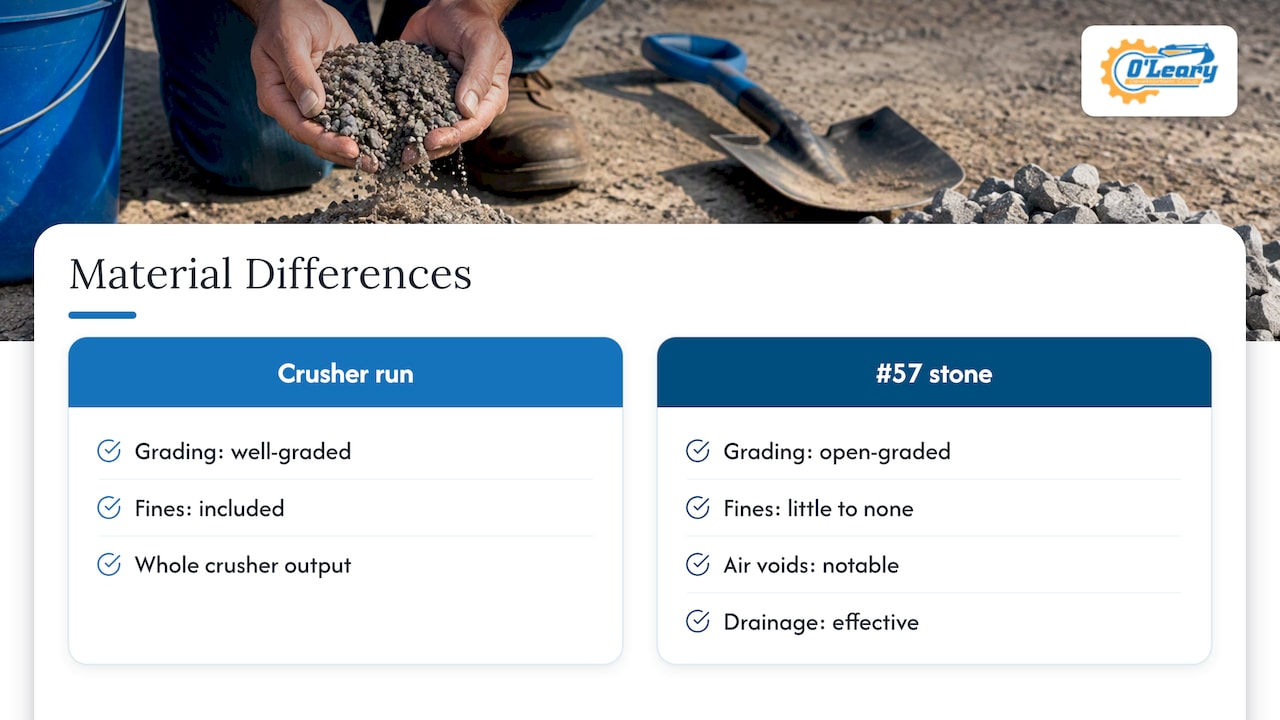
Crusher run is the whole output of the crusher. FHWA training material separates aggregates by how they are graded, and crusher run falls in the well-graded group, meaning it includes fines. Crushed stone as a general term covers rock broken into specific sizes, often with fines removed for clean, consistent sizing, as with #57.
The Penn State Center for Dirt and Gravel Road Studies describes open-graded aggregates as porous, with notable air voids between stones and little to no fines. They drain effectively but do not compact well into a dense mass. That is #57.
Crusher run in plain terms
Picture angular stone, typically up to about 3/4 inch or 1 inch, mixed with everything smaller, down to powder. The sharp faces lock together. The dust fills the spaces between the stones. With moisture and a plate compactor or roller, the layer tightens into something close to a solid pad.
Crusher run goes by several names depending on who you ask: crush and run, crusher fines mix, dense-graded aggregate, and in Texas often road base or flex base. Names and exact gradations vary by quarry, so always ask the supplier for the actual size and spec rather than relying on the name.
#57 stone in plain terms
#57 is a standard size designation. The stone runs from about 1 inch down to roughly 3/8 inch, with the small stuff screened out. The result is a pile of clean, angular stones with plenty of air between them. Water passes straight through. Nothing binds the stones together.
Our own #57 is #57 limestone, 1" minus, which is a good example of the clean, uniform look people want for drainage and decorative base work.
Side-by-side comparison
Factor
Crusher run
#57 stone
Grading
Well-graded, includes fines
Open-graded, little to no fines
Compaction
Compacts dense and firm
Settles, but stays loose
Drainage
Slow, sheds water off the surface
Very fast, water moves through
Driveway surface
Good, holds ruts less
Shifts and tracks under tires
Base under slabs and pavers
Standard choice for load-bearing
Used where drainage is needed
Pipe bedding and French drains
Poor, fines can clog
Standard choice
Look
Gray, dusty, uniform when packed
Clean and cleaner-looking
Typical cost per ton
Often lower
Often higher
Why #57 does not make a stable surface
This is the most common mistake we hear about. People assume that cleaner, nicer-looking stone must be the premium option, so they order #57 for a driveway and expect it to firm up.
It will not. Penn State’s guidance is that #57 and other open-graded stone lacks the fines to fill its own voids, so it stays relatively loose and mobile under traffic. On a driveway, that means stones migrate to the edges, tire tracks form, and you feel the stone move when you walk or drive on it. Heavy-duty edging helps, but it does not change how the material behaves.
FHWA researchers studying open-graded aggregates note that compaction control is different from dense-graded material. Crusher run is judged on density and load-bearing capacity. Open-graded stone is more often judged on whether it has stopped moving under the compactor. In other words, you can get #57 to stop shifting during construction, but it will not become a dense solid. Set your expectations for how firm the finished surface feels accordingly.
Why crusher run is not a drainage material
The same fines that make crusher run strong also block water. Once compacted, it sheds water laterally and across the surface instead of letting it pass through. That is helpful on a crowned driveway with proper side drainage. It is a problem in a French drain, around a perforated pipe, or behind a retaining wall where water must move freely.
In those spots, fines can migrate and clog the system over time. Use clean stone. If you are laying out a drain field or similar system, this homeowner guide on drain field materials explains why clean, open stone matters where water has to move through it.
Ready to Order?
Call Now: 210-983-8005
Same-day delivery available on most orders in San Antonio and surrounding cities
For the driving surface, crusher run is the better answer. It compacts, resists rutting and stays put. If the driveway runs through a low area or sits on clay that holds water, add a layer of #57 below the crusher run, ideally wrapped in geotextile fabric to keep fines from the layer above from working down into it.
A typical sequence, from the ground up:
Prepare and shape the subgrade, removing organic soil and soft spots.
Lay geotextile fabric if the subgrade is soft or clay-heavy.
Place a #57 layer only if you need subsurface drainage.
Place crusher run in lifts and compact each one.
Crown the surface so water sheds to the sides.
If you want to know how thick each layer of road base should be and how tightly to compact it, see our guide to compacting road base in 4 to 6 inch lifts to 95% Proctor. Compaction technique matters as much as the choice of stone.
There is one exception worth knowing. Permeable pavements are built on purpose with open-graded stone below, because the voids store and release water. University of Maryland Extension’s permeable hardscapes fact sheet explains how the spaces between the gravel hold water and let it filter into the soil. That is a designed system, not a standard driveway.
For slab and foundation work, follow your engineer’s or builder’s specification. If the plans call for a specific base material and thickness, order exactly that.
Drainage, pipe bedding and backfill
#57 is the clear choice. French drains, area drains, the gravel envelope around perforated pipe, and backfill behind retaining walls all need water to move. #57 does that job without clogging.
Walkways, patios and light-duty paths
For pavers and flagstone, builders usually compact a dense base first, then add a thin bedding layer on top. Crusher run or road base fits the base. For a gravel path you plan to walk on, #57 is more comfortable to look at but shifts, so many people finish with crusher run or a smaller decorative stone on top of a compacted base. Pea gravel is another option for light foot traffic, and it is available as pea gravel.
Quick decision table
Your project
Better choice
Gravel driveway surface
Crusher run
Wet or clay-heavy driveway
#57 below, crusher run above
Base under concrete or pavers
Crusher run or road base
French drain or pipe bedding
#57
Behind a retaining wall
#57
Parking pad for trucks or trailers
Crusher run, compacted in lifts
Permeable pavement base
#57, per the design
Cost: which is cheaper?
The honest answer is that it depends on the quarry, the haul distance and the day. Prices are local. That said, Penn State’s technical bulletin points out that #57 requires an extra step of screening to remove fines, so it is commonly priced higher per ton than unscreened crusher run. For large base areas, crusher run is generally the more economical choice.
The cheaper material is not always the right one, though. A wrong choice costs more than a price difference per ton: you can end up pulling out and replacing an entire layer.
Two things matter more than the per-ton rate:
Coverage. Your total tonnage depends on area and depth. Compacted base needs more material than the loose volume suggests, so order a little extra.
Delivery. For a 10-yard dump truck load or a multi-load job, the haul, scheduling and ability to place material where it is needed all affect the final price.
We publish per-load pricing for hauling, and for specific materials we quote by project. Request a quote with your delivery address and the amount you need and we will price it accurately.
Texas-specific notes for San Antonio projects
In the San Antonio area, limestone is the local rock, so both of these materials are commonly crushed limestone. Soils here include expansive clays in many neighborhoods, and shallow rock in others. Clay-heavy subgrade is a good reason to think about drainage under a driveway, since standing water softens the ground and weakens the base above it.
Two local habits are worth knowing:
Crusher run is often sold locally under road base names. We carry #2 road base and crushed limestone aggregate. If you are not sure what you are looking at, describe your project and ask which grade fits.
After heavy rain, a driveway that was built with the wrong layer shows it quickly. Ruts, soft spots and migrating stone are the usual signs.
Our point of view
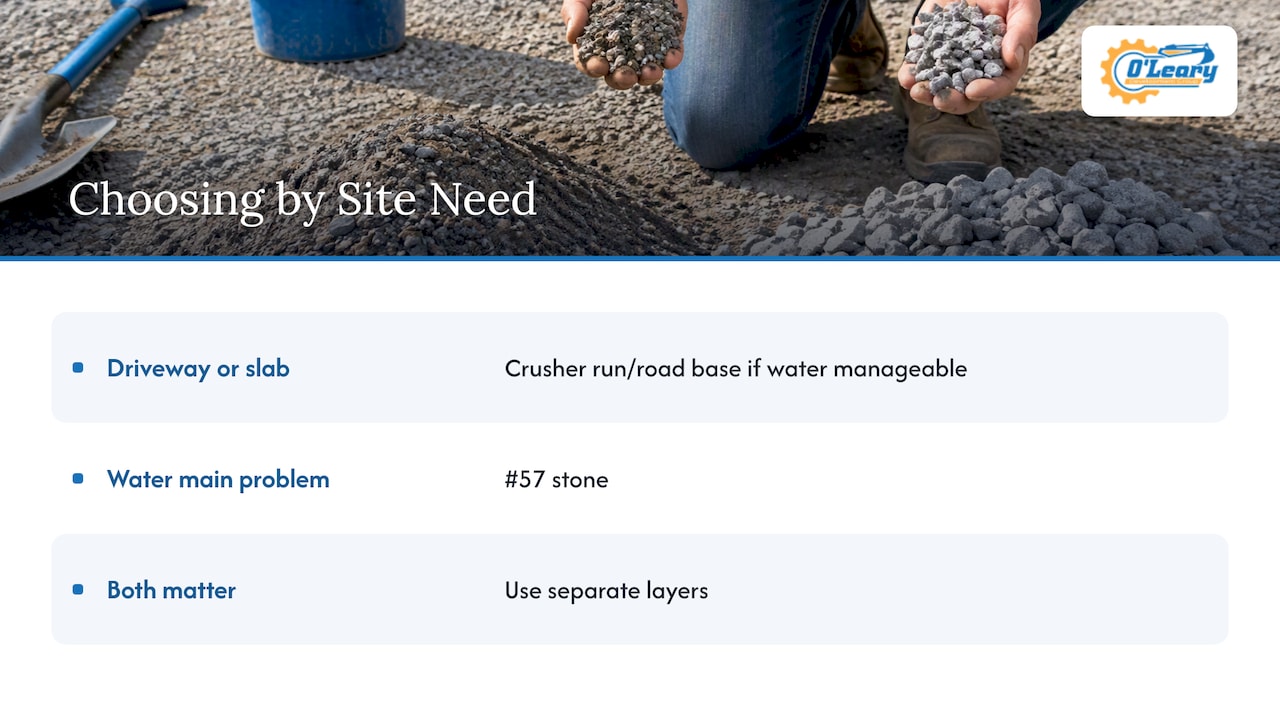
We haul and deliver bulk materials around San Antonio every week, and the crusher run versus #57 question comes up constantly. Most of the time, the customer does not need a lecture on gradation. They need us to ask three questions: What is going on top of this layer? How much weight will it carry? Where will the water go?
If the answer to the first two is a driveway or a slab, and the water is manageable, it is crusher run or road base. If water is the main problem, it is #57. If both matter, it is both, in separate layers.
Schedule Delivery in Minutes
Get Your Free Quote Today
Tell us your location, access, and estimated yardage — we’ll handle the rest
We would rather talk you out of the wrong order than deliver it. A wrong load is a wasted day for you and for the truck. When we dispatch, we check the load against the job description and we can deliver same-day or next-day depending on schedule and availability. Contractors on repeat jobs can set up an account so ordering the same grade again takes a minute.
The one habit we recommend to everyone: do not pick by price or by looks. Pick by what the layer has to do.
Dimensions. Length, width and desired compacted depth.
Site access. A dump truck needs clear room to maneuver and a spot to unload. Overhead lines, soft ground and tight gates matter.
Drainage conditions. Does water pool there? Is the soil clay?
Timing. Whether you need same-day, next-day or scheduled deliveries.
With that, a supplier can recommend the material and a load count. If you are unsure how much you need, a good rule is to calculate the volume in cubic yards, convert to tons using the supplier’s stated weight per yard, and add a margin for compaction. Ask your supplier for their conversion, since weight varies by material and moisture.
The naming around aggregates gets confusing. One quarry’s crusher run is another’s base, and a third calls it something else. A guide on crushed stone versus gravel from a land-clearing contractor suggests asking suppliers pointed questions about what is in the pile, and we agree with that approach. Ask for the size range, whether it includes fines, and what the material is typically used for. A reliable supplier answers plainly.
A few warning signs that a recommendation may be off:
A supplier suggests #57 for a driveway surface without mentioning edging or movement.
Someone proposes crusher run for a drain field or French drain.
No one asks what you are building.
Order from us
If you are ready to price a load, we deliver dump truck loads of road base, #57 limestone, gravel, fill dirt and other bulk materials across San Antonio and surrounding cities. Start with our services page, or go straight to dump truck hauling in San Antonio if you already have material on site and need it moved. If you are clearing a demolition site first, our demolition haul off service is listed at $275 per truck load.
FAQ
Is crusher run the same as crushed stone?
No. Crushed stone is a general term for rock broken to specific sizes, often with fines removed. Crusher run is the full output of the crusher, including the fine dust, which is why it compacts. #57 is a crushed stone with the fines taken out.
Does #57 stone need to be compacted?
It can be settled with a plate compactor so it stops shifting during construction, but it will not form a dense, firm layer. FHWA research treats compaction of open-graded stone differently from dense material. If you need a firm surface, use crusher run instead.
Is crusher run or #57 cheaper?
It varies by quarry and distance, but #57 is commonly priced higher per ton because it needs extra screening. For a large base area, crusher run is usually the more economical pick. Ask for a delivered quote, since haul distance affects the total.
Is crusher run better than gravel for a driveway?
For a driveway surface that stays firm, yes, crusher run generally outperforms clean gravel because the fines bind it together. Clean stone drains better but shifts. If drainage is a concern, put clean stone underneath and crusher run on top.