Here’s the full quick-reference breakdown for one cubic yard:
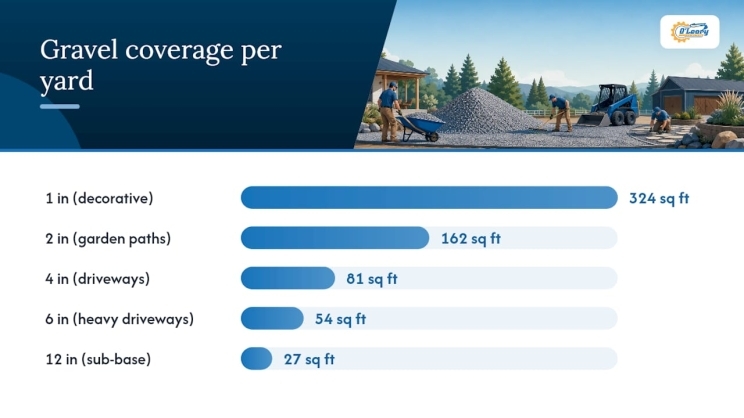
1 inch deep: 324 sq ft
2 inches deep: 162 sq ft
3 inches deep: 108 sq ft
4 inches deep: 81 sq ft
6 inches deep: 54 sq ft
12 inches deep: 27 sq ft
If you’re covering a 10×10 patio at 2 inches, one cubic yard is enough to complete the area. A standard single-car driveway at 4 inches will need roughly 6–7 cubic yards for a 12×40 run. The sections below give you the formula, the conversion to tons, and worked examples you can copy directly into a quote request.
Key Takeaways
One cubic yard of gravel covers 324 sq ft at 1 inch deep and 81 sq ft at 4 inches — depth is the single biggest driver of how much material you need.
That 0.62 cubic yards works out to roughly 0.85 tons at a density of about 1.35 tons per cubic yard, which is typical for pea gravel or standard crushed stone. Round up to 0.75 yards when ordering to account for minor losses.
Pro Tip:Always convert depth to feet before running the formula. Forgetting that step is the single most common calculation error — it produces a number 12 times too large and throws off your entire order.
Coverage reference: how many square feet does one cubic yard cover?
The table below maps gravel coverage per yard to common project depths, so you can match your project type to the right quantity without reworking the math each time.
Depth
Coverage per Cubic Yard
Typical Use
1 inch
324 sq ft
Thin decorative top-dressing
2 inches
162 sq ft
Garden paths, flower beds
3 inches
108 sq ft
Walkways, light foot traffic
4 inches
81 sq ft
Standard driveways, patios
6 inches
54 sq ft
Heavy driveways, RV pads
12 inches
27 sq ft
Sub-base, drainage, structural fill
Project-depth guidance from material calculators consistently recommends 2 inches for garden paths (about 162 sq ft per yard), 4 inches for standard driveways (about 81 sq ft per yard), and 6 inches for heavy-use or RV surfaces (about 54 sq ft per yard). Drainage applications and structural sub-bases often call for 12 inches, which drops coverage to just 27 sq ft per yard.
Deeper layers do more than just use more material. At 4 inches and below, gravel locks together under load, resists rutting, and sheds water more reliably than a shallow decorative layer. A 2-inch path looks great but won’t hold up under a wheelbarrow or regular foot traffic in wet conditions. Choosing the right depth upfront prevents the frustrating experience of adding a second load six months later.
Decorative/aesthetic: 1–2 inches
Foot traffic and garden paths: 2–3 inches
Driveways and parking areas: 4–6 inches
Structural sub-base or drainage: 6–12 inches
How do you convert cubic yards to tons for budgeting and delivery?
Most suppliers price bulk aggregates by the ton, not the cubic yard. Gravel typically weighs 1.4–1.7 tons per cubic yard (2,800–3,400 lb/yd³), with lighter materials like pea gravel sitting near the low end of that range. The conversion is simple: multiply your cubic yards by the material’s density in tons per cubic yard.
Crushed stone and crusher-run mixes often run 1.35–1.55 tons per cubic yard, while road base with fine particles tends toward the heavier end because the fines fill voids between larger stones. Moisture content also shifts the number: wet material weighs more than dry, which is why a supplier’s quoted tonnage can differ from your estimate if the material was recently wetted.
Ready to Order?
Call Now: 210-983-8005
Same-day delivery available on most orders in San Antonio and surrounding cities
Conversion example: You calculated 5 cubic yards of standard crushed stone. At 1.5 tons per cubic yard, that’s 7.5 tons. When you call for a quote, give the supplier your cubic yard figure and ask what density they use for that specific product. That single question prevents the most common budget mismatch between your estimate and the invoice.
Always ask suppliers which unit they price in and request the product density they used for the quote rather than assuming a generic conversion. Different products from the same yard can vary by 0.2–0.3 tons per cubic yard, which adds up fast on larger orders.
For pea gravel and decorative stones, density tends to be lower because of air gaps between rounded particles. Larger rock sizes like 4×8 bull rock have even more void space, which means they cover less area per ton than a finer, tightly packed crushed stone.
How much extra gravel should you order, and what are your hauling options?
Ordering exactly what the formula produces is a reliable way to come up short. Professionals typically add 10–15% for small projects and 5–10% for larger, straightforward loads to account for compaction, uneven subgrade, and material lost during spreading.
Why the buffer matters:
Crushed stone and crusher-run mixes can compact by 20–30% under traffic, reducing the finished depth below your target.
Low spots in a subgrade absorb more material than a flat-grade calculation assumes.
Spillage during offloading and spreading is normal, especially on sloped sites.
Returning for a second delivery costs more per yard than ordering right the first time.
On a 5-cubic-yard order, that’s an extra half yard — a small cost compared to a second delivery fee.
Bags vs. cubic yards vs. truckloads:
Bags (0.5 cu ft each): Convenient for tiny areas under 10 sq ft, but expensive per unit. You’d need roughly 54 bags to equal one cubic yard.
Cubic yard (bulk delivery): Cost-effective for anything over 1–2 yards. Delivered loose by dump truck.
Truckload: Most efficient for large projects. A standard half-ton pickup can safely carry only about 0.5–1 cubic yard of gravel before hitting payload limits — weight, not bed volume, is the constraint.
Pro Tip:If your project needs more than 1 cubic yard, skip the pickup and book a delivery. Overloading a half-ton truck with 2 yards of crushed stone risks suspension damage and is a safety issue on public roads.
Worked examples for common projects
10×10 patio at 2 inches: 10 × 10 × (2÷12) ÷ 27 = 0.62 yd³ → 0.93 tons → order 0.7 yd³ (rounds to 1 yd³ for delivery)
12×40 single-car driveway at 4 inches: 12 × 40 × (4÷12) ÷ 27 = 5.93 yd³ → 8.9 tons → order 6.5 yd³ with 10% buffer
15×2 dry creek bed at 4 inches: 15 × 2 × (4÷12) ÷ 27 = 0.37 yd³ → 0.56 tons → order 0.5 yd³ (minimum delivery may apply)
10×12 shed base at 4 inches: 10 × 12 × (4÷12) ÷ 27 = 1.48 yd³ → 2.22 tons → order 1.65 yd³ with 10% buffer
Quick checklist for your order or quote request:
Area dimensions (length × width in feet)
Desired depth in inches
Calculated cubic yards (show your math)
Material type and preferred gravel size
Delivery address and gate/access width
Preferred delivery date and drop location on site
How do you measure irregular areas accurately?
Rectangular areas are easy. Curved beds, circular patios, and irregular shapes take one extra step: divide the area into rectangles, circles, or triangles, calculate each volume separately, then add the cubic yards together.
Rectangle: Length × Width (straightforward)
Circle: π × radius² (use 3.14 × r²); a 10-foot-diameter circle has an area of about 78.5 sq ft
Triangle: 0.5 × base × height
Irregular shape: Sketch it, break it into the above shapes, sum the areas
For sloped surfaces, measure depth at the high end and the low end, then use the average. A slope that runs from 3 inches at the top to 5 inches at the bottom averages to 4 inches for calculation purposes.
Common mistakes to avoid:
Forgetting to measure gate width before booking delivery (most dump trucks need at least 10–12 feet of clearance)
Using inside dimensions when the gravel needs to extend to the edge of a border or curb
Ignoring low spots that will absorb extra material before the surface levels out
Measuring a wet or recently disturbed subgrade, which compresses differently than settled ground
Pro Tip:Sketch your site on paper with three labeled dimensions (length, width, depth) before calling for a quote. It takes two minutes and eliminates the back-and-forth that delays accurate pricing.
What to expect when ordering delivered gravel
Getting an accurate quote from a local material delivery service comes down to the information you provide upfront. Suppliers need your dimensions, depth, material preference, and site access details to give you a firm number.
What suppliers typically ask:
Total area dimensions and desired depth
Material type (pea gravel, crushed stone, road base, riprap)
Drop location on site (front yard, backyard, driveway apron)
How delivery is typically priced:
Per load (flat rate per dump truck load, regardless of exact weight)
Per ton (weight-based, confirmed at the scale house)
Combined (material cost per ton + delivery fee)
Always confirm which pricing model applies before you commit. A per-load quote can be a better deal on heavy materials; a per-ton quote rewards lighter aggregates.
Schedule Delivery in Minutes
Get Your Free Quote Today
Tell us your location, access, and estimated yardage — we’ll handle the rest
Preparing your site for delivery:
Clear the drop zone of vehicles, equipment, and debris
Mark the exact spot where the driver should place the load
Confirm overhead clearance (power lines, tree branches) along the truck’s path
Have a contact number ready in case the driver needs to reach you on arrival
For readers also estimating fill dirt or topsoil quantities, the same formula applies — the only variable that changes is the material density when converting to tons.
A few rules of thumb that hold up on real projects
Most ordering mistakes come from one of two places: underestimating depth or skipping the overage buffer. After working through dozens of material estimates, a few heuristics consistently produce accurate orders.
For depth, the defaults that rarely disappoint: 2 inches for decorative paths and flower beds, 4 inches for driveways and patios, 6 inches for anything that carries vehicle weight regularly. Going lighter than 4 inches on a driveway is a short-term decision that leads to ruts and thin spots within a season.
One mistake worth calling out specifically: ordering by the bag for anything larger than a small garden accent. The math never works in your favor. Fifty-four half-cubic-foot bags equal one cubic yard, and the per-unit cost of bagged material is typically several times higher than bulk delivery. If your project needs more than half a yard, bulk delivery is the right call.
Ready to order? Get bulk gravel delivered to your San Antonio project site
Calculating your cubic yards is the first step. Getting the right material to your site on time is where Olearydevelopmentgroup makes the difference for contractors and homeowners across Greater San Antonio.
Olearydevelopmentgroup delivers bulk gravel, crushed stone, road base, pea gravel, and specialty landscape materials directly to your project site with same-day availability, GPS-tracked trucks, and transparent per-load pricing. No guesswork on delivery windows, no surprise fees. Whether you need 1 yard for a backyard path or 20 yards for a commercial driveway, the process is the same: give the team your dimensions, depth, material preference, and site access details, and you’ll get an accurate quote fast.
To request a quote, visit the dump truck hauling and material delivery page, enter your project details, and book online. Same-day delivery is available across San Antonio and surrounding cities.
Sources
These tools let you verify your numbers or run an online calculation when you want a second check on your manual formula.
Use an online calculator when you have an irregular shape or want to cross-check a manual result. For straightforward rectangles, the formula is fast enough to run in your head once you’ve done it a couple of times.
FAQ
How much area does 1 yard of gravel cover?
One cubic yard covers 324 sq ft at 1 inch deep, 162 sq ft at 2 inches, 81 sq ft at 4 inches, and 54 sq ft at 6 inches. The deeper the layer, the less area a single yard covers.
How much gravel do I need for a 10×10 area?
A 10×10 area at 2 inches deep needs about 0.62 cubic yards, which works out to roughly 0.85 tons at standard crushed stone density. Round up to 0.75 yards when ordering to allow for minor losses.
Is 1 ton of gravel equal to 1 cubic yard?
No. Most gravel weighs 1.4–1.7 tons per cubic yard, so one ton is less than one cubic yard. Always ask your supplier for the specific density of the product you’re ordering before converting between tons and yards.
Will 1 yard of gravel fit in a pickup truck?
A half-ton pickup can safely carry only about 0.5–1 cubic yard of gravel before hitting its payload limit. For anything over 1 cubic yard, a bulk delivery by dump truck is safer and more cost-effective.