Fill Dirt Delivery Cost: What to Expect and Budget
O'Leary Development GroupAugust 14, 2026
Discover what to expect for fill dirt delivery costs, including pricing breakdowns for material and delivery. Budget wisely for your project!
San Antonio’s Go-To Material Supplier
Get a Free Per-Load Quote Today
Same-day delivery available · Transparent pricing · Licensed & insured
Delivered fill dirt typically runs $5–$25 per cubic yard for the material itself, plus a delivery fee of $50–$150 per trip for a standard load of up to 15 cubic yards. Put those together and a bulk truck load delivered lands between $150 and $600 for most projects. On a per-ton basis, fill dirt is commonly quoted at $4–$15 per ton before delivery.
Here is what that looks like at a glance:
Material only: $5–$25 per cubic yard / $4–$15 per ton
Delivery fee: $50–$150 per trip (up to 15 cubic yards, within a base radius)
Your immediate next step: measure your area, calculate the cubic yards you need (length × width × depth in feet ÷ 27), and contact at least two local suppliers with that number plus your site address. Olearydevelopmentgroup serves the Greater San Antonio area with same-day and next-day bulk fill delivery, and you can request a quote online in minutes.
Key Takeaways
Delivered fill dirt costs $5–$25 per cubic yard for material plus $50–$150 per trip for delivery, with total truckload costs typically landing between $150 and $600 for most standard orders.
Point
Details
Material price range
Raw fill dirt runs $5–$25 per cubic yard or $4–$15 per ton before delivery.
Delivery fee range
Base delivery adds $50–$150 per trip; mileage beyond the base radius adds roughly $10 per mile.
Truckload total
A 10–15 yard delivered load typically costs $150–$600; the national average across all soil types is roughly $839.
Calculate your yards
Use length × width × depth (feet) ÷ 27, then add 5–10% for compaction overage.
Olearydevelopmentgroup
Serves Greater San Antonio with same-day bulk fill delivery, insured fleets, and contractor account options.
How is fill dirt delivery cost calculated — by yard, ton, or truckload?
Suppliers quote fill dirt three ways, and knowing which unit you are looking at prevents costly mismatches when comparing bids.
Per cubic yard is the most common unit for residential and landscaping orders. One cubic yard is a 3×3×3-foot cube of material. Fill dirt priced at $5–$25 per cubic yard is the baseline material cost before any delivery charge is added.
Per ton shows up more often in commercial and road-base contracts. The conversion between yards and tons depends on moisture content and compaction, but a working estimate for fill dirt is roughly 1.2–1.5 tons per cubic yard. Wet or clay-heavy fill sits toward the heavier end. Use 1.35 tons per cubic yard as a midpoint for budgeting, and confirm the actual density with your supplier before finalizing quantities.
Per truckload bundles material and sometimes delivery into one line item. This is convenient but makes comparison harder. Always ask suppliers to break out the unit price and delivery fee separately so you can compare bids on equal terms.
Material
Typical per-yard range
Typical per-ton range
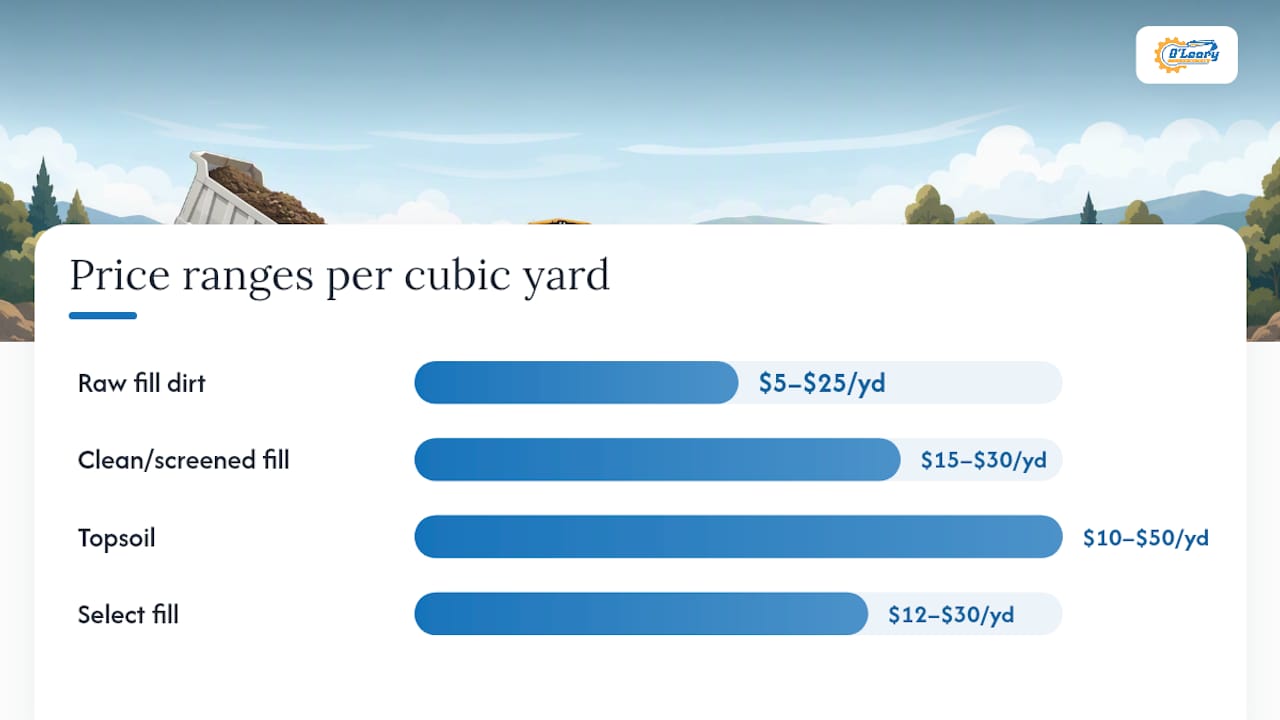
Raw fill dirt
$5–$25
$4–$15
Clean/screened fill
$15–$30
$10–$20
Topsoil
$10–$50
$8–$30
Select fill (sandy clay)
$12–$30
$8–$15
Topsoil costs noticeably more than raw fill dirt because it is screened, nutrient-rich, and intended for planting. Fill dirt runs $5–$25 per yard while topsoil commonly reaches $10–$50 per yard. If you only need structural fill under a slab or behind a retaining wall, raw fill dirt is the right call and the cheaper one.
Pro Tip:Ask every supplier whether their quoted price includes delivery or is material-only. Some list a per-yard rate that covers both; others add delivery as a separate line. Getting that answer upfront saves you from a surprise invoice.
Distance and mileage: Base delivery fees typically cover a set radius (often 10–15 miles). Beyond that, carriers commonly add around $10 per mile per trip. A site 30 miles out can add $150–$200 to a single load.
Truck size and load capacity: A standard tandem-axle dump truck carries 10–14 cubic yards. Larger tri-axle or semi-end-dump trucks carry 14–22 yards but require more road clearance and turning space.
Site access and offloading difficulty: Narrow driveways, low-hanging wires, soft ground, or a tight turning radius can force a smaller truck or a longer unload cycle, both of which raise cost.
Minimum-load fees: Small orders (1–3 yards) often trigger a minimum delivery fee that makes the per-yard cost much higher than the standard rate.
Fuel surcharges: Diesel price swings get passed through as a percentage surcharge, typically 3–8% of the haul total.
Tipping and disposal fees: If you need contaminated or mixed soil removed, disposal fees apply on top of the delivery charge.
Truck type
Typical capacity
Base delivery example
Single-axle dump
5–8 cubic yards
$50–$100 per trip
Tandem-axle dump
10–14 cubic yards
$75–$150 per trip
Tri-axle dump
14–15 cubic yards
$100–$200 per trip
Semi end-dump
18–20 cubic yards
$150–$300 per trip
A practical mileage example: a tandem-axle truck delivering 12 yards within 10 miles might charge $100 for delivery. That same truck at 25 miles out could add $150 in mileage fees, pushing the delivery portion alone to $250 before a single yard of material is priced.
Small orders face disproportionately high per-yard delivery costs because the fixed trip cost gets spread over fewer yards. Ordering at or above the 10-yard threshold is often where per-yard delivery costs start to normalize.
Delivered-cost examples for common order sizes
These examples use a mid-range material rate of $12 per cubic yard and a base delivery fee of $100 within a 15-mile radius. They are illustrative; your actual quote will vary by supplier, location, and site conditions.
Order size
Material cost
Delivery fee
Estimated total
1 cubic yard
$12
$75–$100 (minimum fee)
$87–$112
10 cubic yards
$120
$100
$220
20 cubic yards
$240
$150–$200 (2 trips)
$390–$440
1 truckload (12 yd)
$144
$100
$244
Assumptions used in these estimates:
Ready to Order?
Call Now: 210-983-8005
Same-day delivery available on most orders in San Antonio and surrounding cities
Material rate: $12/yd (mid-range for raw fill dirt)
Base delivery: $100 per trip, covering up to 15 cubic yards within 15 miles
20-yard order requires two tandem-axle trips; a single tri-axle truck could reduce that to one trip at a higher per-trip fee
No spreading, compaction, or disposal fees included
For the 20-yard scenario, Hello Gravel’s 2026 data shows material-only costs of roughly $160–$600 for 20 cubic yards depending on fill quality, before delivery is added. That range confirms the wide spread you should expect when comparing quotes.
HomeAdvisor’s data puts the average truckload cost at roughly $839 across all soil types and locations, with project totals ranging from $125 to $3,000. That average reflects premium soils and longer hauls pulling the number up. For basic raw fill dirt on a short haul, staying well below $839 per load is realistic.
Extra charges to watch for on your quote
Several add-on fees can materially change what you actually pay. Spotting them before you sign a quote is far easier than disputing them after delivery.
Spreading and grading: Dumping material in one pile is standard. Having the driver or a crew spread and grade it typically adds $25–$150 per hour or a flat per-yard fee. Confirm whether “delivery” in the quote means dump-only or includes placement.
Compaction: Mechanical compaction with a plate compactor or roller is a separate service. Expect $50–$200 per hour depending on equipment size.
Contaminated soil handling: If the fill contains debris, organics, or chemical contamination, disposal fees and regulatory handling costs apply. These can run hundreds to thousands of dollars per load.
Permit and overweight fees: Loads over the legal axle weight limit require overweight permits, which vary by state and route. In Texas, overweight permits are issued by TxDOT and fees depend on load weight and distance.
Wait and standby time: If your site is not ready when the truck arrives, most carriers charge a standby fee of $75–$150 per hour after a short grace period (often 15–30 minutes).
Disposal or tipping fees: Removing existing soil or debris from your site before fill is placed adds a separate haul-off charge.
Distance and disposal fees together can shift per-load cost by tens to hundreds of dollars, so these line items deserve a direct question on every quote you receive.
When reviewing a quote, ask specifically: “Does this price include spreading? Is there a standby fee? Are disposal costs included if I need existing material removed?” Any quote that does not clearly answer those three questions needs a follow-up before you commit.
How many cubic yards of fill dirt do you actually need?
Divide by 27 because there are 27 cubic feet in one cubic yard. Use the depth in feet, not inches. For example, 6 inches of depth = 0.5 feet.
Worked examples:
Small garden bed (10 ft × 10 ft × 0.5 ft deep):
10 × 10 × 0.5 = 50 cubic feet ÷ 27 = 1.85 cubic yards → order 2 yards
Backyard low spot (20 ft × 15 ft × 1 ft deep):
20 × 15 × 1 = 300 cubic feet ÷ 27 = 11.1 cubic yards → order 12 yards
Driveway fill (40 ft × 12 ft × 0.5 ft deep):
40 × 12 × 0.5 = 240 cubic feet ÷ 27 = 8.9 cubic yards → order 10 yards
Fill dirt compacts when loaded, hauled, and placed, so what measures as 10 yards in the truck often settles to slightly less in the ground.
For a more precise calculation tailored to your project dimensions, use the fill dirt quantity guide from Olearydevelopmentgroup before you request quotes.
What to tell suppliers to get an accurate quote
Vague requests get vague quotes. Giving suppliers the right information upfront produces bids you can actually compare side by side.
Supplier checklist — provide all of this:
Full delivery address and any gate codes or access restrictions
Specific drop point on the property (front driveway, back lot, specific corner)
Overhead clearance (power lines, tree branches, low overhangs)
Vehicle clearance (width of driveway or access road)
Material specification: raw fill dirt, clean fill, select fill, or topsoil
Quantity in cubic yards (use the formula above)
Whether you need spreading, grading, or compaction
Whether you need any existing material removed
Permit requirements if you are aware of them
Questions to ask every supplier:
Is delivery included in the per-yard price, or is it a separate line item?
What is the base delivery radius, and what is the per-mile charge beyond it?
Is there a minimum order quantity or minimum delivery fee?
Are spreading and compaction included, or billed separately?
Are there fuel surcharges, and how are they calculated?
What is the standby fee if the site is not ready?
Red flags on a quote:
Price listed as a single lump sum with no unit breakdown
No mention of truck type or load capacity
No clarification on whether delivery is included
No note about site access requirements or standby fees
Vague material description (“dirt” with no specification)
Reducing cost does not require cutting corners. These strategies work within normal project constraints.
Schedule Delivery in Minutes
Get Your Free Quote Today
Tell us your location, access, and estimated yardage — we’ll handle the rest
Order at or above the 10-yard threshold. Small orders carry disproportionate delivery fees. Consolidating two small orders into one larger delivery often saves more than the extra material costs.
Coordinate with nearby trades. If a neighbor or nearby contractor is also ordering fill, combining orders on the same truck run can reduce per-load delivery costs for both parties.
Accept clean construction surplus when appropriate. Excavation contractors often have excess fill they need to move. Platforms that match surplus fill with recipients can provide material at low or no cost. The Spruce outlines practical steps for finding free fill dirt, including what to verify with the donor.
Time your order to avoid peak season. Spring and early summer are the busiest periods for landscaping and construction deliveries. Ordering in late fall or winter often means faster scheduling and occasionally better pricing.
A legal and safety note on free fill: Always confirm that donated fill is clean and uncontaminated before accepting it. Soil containing construction debris, treated wood, or chemical residue can create liability and remediation costs that far exceed what you saved on material. Ask for documentation of the source site and, for large volumes, consider a basic soil test.
Pro Tip:Stage a single, clear unload area before the truck arrives. A driver who cannot find a safe dump point will either leave or charge standby time. Mark the spot, clear the path, and confirm overhead clearance the day before delivery.
How the price ranges in this article were estimated
The ranges throughout this article draw on published pricing guides, hauling cost databases, and contractor pricing methodology sources. Here is what each contributed and the key assumptions used.
Data sources:
HomeGuide’s 2026 fill dirt and topsoil cost guide: per-yard and per-ton material ranges, base delivery fee ranges
HomeAdvisor’s 2025 soil delivery cost data: average truckload cost and wide project range
DirtMatch’s 2026 contractor pricing guide: per-load pricing methodology, cycle time, and fuel cost components
Hello Gravel’s 2026 20-yard cost guide: example totals for a commonly searched order size
Numeric assumptions:
Density conversion: 1.35 tons per cubic yard (midpoint for fill dirt; actual varies by moisture and clay content)
Standard truck load: 10–14 cubic yards for a tandem-axle dump truck
Base delivery radius: 10–15 miles; $10/mile increment beyond that
Material rate used in examples: $12/yd (mid-range for raw fill dirt)
Caveats: Prices vary by region, season, and local market conditions. San Antonio and South Texas markets may differ from national averages due to local fuel costs, soil availability, and contractor density. Always get at least two local quotes using the checklist above before finalizing your budget.
An honest take on what actually matters in fill dirt pricing
The number most people fixate on is the per-yard material rate. It is the easiest to compare and the one suppliers advertise most prominently. But in most residential and mid-size commercial projects, delivery logistics end up driving more of the final cost than the material price itself.
A supplier offering $8 per yard but located 30 miles away will often cost more per delivered yard than a supplier at $14 per yard located 5 miles out, once mileage fees are added. The math is not complicated, but it requires asking the right questions before you commit to a bid.
The other underestimated variable is site readiness. Standby fees, second-trip charges, and access-related truck downgrades are all avoidable costs. Clearing the drop zone, confirming overhead clearance, and having someone on site when the truck arrives are free actions that protect your budget.
For contractors managing multiple deliveries across a project, net-30 invoicing and contractor account features matter too. Tracking per-load costs against cycle time and fuel is how experienced haulers price accurately, and it is the same logic you should use when evaluating whether a quoted rate is reasonable.
Get fill dirt delivered in San Antonio with Olearydevelopmentgroup
If your project is in the Greater San Antonio area, Olearydevelopmentgroup delivers bulk fill dirt, select fill, topsoil, road base, and other materials with same-day and next-day availability. The fleet is fully insured and GPS-tracked, and you can request a quote online without a phone call.
Contractor accounts include net-30 invoicing and volume pricing, which makes recurring deliveries easier to manage across a job site. For one-time residential orders, the online booking system gives you a fast quote with transparent per-load pricing, no hidden fees. Whether you need a single tandem-axle load or a multi-trip commercial haul, the dump truck hauling service in San Antonio is built for exactly that. Request your quote at the San Antonio material delivery page and get your delivery scheduled.
How much does a dump truck load of fill dirt cost?
A standard dump truck load of fill dirt (10–15 cubic yards) typically costs $150–$600 delivered, depending on haul distance, material quality, and site access. The national average across all soil types runs closer to $839 per truckload when premium soils and longer hauls are factored in.
How much is 1 cubic yard of fill dirt delivered?
Expect to pay $87–$112 for a single cubic yard delivered, since most suppliers apply a minimum delivery fee of $75–$100 even for small orders. The material itself costs $5–$25 per yard; the delivery fee dominates the total at that quantity.
How much does 20 cubic yards of fill dirt cost?
Material alone for 20 cubic yards of raw fill dirt runs roughly $160–$600 depending on fill quality. Add delivery fees of $150–$200 for two tandem-axle trips (or one larger truck), and total delivered cost typically lands in the $390–$440 range for most markets.
Is fill dirt cheaper than topsoil?
Yes. Raw fill dirt costs $5–$25 per cubic yard, while topsoil commonly runs $10–$50 per cubic yard. Fill dirt is unscreened and lacks organic matter, making it suitable for structural fill under slabs, behind walls, or for grading, but not for planting. For growing areas, topsoil or LC fill topsoil is the right material.