Discover the different dump truck load sizes, their legal limits, and how to maximize your haul efficiently. Get the insights now!
San Antonio’s Go-To Material Supplier
Get a Free Per-Load Quote Today
Same-day delivery available · Transparent pricing · Licensed & insured
Most dump trucks on U.S. job sites fall into five practical dump truck load sizes: small single-axle beds, tandem-axle beds, tri-axle beds, and quad-axle or semi-transfer setups with typical volume and weight ranges corresponding to common regulatory and operational limits. Here is what governs which number actually matters on your haul:
Light materials (mulch, dry topsoil): Volume fills the box first. A 14-yd tri-axle hauling dry mulch at ~600 lb/yd³ weighs well under legal limits, so you load to the box.
Medium materials (wet topsoil, road base): Either limit can bite. Run the ton calculation before dispatch.
Heavy materials (wet sand, gravel, asphalt): Weight governs. A 12-yd tandem loaded with wet sand can exceed tandem-axle limits before the box is full.
Print the capacity chart in the next section and keep it in the cab.
Key Takeaways
Matching truck size to material density is the single most reliable way to maximize legal payload and avoid overweight violations on every haul.
Point
Details
Bed sizes and ton ranges
Common beds run 5–24+ yd³; legal payloads range from 5–10 tons (single-axle) to 22–30+ tons (quad/semi).
Weight governs heavy materials
Wet sand, gravel, and asphalt typically hit axle or GVWR limits before the box is full; calculate tons before loading.
Bridge Formula check required
Federal law requires checking every axle group (1–3, 1–5, 2–5); being under 80,000 lb GVW is not sufficient.
Moisture shifts density 20–40%
A legal dry-topsoil load can become overweight after rain; always verify density conditions before dispatch.
Olearydevelopmentgroup
Delivers pre-planned loads across Greater San Antonio with GPS-tracked trucks, contractor accounts, and net-30 terms.
What dump truck load sizes can you legally haul? A printable capacity chart
The table below maps common truck configurations to their typical bed volume and legal payload range in short tons. The “Limiting Factor” column tells you what usually caps the load before the box is physically full.
Truck Type
Bed Size (yd³)
Typical Legal Payload (short tons)
Limiting Factor
Small single-axle
5–8
5–10
GVWR
Tandem (10-wheeler)
8–14
10–14
Tandem axle (34,000 lb)
Standard full-size tandem
10–16
12–16
Tandem axle / Bridge Formula
Tri-axle
14–20
18–25
Bridge Formula / GVWR
Quad-axle / semi-transfer
18–24+
22–30+
Bridge Formula / state permit
A full box does not equal a legal load. A standard 12-yd tandem loaded with wet sand at 3,200 lb/yd³ weighs roughly 19.2 tons, which is 38,400 lb of cargo alone — well past the 34,000-lb tandem limit. State weight limits on non-Interstate routes can differ from federal baselines, and some states carry grandfathered higher limits. Weigh your first test load for each new material before committing to a full production schedule.
How to convert cubic yards to tons for any material
The formula is straightforward:
Multiply cubic yards by material density in pounds per cubic yard, then divide by 2,000 to approximate short tons.
Density is where most ordering errors happen. Material densities vary widely, and moisture alone can shift a material’s weight by 20–40%, which means a load that was legal on Monday morning can be overweight after Tuesday’s rain.
Common material density ranges
Material densities vary based on moisture and compaction. For example, topsoil, sand, gravel, asphalt, concrete rubble, and mulch have typical density ranges that affect how many tons fit per cubic yard. It’s important to consider local variations and conditions.
Worked example: same 10-yd box, three materials
Gravel (dry, 2,700 lb/yd³): 10 × 2,700 ÷ 2,000 = 13.5 tons. A tandem handles this; check axle distribution.
Wet topsoil (1,900 lb/yd³): 10 × 1,900 ÷ 2,000 = 9.5 tons. Well within tandem limits for most trucks.
Mulch (500 lb/yd³): 10 × 500 ÷ 2,000 = 2.5 tons. Volume governs entirely; fill the box.
Ask your supplier for a local density spec sheet when planning heavy loads. Published ranges are planning tools, not guarantees.
U.S. legal weight limits every hauler must check before loading
States cannot impose lower limits on the Interstate but may have higher grandfathered limits on state routes. That 80,000-lb GVW ceiling sounds generous until the Bridge Formula enters the picture.
Ready to Order?
Call Now: 210-983-8005
Same-day delivery available on most orders in San Antonio and surrounding cities
The Federal Bridge Formula ties allowable axle-group weight (W) to the number of axles in the group (N) and the distance between the outermost axles of that group (L). Being under 80,000 lb gross is not enough if a specific axle group’s spacing reduces its allowable weight. The formula can effectively lower your legal payload below what the individual axle ratings suggest.
Statistic: The federal GVW ceiling is 80,000 lb, but the Bridge Formula can reduce allowable gross weight below that threshold for certain axle configurations. Source: FHWA Bridge Formula & Weights
Axle groups to check on every heavy haul
Axles 1–2 (steer + drive): single-axle and tandem limits
Axles 1–3 (steer + tandem drive): Bridge Formula group
Axles 2–3 (tandem drive alone): 34,000 lb tandem limit
Axles 1–5 and 2–5 on tri-axle or quad configurations: Bridge Formula group
Full axle span (first to last): gross Bridge Formula check
One specific exception worth knowing: two consecutive sets of tandem axles may each carry 34,000 lb when the overall distance between the first and last axle of those tandems is 36 feet or more. Axle spacing is not just a chassis spec — it is a compliance variable.
How to calculate your legal payload before leaving the yard
Follow these steps for any truck and material combination.
Pull the truck’s tare weight and GVWR from the cab card. Subtract tare from GVWR to get your maximum legal cargo weight in pounds.
Get the material density. Use the supplier’s spec sheet or your own weigh-ticket history. If neither is available, use the conservative (higher) end of the density range from the table above.
Calculate theoretical load weight at a full box. Multiply bed volume (yd³) by density (lb/yd³).
Compare against GVWR cargo limit. If theoretical weight exceeds GVWR cargo capacity, reduce cubic yards: Cargo limit ÷ density = maximum yd³.
Check each axle group against federal and Bridge Formula limits. Confirm tandem axle groups stay at or below 34,000 lb and that no axle-group combination exceeds its Bridge Formula allowance.
Reduce load or redistribute if any check fails. Shifting material forward or backward changes axle group weights; sometimes a small redistribution keeps you legal without reducing volume.
Weigh the loaded truck before leaving the yard when in doubt. A scale ticket is your best defense against a roadside fine.
Full box: 12 × 3,200 = 38,400 lb. Exceeds cargo limit by 4,400 lb.
Maximum legal yd³: 34,000 ÷ 3,200 = 10.6 yd³.
Load to 10 yd³ (rounding down for margin), then verify tandem axle group weight at the scale.
Pro Tip:Keep a laminated card in each cab showing that truck’s tare weight, GVWR, and the maximum yd³ for your three most common materials. Drivers can run the check in under two minutes without a calculator.
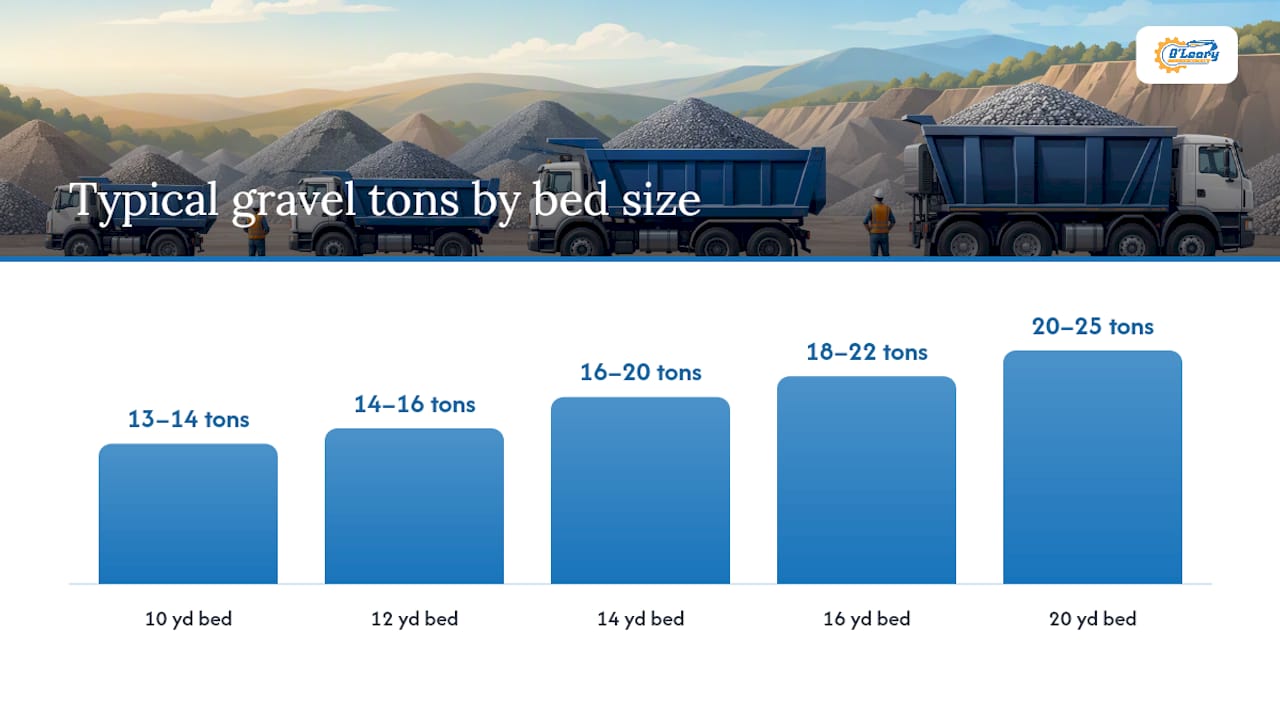
Real-world tons by bed size: 10, 12, 14, 16, and 20 yd beds
The ranges below reflect typical legal payloads, not theoretical box capacity. Exact legal payload depends on GVWR, axle ratings, and Bridge Formula constraints for each specific truck.
Bed Size
Gravel (tons)
Wet Sand (tons)
Dry Topsoil (tons)
Wet Topsoil (tons)
Asphalt (tons)
Mulch (tons)
10 yd
13–14
13.5–16*
5–7
8–11
18–20*
2–3
12 yd
14–16
14–16*
6–8
9–13
18–20*
2.5–3
14 yd
16–20
16–20*
7–10
11–15
20–25*
3–5
16 yd
18–22
18–22*
8–11
12–17
22–28*
4–6
20 yd
20–25
20–25*
10–14
15–22
25–30*
5–8
*Asterisked cells indicate loads where GVWR or axle limits will typically cap the payload before the box is full. Reduce cubic yards per the step-by-step calculation above.
A 12-yd tandem on gravel typically runs 14–16 tons, but that same truck on wet sand is often capped at 10–11 yd³ to stay legal. Ground conditions add another layer: soft residential soil or a posted bridge on the access route may push you toward a smaller truck regardless of what the weight math says. Tri-axles are often the most efficient choice for heavy aggregates like asphalt millings or crushed stone because axle distribution lets you carry more legal tons per trip than a comparable tandem.
Estimating yardage on-site: swell, compaction, and moisture
Before you order, measure what you actually need. The basic volume formula for a rectangular stockpile or fill area is:
L (ft) × W (ft) × H (ft) ÷ 27 = cubic yards
For irregular piles, break the shape into sections and sum them.
Field checklist before ordering
Measure the fill area or stockpile in at least two directions and average the depth.
Identify whether you need bank measure (in-ground), loose measure (in the truck), or compacted measure (final placed volume).
Apply a swell factor for loose material: excavated soil typically swells 10–30% in the truck, meaning a 10-yd³ bank cut becomes roughly 11–13 yd³ loose.
Apply a compaction factor when estimating final placed volume: loose fill compacts 10–20% depending on material and equipment.
Check recent rainfall. Wet material is denser and heavier per yard, which can push a borderline load over the axle limit.
Pro Tip:Ask your supplier for wet-density specs on any aggregate or soil product you are ordering in volume. A quick call before the first load can save you from trimming every truck by 1–2 yd³ all day.
For help converting your fill area to a truckload count, the fill dirt volume calculator at Olearydevelopmentgroup walks through the math step by step.
On-site safety and compliance checklist before every haul
Running through this list before each trip takes under five minutes and can prevent a fine that costs far more.
Tarp secured: All loads must be covered on public roads in most states. Confirm the tarp is latched and not dragging.
Load distribution checked: Heavy material should be centered over the drive axle group, not piled at the tailgate. Rear-heavy loads shift axle weights and can push the rear tandem over 34,000 lb.
GVWR and axle limits verified: Confirm cargo weight against the cab card before leaving the yard.
Bridge Formula groups checked: Run axle-group checks for configurations 1–3, 1–5, and 2–5 on multi-axle trucks.
Overweight/oversize permit in hand: If any limit is exceeded under a state-issued permit, carry the permit and know the approved route.
Posted bridge and route check: Some county roads and bridges have posted weight limits below federal thresholds. Plan the route before dispatch, not at the bridge.
State-line crossing: Weight limits and permit requirements change at state lines. Confirm the destination state’s rules if crossing.
For broader construction zone safety practices, including work-zone signage and driver protocols, the United Contractor Employment Portal publishes practical guidance worth keeping on file.
Overweight fines in most states start in the hundreds of dollars and scale with the degree of excess, sometimes reaching thousands of dollars per violation plus potential vehicle impoundment. A single scale ticket at the yard costs a fraction of that.
Schedule Delivery in Minutes
Get Your Free Quote Today
Tell us your location, access, and estimated yardage — we’ll handle the rest
How these figures were compiled
The capacity ranges and legal thresholds in this article draw from four source types:
The bed-size ranges, ton estimates, and density figures here are grounded in federal regulatory text (23 CFR § 658.17 and FHWA Bridge Formula guidance), published industry capacity charts, material density tables from aggregate suppliers, and fleet weigh-ticket sampling across common truck configurations. Where density ranges vary by moisture or gradation, we applied the conservative (higher-density) end of the range to produce payload estimates that keep you on the safe side of axle and GVWR limits. Figures should be verified against your specific truck’s cab card and a certified scale for production hauls.
Olearydevelopmentgroup’s hauling fleet operates across Greater San Antonio and surrounding cities, delivering fill dirt, gravel, limestone, road base, sand, topsoil, mulch, and specialty landscape stone. Fleet weigh-ticket records from repeat material types inform the practical ranges cited here, particularly for wet versus dry topsoil and gravel density variation across local quarry sources.
A contractor’s perspective on load planning
The numbers in a capacity chart are a starting point, not a guarantee. Here are the practical rules that actually hold up in the field:
Published yardage never accounts for spreading loss, and running short on the last lift costs more in delay than the extra material costs up front. For dense aggregates like crushed limestone or pea gravel, move to a tri-axle before you assume a tandem can handle the volume. The math usually shows the tandem is capped 2–3 yd³ short of the box, which means more trips and more fuel for the same tonnage delivered.
Pre-weigh your heaviest material mix on the first truck of the day. That ticket becomes your reference for every subsequent load. It also protects you if a DOT officer questions the load: a weigh ticket from earlier that morning is hard to argue with. The small operational trade-off is time at the scale, but on a 50-load day, that discipline pays back in avoided fines and tighter bid accuracy.
Fewer, heavier trips reduce road wear on your site access and cut fuel cost per ton. But if the access road is soft or the client’s driveway has a posted limit, a smaller truck making more trips is the right call. Equipment damage and liability on a client’s property cost more than the efficiency loss.
Olearydevelopmentgroup handles load planning so you don’t have to
Miscalculated loads mean wasted trips, overweight fines, and project delays. Olearydevelopmentgroup’s GPS-tracked fleet delivers fill dirt, gravel, limestone, road base, manufactured sand, topsoil, mulch, and specialty stone across Greater San Antonio with per-load pricing, same-day availability, and contractor accounts with net-30 invoicing. Every load is dispatched with material weight in mind, so you get the right truck for the right material without running your own axle checks from scratch.
Contractor accounts include volume pricing and dedicated dispatch, which means fewer calls and more loads moving. Book online or request a quote in minutes at Olearydevelopmentgroup’s dump truck hauling service page. If you need local delivery across San Antonio and surrounding cities, the San Antonio material delivery page has zone details and booking options ready.
This article is general information, not a substitute for advice from a qualified lawyer. Consult a qualified legal professional about your own circumstances before acting on anything here.
FAQ
What sizes do dump trucks come in?
Dump trucks commonly range from 5–8 yd³ (small single-axle) up to 18–24+ yd³ for quad-axle and semi-transfer configurations, with tandems and tri-axles filling the middle range at 8–20 yd³.
How many tons can a 10-yard dump truck haul?
A 10-yd truck hauling gravel at roughly 2,700 lb/yd³ carries about 13.5 tons, but legal payload depends on the truck’s GVWR and axle ratings — wet sand or asphalt in the same box can exceed axle limits before the box is full.
Can a dump truck carry 200 tons?
No standard on-road dump truck carries more than typical federal limits. That tonnage requires off-highway mining haul trucks, which operate outside federal highway weight regulations entirely. On-road semis and transfer setups top out around 25–30+ tons under federal limits.
What sizes are available for landscaping versus heavy construction?
Landscaping jobs typically use 6–8 yd bodies for mulch, topsoil, and decorative stone, while heavy construction and aggregate hauling calls for 10–16 yd tandems or 14–20+ yd tri-axles to maximize legal tons per trip.