Discover how to choose the right river rock size for your landscaping needs. Our guide simplifies selection for beautiful, functional outdoor spaces.
San Antonio’s Go-To Material Supplier
Get a Free Per-Load Quote Today
Same-day delivery available · Transparent pricing · Licensed & insured
For most decorative beds and walkways, 1"–3" river rock is the right call. Use 3/4" where drainage is the priority, and step up to 2" to 4" (or larger) for dry creek beds, swales, and erosion-control zones. Here is a quick reference before the full chart:
3/4 inch (#57 grade) (sizes verified by supplier): French drains, drainage trenches, utility paths
1" to 3" (all-purpose) (sizes verified by supplier): decorative beds, walkways, general ground cover
2" to 4": dry creek beds, visible drainage swales, moderate erosion control
3" to 5" and larger: accent stones, heavy erosion zones, water feature edges
According to Angi’s landscape guide, matching rock size to function (walkability vs. water flow) is the single most important decision you make before choosing color or cost.
Key Takeaways
Matching river rock size to function, not just appearance, is the decision that determines whether your project holds up over time.
Point
Details
All-purpose size
1"–3" river rock suits most decorative beds, walkways, and ground cover, laid at 3" depth.
Drainage size
Use 3/4 inch (#57 grade) (sizes verified by supplier) for French drains and drainage trenches where water flow matters.
Creek and swale size
2" to 4" rock resists washout in dry creek beds and visible drainage swales.
Coverage formula
Cubic yards = (area sq ft × depth in inches) ÷ 324; order 10% extra for settling.
Olearydevelopmentgroup
Delivers bulk river rock in all sizes across San Antonio with same-day options and per-load pricing.
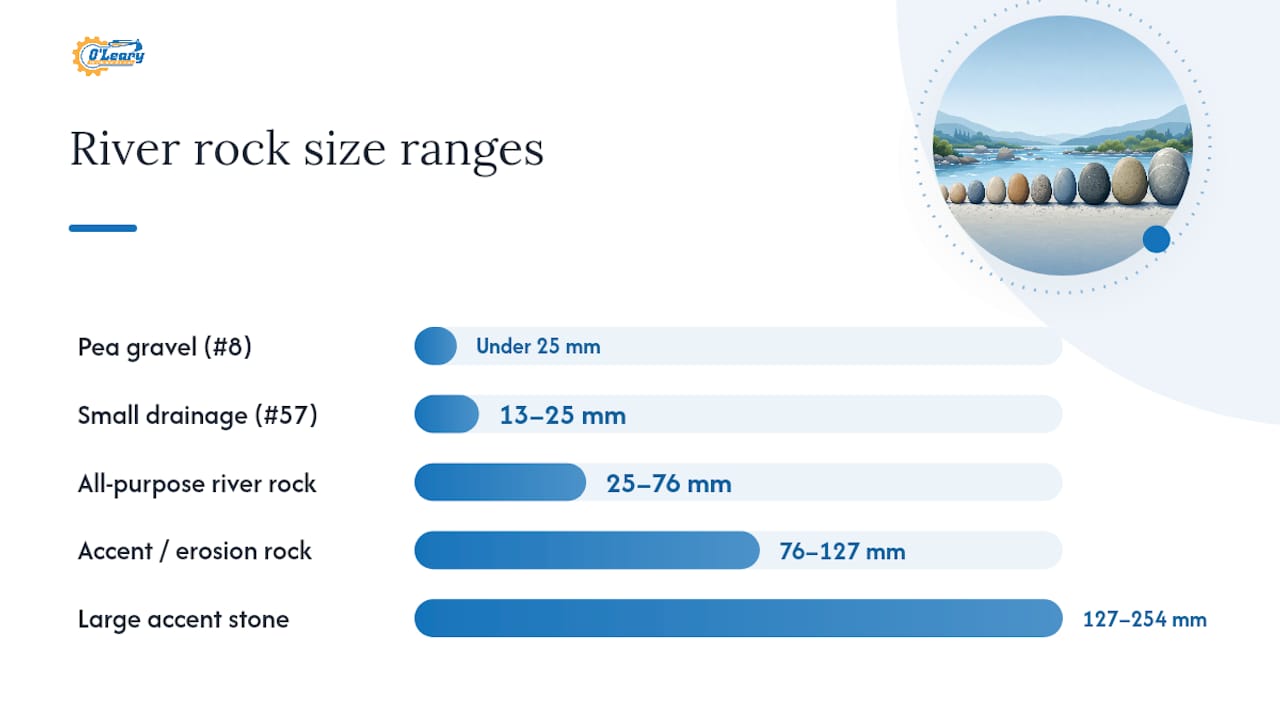
Full river rock sizes chart: names, inches, mm, and supplier codes
The table below covers the standard landscape rock sizes you will encounter at most U.S. suppliers, from pea gravel through large accent stone.
Common Name
Inch Range
mm Range
Common Supplier Code
Best For
Pea gravel
Under 1"
Under 25 millimeters
#8
Borders, plant rings, low-traffic paths
Small drainage rock
1/2"–1"
13 to 25 millimeters
#57
Driveways, walkways, general landscaping
All-purpose river rock
1"–3"
25 to 76 millimeters
None standard
Decorative beds, ground cover, paths
Creek/swale rock
2" to 4"
51 to 102 millimeters
None standard
Dry creek beds, drainage swales
Accent/erosion rock
3"–5"
76 to 127 millimeters
None standard
Erosion control, water feature edges
Large accent stone
5"–10"
127 to 254 millimeters
None standard
Focal points, retaining borders
Boulders
10"+
Over 254 millimeters
None standard
Structural accents, large erosion zones
A few notes on reading this chart. Supplier codes like #8 and #57 are nominal sieve grades, not exact measurements. #57 stone typically runs 1/2"–1" and is widely used for decorative landscaping, driveways, and walkways because it is less likely to wash away than pea gravel. The #8 grade covers pea-sized material under 1". Ranges overlap between suppliers, so always confirm the inch range with your specific yard before ordering.
Pro Tip:Request a physical sample or review product photos before placing a bulk order. Unwashed stone often appears brown or dusty until rinsed; the delivered color can look noticeably different from the supplier’s website photo.
How much river rock do you need? Coverage math and worked examples
The core formula for any bulk rock order is straightforward:
Cubic yards = (Area in sq ft × Depth in inches) ÷ 324
That divisor (324) converts square feet and inches into cubic yards in one step. Depth recommendations from supplier guides follow a simple rule: lay stone at roughly one stone-diameter deep. That means about 2" for pea gravel and 3/4 inch rock, 3" for 1"–3" rock, and 4" for 3"–5" stone.
Worked example A: decorative bed
Area: 10 ft × 20 ft = 200 sq ft
Depth: 3" (standard for 1"–3" all-purpose rock)
Cubic yards: (200 × 3) ÷ 324 = 1.85 cubic yards
Estimated tons: 1.85 × 1.4 = roughly 2.6 tons (using a practical average of 1.3–1.5 tons per cubic yard for decorative river rock)
Wheelbarrow loads: at roughly 3 cubic feet per standard wheelbarrow, 1.85 cubic yards (about 50 cubic feet) = roughly 17 loads
Worked example B: dry creek bed
Area: 6 ft × 40 ft = 240 sq ft
Depth: 5" (midpoint of a 4"–6" mixed-size fill)
Cubic yards: (240 × 5) ÷ 324 = 3.7 cubic yards
Estimated tons: 3.7 × 1.4 = roughly 5.2 tons
Wheelbarrow loads: roughly 33 loads
Quick conversion cheatsheet
1 cubic yard = 27 cubic feet
1 standard wheelbarrow = approximately 3 cubic feet (about 9 loads per cubic yard)
1 cubic yard of decorative river rock weighs approximately 1.3–1.5 tons (confirm density with your supplier)
1 ton of river rock covers roughly 70–100 sq ft at a 3" depth, depending on stone size
Coverage per ton or per cubic yard varies by rock size and supplier, so treat these figures as planning estimates and confirm with your delivery yard before finalizing the order.
Rock settles after installation, and you will almost always need a small top-up. Ordering short and waiting for a second delivery costs more in both time and landscape rock delivery cost than a modest overage.*
Ready to Order?
Call Now: 210-983-8005
Same-day delivery available on most orders in San Antonio and surrounding cities
What determines river rock size and how suppliers grade it
River rock gets its rounded shape from water action over time. Suppliers then size the material by running it through a series of screens (sieves) with specific opening dimensions. The resulting grade is a nominal range, meaning most stones in the batch fall within that range but not all of them will.
A few key factors shape what you actually receive:
Sieve size: the physical screen opening that sets the grade’s upper and lower bounds
Name vs. number codes: some yards use descriptive names (pea gravel, creek rock); others use ASTM-style numbers (#57, #8). Both refer to the same sieve-based grading system, but terminology varies by region.
River rock vs. crushed stone: river rock is naturally rounded; crushed stone is angular. They behave differently underfoot and in drainage applications.
Before confirming any order, run through this short checklist:
Confirm the inch range (not just the name or code)
Ask whether the material is washed or unwashed
Request a sample photo or physical sample for color approval
Verify whether the supplier sells by cubic yard, ton, or pallet
How to pick the right river rock size for your project
Start with three questions before you look at any size chart:
Will people walk on it? Foot traffic needs a stable surface. Stones smaller than 3/4" shift and scatter underfoot; 1 inch to 3 inch locks in better and stays put.
Will water flow through or over it? Drainage applications need void space. Pea gravel and 3/4 inch rock work well in French drains; larger stone handles surface runoff in swales.
Is the goal decorative or structural? Decorative beds prioritize appearance; erosion-control zones prioritize mass and stability.
Quick size recommendations by use case:
Flower beds and borders: 1"–3" all-purpose rock, laid 3" deep
High-traffic walkways: 1" river rock (contractors often prefer this size for walkable surfaces because it balances appearance and resistance to tracking)
French drains: 3/4 inch (#57 grade) (sizes verified by supplier) which allows water to move freely while staying in place
Dry creek beds and swales:2" to 4" native river rock resists washout better than smaller decorative stone
Water features: 2" to 4" for the main basin; 3"–5" accent stones at the edges
Planting rings around trees: pea gravel or 3/4", kept away from the trunk
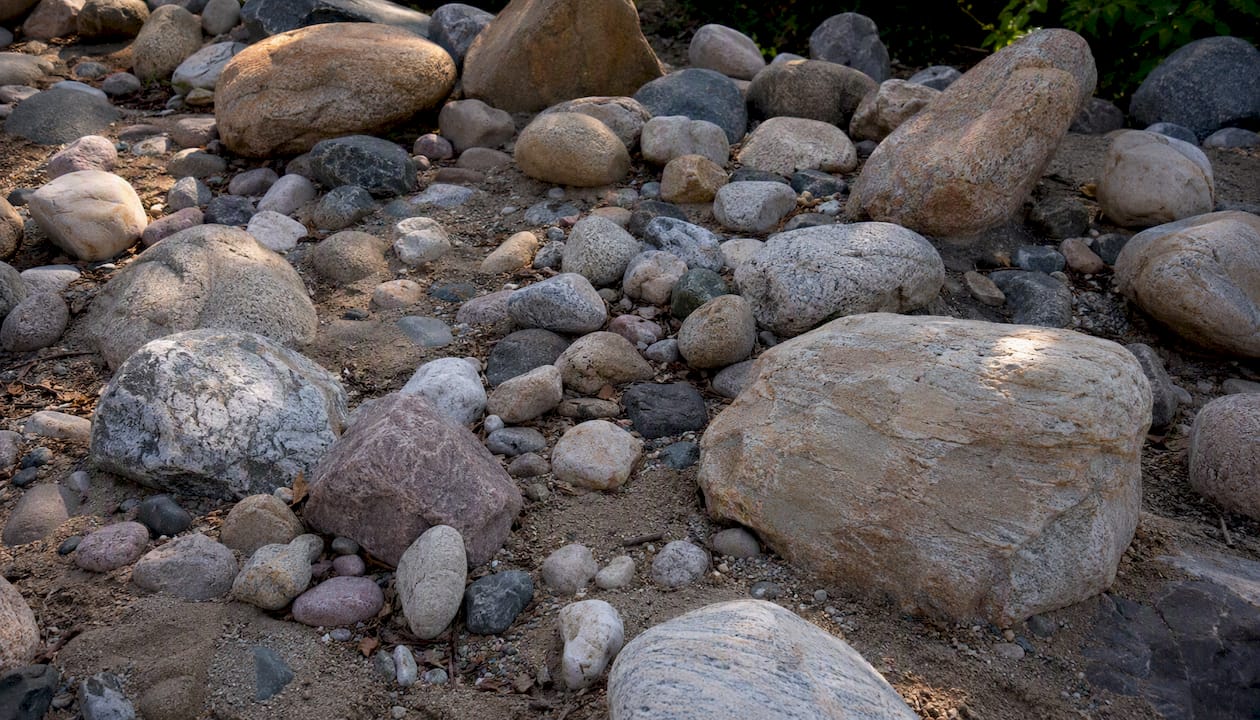
Mixing sizes gives a more natural result. A dry creek bed with 1"–3" surface rock and 3"–5" accent stones along the channel edges looks more realistic and holds its shape better than a single-size fill.
Practical applications by size: what each grade actually does
Pea gravel (under 1 inch)
Best for low-traffic decorative borders, potted plant rings, and playground surfaces. Pea gravel drains well but moves easily, so avoid it anywhere runoff will push it across a paved surface or into a lawn.
Do: use around raised beds, under play equipment, in contained borders
Don’t: use in open swales, on slopes, or in high-flow drainage channels
3/4 inch rock (#57 grade)
The go-to size for French drains and utility drainage. It sits firmly enough to stay in place under moderate flow while leaving enough void space for water to move through quickly.
Do: use in drainage trenches, under permeable pavers, in utility paths
Don’t: use as a primary decorative surface where foot traffic is heavy
1 to 3 inch all-purpose river rock
The most popular decorative size across the U.S. It balances visual weight, stability, and ease of spreading. Lay it at approximately 3 inches depth for ground cover and beds.
Do: use for decorative beds, walkways, general ground cover
Don’t: expect it to hold in high-velocity runoff without a larger anchor stone underneath
2" to 4" creek and swale rock
Purpose-built for visible drainage features. The added mass keeps stones in place when water moves through a swale or dry creek bed. Check out 2" septic rock as a practical example of this size range in action.
Do: use as the primary fill in dry creek beds and drainage swales
Don’t: use as a walkable surface; the irregular size is uncomfortable underfoot
3 to 5 inch accent and erosion-control rock
Heavy enough to anchor the edges of water features and erosion-prone slopes. Works well as a top layer over geotextile fabric on hillsides.
Do: use along channel edges, at the base of retaining walls, and around water feature perimeters
Don’t: use as the sole material in a French drain; the large voids pass too much fine material
Pro Tip:For dry creek beds, combine 1 to 3 inch rock as the main fill with 3 to 5 inch accent stones placed along the outer edges of the channel. The larger stones anchor the border, the smaller fill handles the center flow path, and the mix looks far more natural than a single size.
Ordering and delivery tips for bulk river rock
Ordering units: cubic yards vs. tons
Contractors typically order by the cubic yard when they have a precise volume calculation. Suppliers often quote by the ton for larger jobs because weight is easier to measure at the scale. For decorative river rock, the practical conversion is 1.3–1.5 tons per cubic yard, but confirm the exact density with your supplier since it varies by stone type and size.
Retail bags (typically 0.5 cubic feet) work for small patch jobs but are expensive per unit compared to bulk delivery. For anything over about 2 cubic yards, bulk delivery is almost always the more cost-effective route.
Delivery checklist
Before your truck arrives, work through these steps:
Schedule Delivery in Minutes
Get Your Free Quote Today
Tell us your location, access, and estimated yardage — we’ll handle the rest
Measure your drop zone. A standard dump truck needs roughly 50–60 feet of clearance to maneuver and dump safely.
Protect nearby plants. Place tarps or plywood over beds adjacent to the drop zone.
Confirm washed vs. unwashed with the supplier one more time at order confirmation.
Approve a color/size sample before the full load ships, especially for decorative stone.
Clarify notification windows if you need multiple drops or a staged delivery.
For larger jobs with mixed sizes, stage the smaller decorative rock closest to the work area and the larger accent stone at the perimeter. This saves significant labor when spreading by hand or wheelbarrow.
Pro Tip:Ask your supplier about minimum delivery quantities before scheduling. Many bulk yards have a one-yard or one-ton minimum for delivery. Knowing this upfront lets you consolidate orders and reduce per-load delivery cost.
For a step-by-step walkthrough of the local ordering process, the landscape rock delivery guide for San Antonio covers scheduling, access requirements, and what to have ready when the truck arrives.
What the delivery side actually looks like
The most common job-site problems we see at Olearydevelopmentgroup are not wrong size choices. They are logistical: a drop zone that is too small for the load, a driveway that cannot handle a loaded dump truck, or a homeowner who ordered by eyeballing the bed instead of measuring. Under-ordering by even half a yard means a second delivery, which doubles the landscape rock delivery cost for that portion of the job.
A good delivery partner handles more than just dropping the material. Staging for multiple-size orders, confirming access before dispatch, and coordinating dump placement to minimize hand-spreading time all reduce total job hours. When you have the coverage math done before you call, the conversation is faster, the quote is more accurate, and the delivery goes smoother. That is the practical value of working through the numbers in this guide before picking up the phone.
Olearydevelopmentgroup delivers bulk river rock across San Antonio
Getting the size right is half the job. Getting it delivered on time, in the right quantity, and placed where you can actually use it is the other half.
Olearydevelopmentgroup provides bulk river rock delivery and dump truck hauling across Greater San Antonio and surrounding cities, with same-day and next-day options available. The service covers all the sizes in this guide, from pea gravel through large accent stone, with GPS-tracked fleets, transparent per-load pricing, and an online booking system that makes requesting a quote fast. Before you call, have your area dimensions, preferred depth, and target size ready. That information is all a dispatcher needs to give you an accurate quote on the spot. Request your delivery quote and get your material scheduled today.
River rocks range from pea gravel (under 1") through small (1"–2"), medium (2"–5"), large (5"–10"), and boulder sizes (10"+). Most U.S. suppliers carry the full range, though naming conventions vary by region.
How big is #8 river rock?
#8 river rock is pea-gravel sized, typically under 1" in diameter. It works well for decorative borders, plant rings, and low-traffic ground cover.
How big is #57 river rock?
#57 stone typically runs 1/2"–1" in diameter. It is widely used for driveways, walkways, and French drains because it stays in place better than pea gravel under moderate water flow.
How many wheelbarrows is 1 yard of river rock?
One cubic yard equals 27 cubic feet. A standard contractor wheelbarrow holds about 3 cubic feet, so 1 cubic yard of river rock takes roughly 9 wheelbarrow loads to move.
How much does river rock delivery cost in San Antonio?
Landscape rock delivery cost in San Antonio varies by load size, material type, and distance. Olearydevelopmentgroup offers transparent per-load pricing with same-day options; the fastest way to get an accurate figure is to request a quote with your area dimensions and preferred size ready.