5 Permeable Driveway Materials and Reservoir Rules for Owners & Pros
O'Leary Development GroupSeptember 29, 2026
Compare five permeable driveway materials and learn the reservoir, testing, and delivery steps contractors use to avoid costly failures.
San Antonio’s Go-To Material Supplier
Get a Free Per-Load Quote Today
Same-day delivery available · Transparent pricing · Licensed & insured
Five material families make up nearly every permeable driveway on the market: porous asphalt, pervious concrete, permeable interlocking concrete pavers (PICP), loose gravel or grid systems, and resin-bound stone. For low cost or DIY projects, gravel and grid systems are the easiest starting point. PICP suits homeowners who want a finished look with easy spot repairs, pervious concrete works for a durable poured surface, porous asphalt gives you an asphalt-style driveway with drainage built in, and resin-bound stone fits high-end aesthetics. Steep slopes, poor soil infiltration, or a high water table can rule out infiltration-based designs before you even pick a surface.
TL;DR:
Permeable driveway costs depend heavily on site conditions, with gravel and grid systems being cheapest but requiring more upkeep and proper base preparation.
Proper reservoir depth and thorough compaction, based on solid soil testing and site design, are critical for longevity regardless of surface material choice.
Underdrains and deeper subbases are often necessary for poorly draining soils or high water tables, adding to installation costs but preventing early failure.
Cost estimates vary regionally, with interlocking pavers typically more expensive to install than porous concrete or asphalt, though repair ease can offset initial expense.
Local permitting rules and needing a stamped drainage plan should be confirmed before installation to avoid costly delays or redesigns.
Olearydevelopmentgroup
Get Materials Delivered To Your Site
O’Leary Development Group delivers dirt, gravel, limestone, topsoil, and landscape stones across San Antonio and surrounding cities.
How permeable driveways manage water beneath the surface
Every permeable driveway relies on layers you never see once construction wraps up. The surface material sits on a choker or bedding course, which rests on a stone reservoir that stores water temporarily while it soaks into the soil or drains through pipe. A geotextile fabric separates the reservoir stone from native soil to keep fines from clogging the voids, and some designs add a waterproof liner or an underdrain when infiltration alone cannot handle the water.
Two basic approaches exist: full infiltration, where water percolates straight into the ground, and detained flow with an underdrain, where marginal soils get help from a pipe that carries excess water to a positive outlet. According to guidance from the EPA’s stormwater best management practices report, designers often increase subbase depth and add underdrains when native soils infiltrate poorly.
Site conditions decide which approach applies. Steep grades, tight soils, and shallow groundwater all affect the design before a single material choice gets made.
Surface layer: the visible driving surface, whether asphalt, concrete, pavers, gravel, or resin-bound stone.
Choker/bedding course: a thin layer of smaller stone that stabilizes the surface material.
Reservoir/subbase: the main water-storage layer, sized to the site’s drainage needs.
Geotextile: fabric that keeps soil fines from migrating into the stone reservoir.
Liner and underdrain: optional components added when infiltration is limited or a foundation is nearby.
Porous asphalt: a familiar surface with hidden drainage
Porous asphalt looks like standard asphalt but skips the fine aggregate that normally fills the mix, leaving voids that let water pass through into a stone reservoir below. It needs a deeper, well-graded base than conventional asphalt and a paving crew experienced with the mix design, since a poorly placed load compacts the pores shut.
Pros: familiar driving surface, solid drainage capacity, and a look that matches conventional asphalt driveways.
Cons: raveling and surface abrasion over time, sensitivity to installer skill, and a need for regular vacuuming or sweeping to prevent clogging.
Cost ranges for porous asphalt and other permeable surfaces vary by region and project scope, according to municipal cost analyses referenced in national reports. Projects on marginal soils typically need a deeper subbase and an underdrain. This adds cost but protects the surface from long-term saturation.
Pervious concrete: a durable poured option for residential traffic
Pervious concrete uses a specialized mix with little to no sand, creating interconnected voids that let water drain through while still supporting vehicle loads. Getting those voids right depends heavily on placement technique. Overworking the surface during finishing closes the pores, and the FHWA’s technical brief on permeable concrete pavements stresses construction quality control as the deciding factor in long-term performance.
Pros: a durable, poured surface well suited to daily residential vehicle use once properly placed.
Cons: workmanship-sensitive installation, freeze-thaw and deicer concerns in cold climates, and periodic cleaning to keep voids open.
FHWA guidance also recommends underdrains in many applications and calls out aggregate gradation as a key design detail, not an afterthought. Correct void content and construction quality control determine whether pervious concrete lasts, per FHWA’s technical brief. Expect thicker subbase sections on sites with slower-draining soil.
Permeable interlocking concrete pavers: modular, repairable, and load-friendly
PICP systems use individual paver units set on a choker course over a reservoir base, with joint stone filling the gaps between units to let water pass through. Edge restraints are not optional here. Without them, the pavers shift under load and the whole system loses its structure. The Montgomery County permeable pavement technical manual specifies #2 stone at the reservoir bottom and #57 stone above it, along with waterproof liners within 10 feet of a foundation in some designs.
Pros: a finished, uniform look, straightforward spot repairs since individual pavers lift out, and good load distribution across the system.
Cons: joint stone migration if the wrong aggregate size gets used, weed growth in neglected joints, and a need for a properly sized reservoir and underdrain on poor soils.
Maintenance stays manageable if joints get swept or vacuumed on a regular schedule rather than left to accumulate debris.
Loose gravel, grid systems, and grass-gravel hybrids for lower-cost projects
Loose gravel driveways rely on angular stone that locks together under traffic, while plastic or concrete grid cells hold gravel or grass in place to resist rutting. Grass-gravel hybrids blend both, offering a greener look with structural support underneath.
Pros: the lowest material cost among permeable options, DIY-friendly installation, and flexible drainage that adapts to irregular driveway shapes.
Cons: rutting under concentrated wheel loads, ongoing edging and compaction needs, and weed or dust management over time.
Loose stone driveways benefit from a well-drained base, and products like pea gravel work well as a surface layer once a proper reservoir and geotextile are in place. Sites with soft or clay-heavy soil usually need a deeper reservoir and a geotextile layer to keep gravel from disappearing into the ground over a season or two.
Resin-bound and resin-bonded stone: premium looks with trade-offs
Resin-bound surfacing mixes stone aggregate with resin before laying it, producing a smooth, permeable surface with consistent texture. Resin-bonded systems apply resin to a base first, then broadcast stone across it, which creates a textured but generally less permeable finish. Both require a professional crew, since mixing ratios and curing conditions affect the final surface significantly.
Pros: a premium, uniform appearance and a smooth, firm surface that reads as more finished than gravel or pavers.
Cons: higher material and labor cost, sensitivity to UV exposure and temperature swings, and a firm requirement for professional installation.
Expect periodic cleaning to maintain both appearance and drainage, and budget for resurfacing sooner than you would with pervious concrete or PICP.
Ready to Order?
Call Now: 210-983-8005
Same-day delivery available on most orders in San Antonio and surrounding cities
Picking a material starts with testing your site, not browsing photos. A percolation test tells you how fast water moves through native soil, and that number decides whether infiltration-based designs are realistic at all.
Run a percolation or infiltration test; soils draining slower than 2 inches per hour generally push designers toward underdrains rather than full infiltration, per University of Florida IFAS guidance.
Check the seasonal high water table; keep at least 2 feet of separation between the water table and the bottom of the aggregate reservoir, per the same IFAS guidance.
Confirm the driveway’s slope; permeable pavement generally should be avoided on grades steeper than 5%, according to IFAS.
Evaluate expected traffic loads, since a driveway serving a single car has different reservoir and surface needs than one serving delivery trucks or heavy equipment.
Weigh the trade-offs honestly. Gravel costs less upfront but asks for more of your time in upkeep. PICP costs more but repairs easily. Resin-bound stone looks the best but carries the highest price tag and the shortest weather tolerance.
Pro Tip:Ask any contractor for their percolation test data, proposed reservoir depth, and compaction targets in writing before signing a contract.
What drives installation cost and how to compare contractor bids
Excavation and haul-away usually set the floor for any permeable driveway budget, since old material has to leave the site before new layers go in. Reservoir stone volume comes next, and it scales with both driveway area and the depth your soil test requires. Geotextile fabric, liners, and underdrain piping add cost on marginal sites but protect the system from early failure.
Demolition and haul-away of existing driveway material or unsuitable soil.
Reservoir stone volume, often specified in cubic yards of open-graded aggregate like #2 or #57 stone.
Geotextile fabric and, where needed, a waterproof liner near foundations.
Underdrain piping and a connection to a positive outlet.
Edge restraints to keep PICP or gravel systems from shifting under load.
Contractor experience and quality assurance during placement.
Interlocking pavers often cost more to install than porous concrete or asphalt, according to cost analyses cited in municipal LID guidance, though the gap narrows once you factor in PICP’s easier repairs. When comparing bids, ask each contractor to specify stone gradation, geotextile spec, and underdrain plan in cubic yards and linear feet rather than a lump sum, so you can see exactly what you are paying for.
Base prep and delivery logistics contractors should not skip
Permeable driveways succeed or fail based on what happens below the surface, and that starts with compaction. Subbase material should go down in lifts of about 4 inches, compacted to a 95% target before the next lift goes on, a process detailed in O’Leary Development Group’s driveway base preparation guidance. Skipping lifts or rushing compaction is one of the most common reasons reservoirs settle unevenly later.
Material delivery timing matters just as much as the material itself.
Stage washed angular stone separately from fines to keep reservoir gradation intact during placement.
Schedule reservoir stone and bedding material for same-day or next-day delivery so compaction crews are not waiting on trucks.
Order in per-load quantities that match your reservoir design rather than guessing volumes on-site.
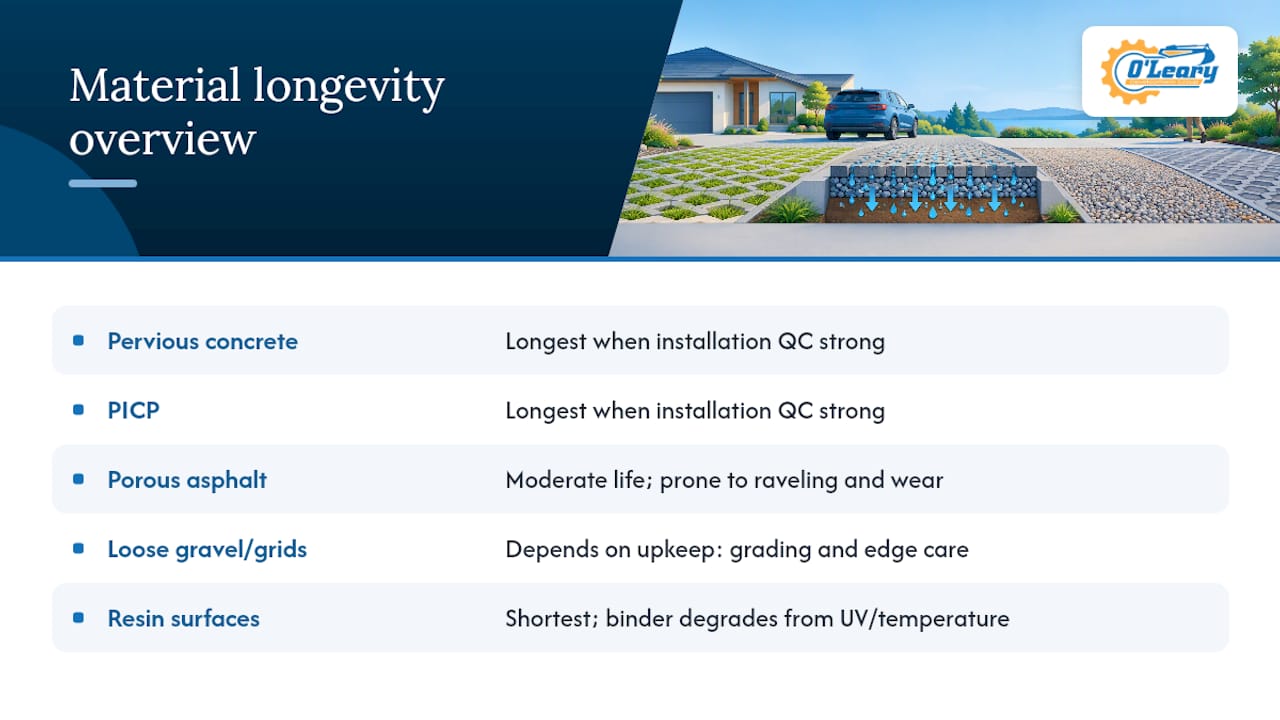
Longevity depends less on the material’s marketing and more on how well the base was built and how consistently the surface gets maintained. Pervious concrete and PICP tend to hold up longest when construction quality control was strong at installation, since both rely on maintaining void structure or joint integrity over decades of freeze-thaw cycles and traffic loads. Porous asphalt sits in the middle: it drains well when new but is more prone to raveling and surface wear than a poured or modular system, especially in high-traffic driveways.
Loose gravel and grid systems have a different failure mode. They rarely crack or crumble, but they migrate and rut without regular grading and edge maintenance, so their practical lifespan depends more on upkeep than on material durability. Resin-bound and resin-bonded surfaces generally have the shortest service life among premium options, since UV exposure and temperature cycling degrade the resin binder faster than concrete or paver joints degrade.
None of these materials perform to their potential without the base design behind them. A driveway with a properly graded reservoir and correct geotextile placement will outlast a driveway using a premium surface material over an undersized or poorly compacted base, regardless of which surface family you pick. That is the piece homeowners underestimate most: the surface is what you see, but the reservoir is what determines how many years you get out of it.
Design choices that shape the look of your driveway
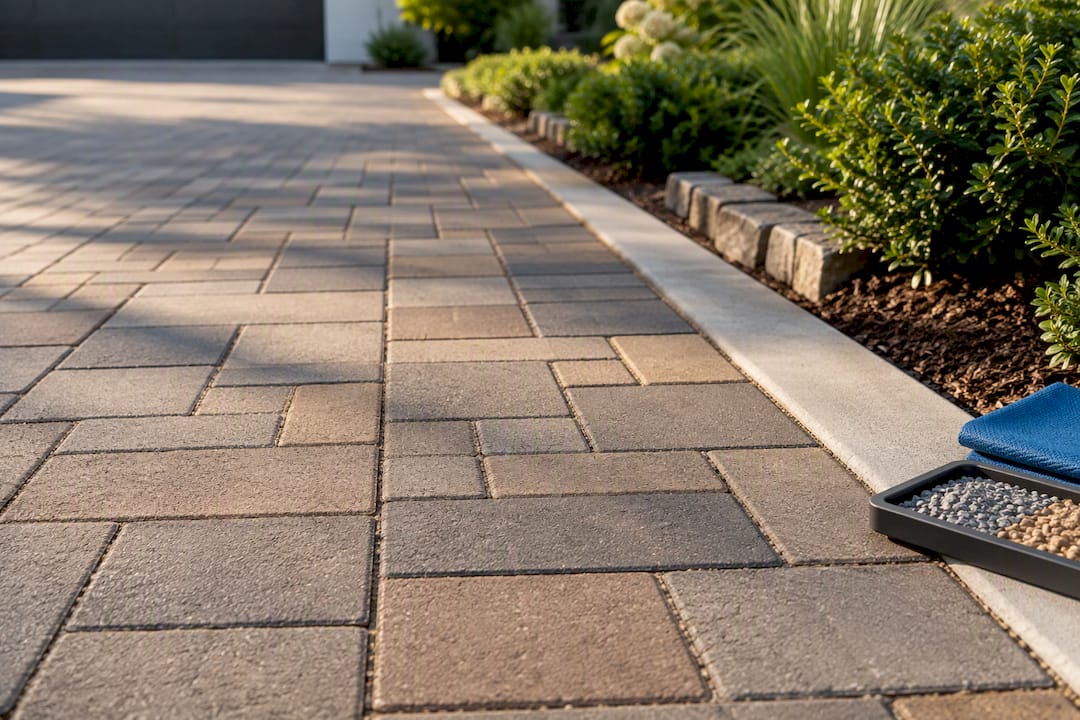
Permeable materials no longer mean sacrificing curb appeal for drainage performance. PICP systems come in multiple paver shapes, colors, and patterns, so you can match a driveway to a home’s exterior the same way you would with standard pavers. Resin-bound surfaces offer some of the widest color and aggregate choices, since the stone blend controls the final appearance and can be tuned to match brick, stucco, or landscaping tones.
Gravel driveways read as more informal and rustic, which suits rural or naturalistic landscaping better than a formal urban lot. Pervious concrete and porous asphalt look closest to conventional driveways, which matters if you want the permeable function without a visibly different surface.
Border treatments and edge restraints also shape the finished look. A steel or concrete edge restraint on a PICP driveway can double as a clean visual border, while gravel driveways often use landscape stone or timber edging to define the space. Whatever material you choose, plan the edge detail alongside the surface, since an unrestrained edge undermines both the driveway’s structure and its appearance over time.
Schedule Delivery in Minutes
Get Your Free Quote Today
Tell us your location, access, and estimated yardage — we’ll handle the rest
Checking local rules before you install
Permit requirements for permeable driveways vary by municipality and stormwater authority, and they often depend on lot size, impervious surface limits, or proximity to a floodplain. Some jurisdictions offer stormwater fee credits for permeable installations, while others require an engineered design stamped by a licensed professional before issuing a permit.
Because these rules differ by location, the only reliable step is contacting your local stormwater or building department before finalizing a design. Ask specifically about setback requirements from foundations and property lines, any required underdrain or overflow connection to public storm systems, and whether your project needs a stamped drainage plan. Skipping this step risks a failed inspection or a costly redesign after installation.
Why the base matters more than the brochure
The material aisle gets all the attention, but the real decision happens in the ground. Homeowners compare paver colors and asphalt textures while skipping the question that actually determines whether the driveway works in five years: what does the reservoir look like, and who is checking compaction as it goes in.
Conventional advice treats permeable pavement like a product choice. It is closer to a drainage system with a driving surface bolted on top. A percolation test and a written underdrain plan matter more than which paver pattern you like, and most driveway failures trace back to skipped soil testing or rushed compaction rather than the wrong surface material.
If you take one thing from this guide, prioritize the invisible layers first. Pick the surface material that fits your budget and aesthetic, but insist on seeing the reservoir design and compaction plan in writing before a contractor breaks ground. The surface is replaceable. A poorly built reservoir usually is not, short of tearing the whole driveway out.
— BRIAN
Getting the materials and hauling your project actually needs
Once you have settled on a material family and a base design, the next step is getting the right aggregate to your site on the right schedule. Material delivery services include washed reservoir stone, road base, and landscape rock with scheduling options aimed at efficient project progress.
Installation need
Relevant O’Leary service
Reservoir and bedding stone
Gravel Delivery
Subbase and road base material
Road Base Delivery
Old driveway removal
Demolition Haul Off Services / Dump Truck Haul Off
Site grading support
Site Prep Support
Per-load pricing and online quote requests are available through the services page, and contractors managing multiple deliveries can review dump truck hauling options for scheduling across a project timeline.
Where to check the design standards yourself
For deeper detail on slope limits, infiltration rates, and reservoir specifications, check the primary sources directly. The FHWA technical brief, EPA’s stormwater BMP guidance, IFAS design considerations, and the Montgomery County technical manual cover the engineering specifics in full.
Consult your local stormwater authority for permit requirements and site-specific design rules before finalizing plans.
Ask a licensed contractor to confirm reservoir depth and underdrain needs against your own soil test results.
There is no single best material since the right choice depends on budget, aesthetics, and site conditions. Gravel and grid systems suit lower budgets and DIY projects, PICP balances a finished look with easy repairs, and pervious concrete or porous asphalt suit homeowners wanting a poured, driveway-like surface.
What are the downsides of permeable paving?
Permeable pavement requires more maintenance than a standard driveway, including regular sweeping or vacuuming to prevent clogging, according to extension guidance. It also is not suitable on steep slopes, poorly draining soils, or sites with a shallow water table, per IFAS design guidance.
What is the cheapest permeable driveway option?
Loose gravel and grid systems are generally the lowest-cost permeable option, since they use simple materials and can be installed without specialized equipment. Costs still rise with reservoir depth and geotextile needs on soils that drain poorly.
What is the typical cost of permeable driveways?
Cost varies widely by material, site conditions, and regional labor rates, with interlocking pavers often costing more than porous concrete or asphalt installations, according to municipal cost analyses. Get a written quote based on your specific reservoir depth and soil conditions rather than relying on general estimates.