Gravel Delivery Timeline: A Scheduling Guide for Your Project
O'Leary Development GroupAugust 20, 2026
Discover how various factors affect your gravel delivery timeline, ensuring your project stays on schedule, no matter the season.
San Antonio’s Go-To Material Supplier
Get a Free Per-Load Quote Today
Same-day delivery available · Transparent pricing · Licensed & insured
That buffer exists because trucks, quarries, and weather all introduce variables no dispatcher fully controls, and a padded schedule keeps your crew working instead of standing around waiting on a load.
A few situations change the math:
Peak season (spring through summer) stretches lead times because quarries and haulers are running full schedules.
Rural or outlying addresses often need an extra day simply due to drive distance from the yard.
Specialty stone or decorative aggregate may need to be special-ordered, pushing timelines past a week.
Quick reference: Standard bulk orders in most service areas move from phone call to dumped load in one to three days, and a local provider like Olearydevelopmentgroup can often work within that same window for Greater San Antonio projects.
Key Takeaways
Point
Details
Standard lead time
Plan for 2 to 4 business days for typical orders, 4 to 7 days during peak season.
Buffer rule
Add a 20% schedule buffer to your supplier’s quoted lead time to absorb delays.
Confirm the driver call
Expect a call 30 to 60 minutes before arrival to verify the drop spot and access.
Match truck to load
Bulk delivery beats pickup hauling once your estimate passes about 2 to 3 cubic yards.
Local execution example
Olearydevelopmentgroup uses online booking and GPS tracking to hit delivery windows across Greater San Antonio.
Gravel Delivery Timeline: Typical Lead Times and What Changes Them
The honest answer to “how long for gravel delivery” depends on four things: how much you need, what kind of material it is, how far the truck has to drive, and what season it is. Once you know those variables, you can predict your own timeline with reasonable accuracy.
Here’s how the bands typically break down:
Same-day or next-day: Available in some markets for smaller loads when trucks are already routed nearby.
2 to 4 business days: The normal window for standard gravel, road base, or crushed stone in most service areas.
4 to 7 days: Recommended if you want the best chance at your preferred delivery window, especially during busy months.
7 or more days: Common for specialty decorative stone, unusual colors, or bulk commercial orders that require multiple truckloads.
Quantity matters more than people expect. A single half-load for a garden bed is easy to slot into a route. A 40-ton commercial order for a parking lot base competes for truck capacity and may need to be split across multiple delivery days. Distance compounds this: a load headed 10 miles from the quarry moves faster than one headed 45 miles out, and rural addresses with limited road access add planning time on the dispatcher’s end.
Weekday timing helps too. Ordering early in the week tends to give suppliers more flexibility than a Friday call for a Saturday drop, since weekend crews are often smaller.
Pro Tip:Once your delivery is scheduled, expect the driver to call 30 to 60 minutes before arrival. Treat that call as your final checkpoint. Confirm the gate is unlocked, vehicles are moved, and someone is on site to point out the exact drop spot.
Many suppliers, including Olearydevelopmentgroup, offer free delivery for orders of 5 or more tons within about 20 miles, while smaller loads or longer hauls commonly carry a delivery fee in the $50 to $100 range. Factoring that threshold into your order size can affect both your budget and how quickly your load gets prioritized on a route.
How to Calculate Gravel Quantity and Truck Capacity
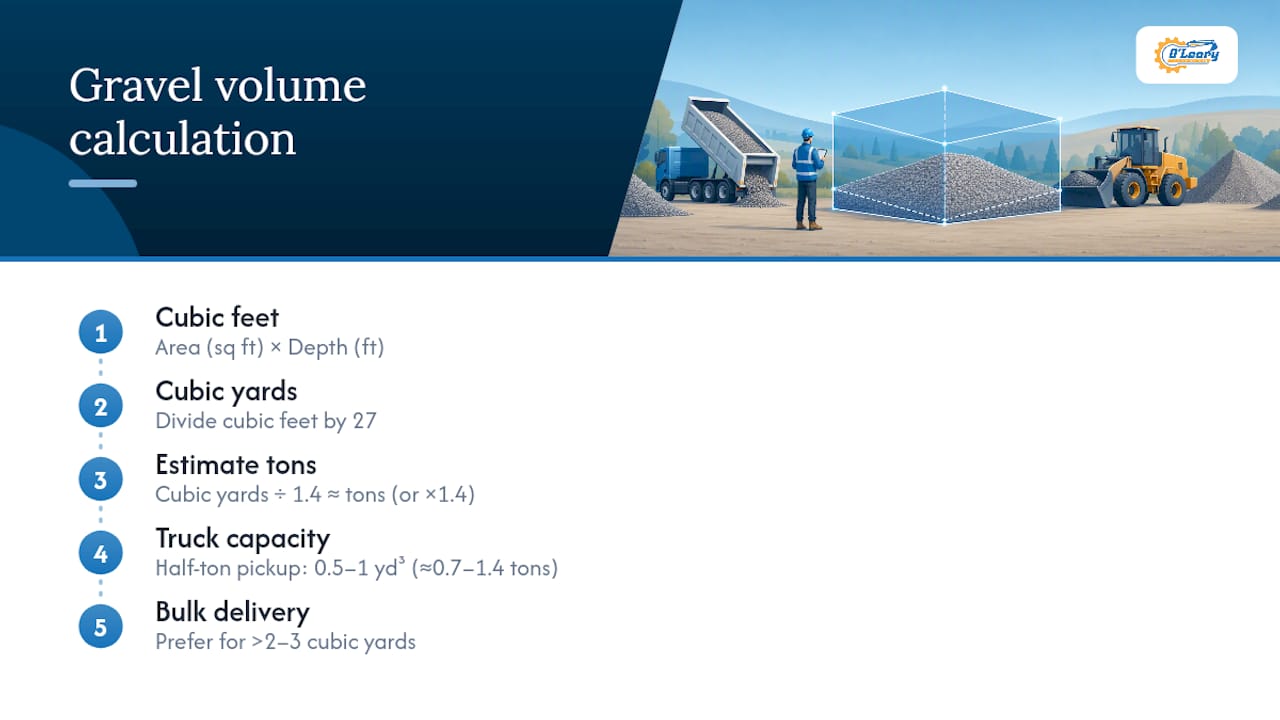
Getting the math right before you call a supplier saves you from a second delivery. The formula is simple: multiply your area by your depth to get cubic feet, then convert to cubic yards.
For tonnage, a cubic yard of gravel is very heavy, so divide your cubic yard total by 1.4 to get a rough ton estimate (or multiply by 1.4 tons per yard, depending on which unit your supplier quotes).
Truck capacity determines whether you’re picking up material yourself or scheduling bulk delivery. A standard half-ton pickup safely hauls about 0.5 to 1 cubic yard, roughly 0.7 to 1.4 tons. Beyond that, you’re either making multiple trips or risking an overloaded truck, which is both a safety issue and a fast way to damage a suspension.
Pro Tip:Once your estimate crosses roughly 2 to 3 cubic yards, bulk delivery almost always beats hauling it yourself in trips. It’s safer, and per-ton pricing on a full load usually works out cheaper than repeated pickup runs.
Ready to Order?
Call Now: 210-983-8005
Same-day delivery available on most orders in San Antonio and surrounding cities
If you’re unsure which material fits your project, comparing washed and crushed gravel options before you order can prevent a mismatch between what you calculated and what actually gets delivered.
What Happens on Gravel Delivery Day
Delivery day runs smoothly when you treat it like a scheduled event, not a surprise. Here’s the sequence to expect:
Confirm your drop spot with the supplier when you book, not the morning of.
Expect the driver’s call 30 to 60 minutes before arrival to verify access and timing.
Clear the access path of vehicles, equipment, or debris before the truck arrives.
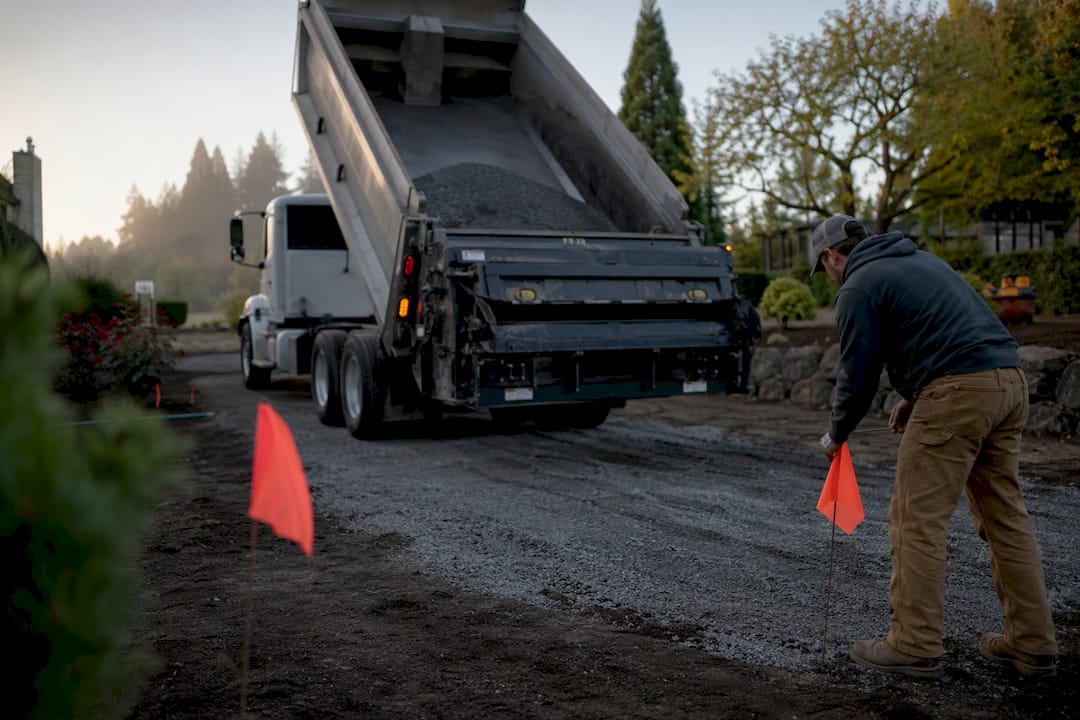
Mark the dump area clearly with a cone, stake, or flag so the driver has no guesswork.
Inspect the load immediately after dumping to confirm material type and rough quantity.
A key thing to understand: drivers dump, they don’t spread. The truck backs into position, tilts the bed, and releases the load in a pile. Moving that gravel from the drop spot to its final resting place is your job, whether that means a wheelbarrow, a rake crew, or a skid steer.
Your delivery-day checklist should include a working phone number on file, any gate codes shared in advance, a visible marker at the dump spot, someone on site to direct the driver, and equipment staged for the spreading work that follows.
Pro Tip:If your site has tight access, ask the supplier ahead of time whether the driver can pull farther onto the property or whether a smaller articulated dump truck is required. Sorting this out before the truck shows up avoids an awkward reschedule.
Site-Prep and Access Checklist Before the Truck Arrives
A failed delivery attempt costs you more time than a slow one. Before the truck shows up, walk your access route and check these points:
Turning radius: Make sure the truck has room to maneuver without backing across a neighbor’s property.
Overhead clearance: Trim branches or check wires, especially for tri-axle trucks with raised beds.
Gate width: Confirm the opening is wide enough for the truck body, not just the cab.
Ground bearing capacity: Never plan to dump on soft turf, freshly poured pavement, or ground weakened by rain.
Underground utilities: Know where septic lines, irrigation, or buried cable run before a loaded truck parks over them.
Two days out, clear vehicles from the drive and confirm your on-site contact person. The day before, lay temporary mats or boards over any surface you’re protecting, and do a final walkthrough of the access path.
Pro Tip:Measure your usable width and confirm truck type with your supplier ahead of time. A tri-axle typically needs 11 to 12 feet of clearance and 13 to 14 feet of overhead room for the bed to tilt safely.
Sequencing Gravel Delivery With Other Project Materials
The most reliable way to time a gravel delivery is to work backward from your installation date, not forward from your order date. Set the day concrete gets poured or pavers get set, then schedule your gravel delivery immediately before that step, not days ahead of it.
For a small patio pour, a realistic sequence looks like this: gravel base delivered on day one, compacted and graded on day two, forms and rebar set on day three, concrete poured on day four. For a larger driveway project, that same sequence stretches out, with rebar lead times running 7 to 10 days in some markets, so gravel typically arrives closer to the compaction step rather than at the very start of the job.
Keep these sequencing priorities in mind:
Foundation base material goes down before rebar or forms.
Build in a compaction window before any structural load sits on top of the gravel.
Finish layers, like decorative stone or top-dress gravel, go in last.
Storing a gravel pile for a week before you need it just invites compaction and weed growth you’ll have to deal with later.
Common Delivery Delays and How to Plan Around Them
Even a well-run supplier hits snags. The usual suspects are peak-season congestion, weather, truck breakdowns, inventory shortages at the quarry, and site access problems discovered too late.
The fix isn’t hoping for good luck. It’s building in room for bad luck:
Add a 20% time buffer to whatever lead time your supplier quotes, particularly during spring and summer.
Order earlier than your install date, not exactly to it, so a one-day slip doesn’t cascade into a missed pour.
Keep a backup local supplier in mind for time-critical projects, especially if your primary hauler has a bad week.
Plan for a short labor hold as your fallback rather than a full schedule collapse.
Pro Tip:When timing is genuinely critical, ask your supplier for a guaranteed delivery window and confirm it again 48 hours before the date. That second confirmation catches most last-minute problems while there’s still time to adjust.
How Long Gravel Takes to Settle After Delivery
Spread and compact your gravel within about 7 days of delivery whenever the pile will sit on a driveway or another surface in active use. Waiting longer invites a few predictable problems:
Schedule Delivery in Minutes
Get Your Free Quote Today
Tell us your location, access, and estimated yardage — we’ll handle the rest
The pile compacts under its own weight, making it harder to spread evenly.
Weeds can take root if the gravel sits undisturbed.
Heavy rain causes dust and runoff issues before the material is graded.
Spread while the gravel is still loose, compact it in multiple passes rather than one heavy pass, and check your grading afterward to confirm water runs off instead of pooling.
How O’Leary Development Group Executes a Reliable Delivery Window
A homeowner books online for a Thursday driveway base delivery. The confirmation email lands within minutes. Two days later, GPS tracking shows the truck en route, and the driver calls 40 minutes out to confirm the gate code and drop spot. The load hits the ground exactly where it was marked, with no crew standing around waiting.
That’s the operational rhythm Olearydevelopmentgroup builds around for both residential and contractor loads across Greater San Antonio. Online booking removes the back-and-forth of phone tag, GPS-tracked fleets give dispatch real visibility into arrival windows, and the driver-call protocol keeps the final mile predictable. For contractors managing several sites, fewer reschedules and safer unloads translate directly into less crew downtime.
Pro Tip:From the hauler’s side, the single biggest predictor of a smooth delivery is a site confirmed ready 24 to 48 hours out. It’s a small check that prevents most access surprises.
Building Buffer Time Into Every Material Order
Gravel is a long-lead item disguised as a same-week errand. I’d argue project managers should schedule it on the critical path the same way they schedule rebar or concrete, with a firm order date tied backward from install day, not a vague “sometime this week” placeholder.
It’s the cheapest insurance available against a stalled crew, and a dependable local hauler relationship pays that back on every job after the first.
Faster Deliveries Start With the Right Hauling Partner
Everything covered above, lead-time bands, truck sizing, driver-call protocols, buffer math, comes down to one practical need: a hauler who actually shows up when scheduled. Olearydevelopmentgroup was built around that exact problem for Greater San Antonio contractors and homeowners.
Same-day and next-day options are available depending on load size and route, online booking lets you lock in a delivery window without playing phone tag, and GPS-tracked fleets mean you get a real-time status instead of a guess. Contractors managing multiple jobs can set up account features like net-30 invoicing to keep material orders moving without holding up billing cycles. Pricing is transparent per load, so you know your delivered cost before the truck leaves the yard.
How long does it take for a gravel driveway to settle?
A properly compacted gravel driveway settles within a few weeks of installation, though most of the compaction happens during the initial spreading and rolling passes. Spreading within 7 days of delivery, as covered above, helps avoid the pile hardening before you can work it.
Will weeds grow through 3 inches of gravel?
Weeds can grow through 3 inches of gravel over time, especially without a landscape fabric barrier underneath, since seeds and existing root systems will still find gaps. A woven barrier beneath the gravel layer significantly reduces this risk.
How much does a 20×20 gravel driveway cost?
A 20×20 foot area at a 4 inch depth needs roughly 3 cubic yards of gravel, and with delivered pricing running $30 to $60 per ton, material costs typically land in the low hundreds of dollars before labor or base prep.
Should I wet gravel before compacting?
Light moisture helps gravel compact more densely by allowing particles to settle together, but soaking it can cause pooling and uneven compaction. A light misting right before running a plate compactor is the usual approach.
How far ahead should I schedule gravel delivery for a construction project?
Providers like Olearydevelopmentgroup can often accommodate tighter windows within their Greater San Antonio service area when trucks are already routed nearby.