
Most dump truck hauling runs within a range of costs per load, with short local hauls landing near the lower end and long or heavy-material runs pushing toward the higher end. Per-load pricing is the industry default because it gives you a fixed number to plan around, though hourly rates show up on multi-stop or standby jobs. Distance, material weight, and truck size move that range more than anything else. The sections below show you how to size your own job and price it with confidence.
TL;DR:
- Most dump truck loads cost between $90 and $320, with local hauls under 15 miles generally around $60 to $125.
- Pricing varies by distance, truck size, material density, and site access conditions, affecting both per-load and hourly rates.
- Accurate estimates require measuring volume in bank and loose cubic yards, then dividing by truck capacity, with engine and site variables influencing final costs.
- Additional line items like disposal fees, wait charges, and fuel surcharges can significantly increase the total bill beyond the initial quote.
- Hiring a hauler is more cost-effective for infrequent jobs, while owning is better for high-volume, year-round hauling needs due to ongoing operational expenses.
Table of Contents
- How Much Does Dump Truck Hauling Cost?
- What Actually Drives a Dump Truck Quote Up or Down?
- How Do You Estimate Your Total Hauling Cost?
- How Do You Get an Accurate Dump Truck Quote?
- How O’Leary Development Group Prices Every Load
- Buying a Dump Truck: Purchase Price vs. Operating Costs
- Should You Rent or Own a Dump Truck?
- How Long Does a Dump Truck Last, and How Fast Does It Depreciate?
- Do Regulations and Permits Affect Dump Truck Cost?
- What Hidden Fees Should You Watch For?
- What the Cost Calculator Gets Right (and What It Doesn’t)
- Get a Straight Quote for Your Next Hauling Job
- Sources
- FAQ
How Much Does Dump Truck Hauling Cost?
Pricing splits into a handful of models, and knowing which one you’re being quoted matters as much as the number itself. Per-load flat rates dominate the market because they transfer delay risk to the hauler and let you plan a budget line before the truck ever shows up.
Here’s how the ranges typically shake out by distance:
- Short haul (under 10 to 15 miles): roughly $60 to $125 per load for common materials, based on zone-based delivery fee data.
- Medium haul (10 to 30 miles): roughly $150 to $250 per load, per the same zone breakdown.
- Long haul (over 30 miles): often $300 to $400 or more per load, especially with disposal fees layered on.
- Market-tiered examples: rural markets run $90 to $140 per load, mid-size metros $130 to $200, and high-cost metros $180 to $320 or higher, according to step-by-step cost modeling for hauling jobs.
Hourly pricing enters the picture when a job involves waiting, multiple pickup points, or unpredictable site conditions. Rates vary by truck class: compact trucks often run $150 to $250 per hour, standard 15 to 20 ton trucks fall between $250 and $400 per hour, and larger rigs can exceed $400 per hour in tighter markets. Per-ton pricing shows up most on aggregate and specialty stone orders where weight, not volume, drives the cost. Hybrid pricing, a base trip fee plus a per-load or per-ton add-on, gives you predictability on the front end and fairness if the job runs bigger than expected.
What Actually Drives a Dump Truck Quote Up or Down?
A quote isn’t just miles times a rate. Several variables stack together, and understanding them helps you spot a fair number versus a padded one.
- Cycle time, not just distance. A hauler prices the full round trip, loading, driving, dumping, and returning, so heavy traffic or a hard-to-reach site raises the effective rate even if the mileage looks short.
- Material density. Gravel, limestone, and sand weigh far more per cubic yard than mulch or loose topsoil, which limits how much a truck can legally carry and raises the per-ton cost of dense materials.
- Truck size and capacity. A tri-axle typically hauls 15 to 20 tons, or 14 to 16 cubic yards, while a Super-10 or quad-axle carries more per trip, which can lower your per-ton cost even when the per-load rate looks higher.
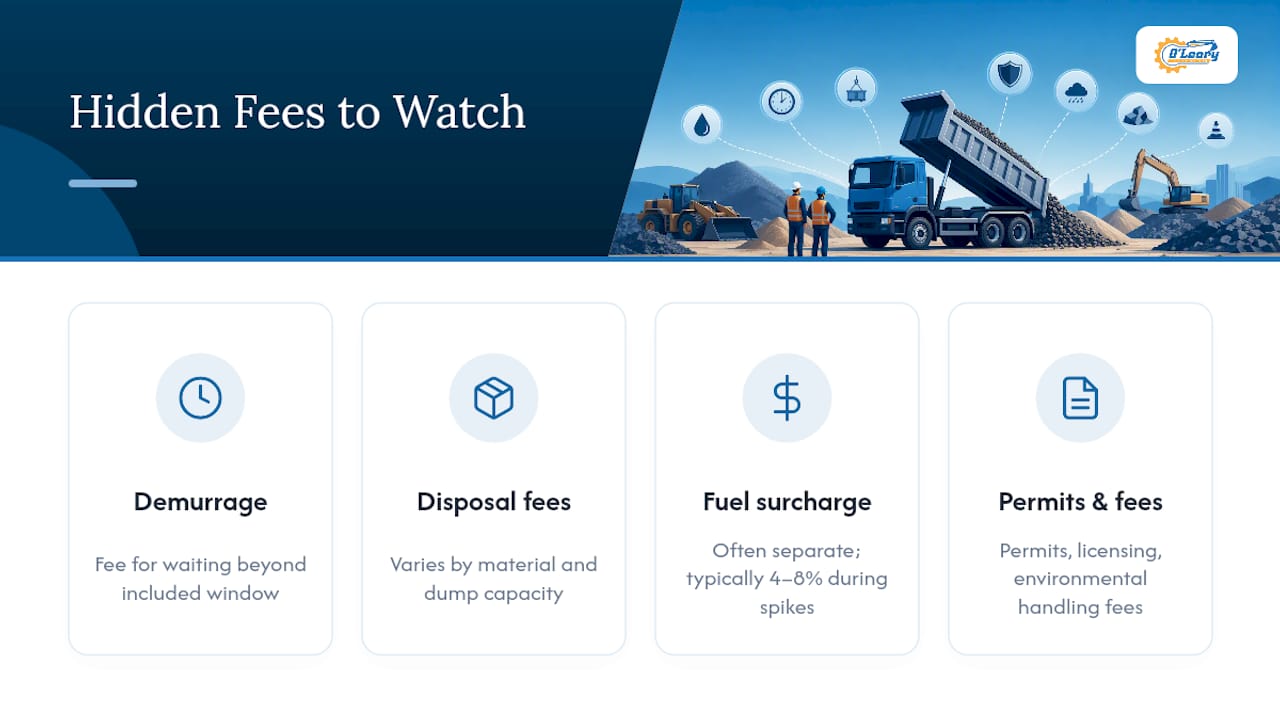
- Fuel surcharges. Diesel volatility pushes many haulers to add a floating surcharge, commonly 4 to 8 percent, rather than rebuild every rate sheet when prices spike.
- Driver pay and overhead. Labor, insurance, registration, and administrative costs all factor into an accurate hauling quote, and a lowball number that skips these is a sign the hauler is underpricing the job.
- Disposal fees, demurrage, and access charges. Dump site fees, extended wait time beyond the included window, and tight or unpaved site access can all add line items you won’t see on a bare per-load rate.
How Do You Estimate Your Total Hauling Cost?
Sizing a job correctly before you call anyone saves you from getting quoted for the wrong number of loads. Here’s the workflow:
- Measure your volume in bank cubic yards (BCY). This is the material as it sits undisturbed in the ground, which is how most excavation estimates start.
- Convert to loose cubic yards (LCY). Once material is dug up, it expands. Common earth swells 20 to 30 percent, so 100 BCY of dirt becomes roughly 120 to 130 LCY once loaded.
- Pick your truck size and divide. If you’re using a tri-axle rated around 14 cubic yards per load, 125 LCY ÷ 14 gives you about 8.9 loads. Round up and add a small buffer for spillage or compaction differences.
- Apply your rate. Multiply your estimated loads by a sample per-load rate, say $150 for a medium-haul job, and add any known mileage or disposal surcharge.
Quick statistic: at a $150 per-load rate for 9 loads, that’s $1,350 before surcharges, which lines up with the $130 to $200 mid-size metro tier for a job of this size.
Pro Tip: Always confirm the exact capacity of the truck a hauler plans to send before you finalize your load count. A “standard truck” quoted at 14 yards versus one that actually holds 10 can throw your entire estimate off by two or three loads.
How Do You Get an Accurate Dump Truck Quote?
The number you get back is only as good as the information you hand over. Give a hauler your site address, access conditions (gate width, slope, overhead lines), material type, estimated volume, preferred delivery window, and whether you need spoil hauled away or disposed of.
- Ask what truck size they’re sending and its rated capacity.
- Ask how much wait time is included before demurrage kicks in.
- Ask for proof of insurance and how invoicing works, especially if you’re setting up a recurring account.
- Ask whether disposal fees are itemized separately or already baked into the per-load rate.
Volume discounts are real leverage. Bundling multiple material types into one scheduled window, or committing to a set number of loads over a project, often gets you a better rate than one-off calls. Get every quote in writing. A hauler who won’t state their wait-time policy or can’t produce insurance documentation on request is a red flag worth walking away from.
Pro Tip: Small orders cost more per ton than full-truck loads because the hauler still eats a full round trip either way. If your job is close to a full-truck quantity, round up rather than ordering short.
How O’Leary Development Group Prices Every Load
O’Leary Development Group runs on transparent per-load pricing across our fleet of tri-axle and larger trucks, so what you’re quoted is what you pay, no surprise line items after delivery. We serve construction, landscaping, and industrial clients across Greater San Antonio with same-day dump truck hauling and online quote requests built for fast turnaround.
A recent example: a landscaping contractor needed roughly 120 LCY of topsoil delivered to a site 12 miles out. Using the workflow above, that penciled out to about 9 loads on a standard tri-axle. We quoted it as a medium-haul job, in line with the $150 to $250 range you’d expect for that distance, with no hidden disposal add-ons because the material was clean fill.
Buying a Dump Truck: Purchase Price vs. Operating Costs
Owning a dump truck involves a much bigger financial commitment than hiring one by the load, and the purchase price is only the entry fee. New dump truck prices vary widely by class and configuration, but that upfront number is often the smallest piece of the long-term math.
Operating costs stack up fast. Diesel fuel, routine maintenance (brakes, tires, hydraulics on the dump bed), commercial insurance, registration, and DOT compliance all recur monthly or annually regardless of how many loads you haul. A single tire blowout or hydraulic pump failure can run into the thousands, and unlike a passenger vehicle, a dump truck’s wear parts take a beating from constant loading and unloading of heavy, abrasive material.