Discover the costs of topsoil delivery, including prices, factors influencing rates, and tips for getting the best deals. Get informed!
San Antonio’s Go-To Material Supplier
Get a Free Per-Load Quote Today
Same-day delivery available · Transparent pricing · Licensed & insured
Bulk topsoil delivery typically runs $20–$50 per cubic yard for screened material, with delivery fees adding $50–$150 per trip in most U.S. markets. A common 5-yard order of screened topsoil works out to roughly $250–$400 total (material plus one delivery fee), assuming a standard dump truck and a site within 15 miles of the supplier. Topsoil puts the delivered range at $20–$80 per yard depending on grade, with delivery consistently landing in that $50–$150 window.
Here is what drives that number up or down:
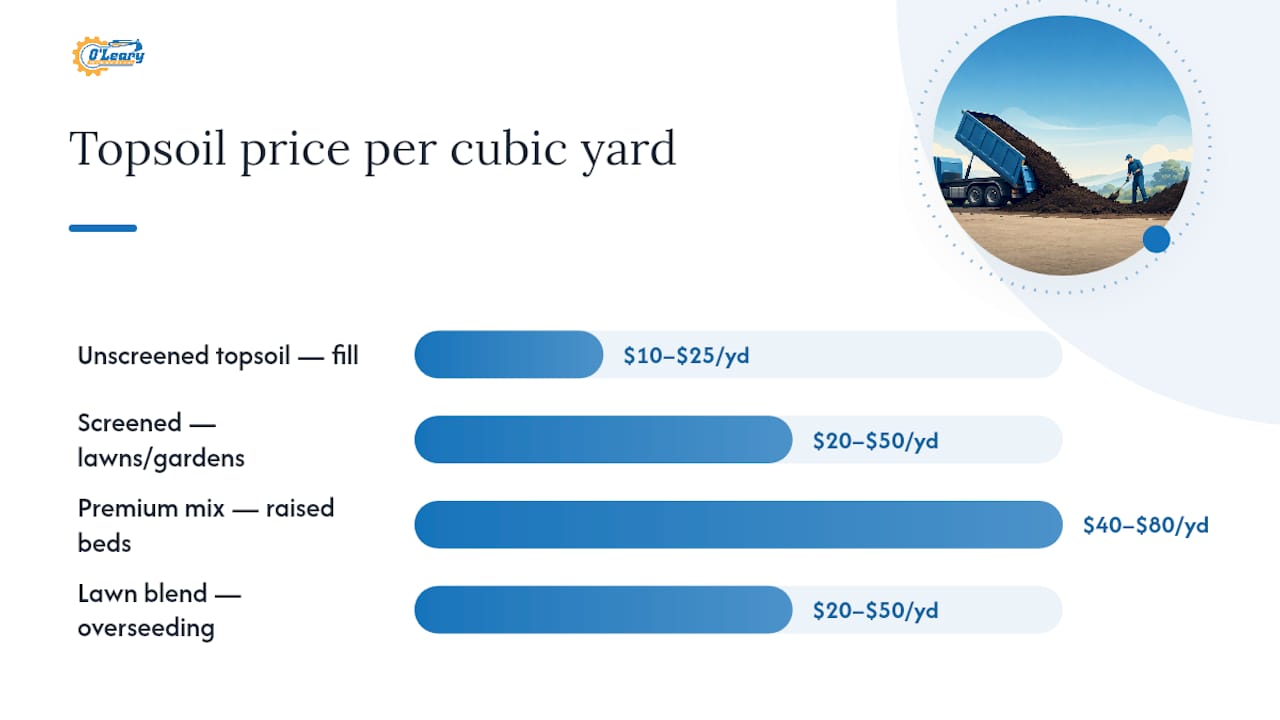
Material grade: Unscreened fill topsoil runs $10–$30/yd; screened topsoil $20–$50/yd; premium blended mixes $40–$80/yd
Delivery distance: Most suppliers include delivery within 10–15 miles; beyond that, expect per-mile surcharges of $2–$5/mile
Order size: Small orders (1–2 yards) often trigger minimum delivery fees that push per-yard cost well above bulk rates
Site access: Tight driveways, soft ground, or long wheelbarrow runs can add access surcharges
For San Antonio-area projects, Olearydevelopmentgroup offers same-day bulk topsoil delivery with transparent per-load pricing and online quotes.
Key Takeaways
Screened topsoil delivered to a standard residential site typically costs $37–$55 per cubic yard all-in, with the delivery fee spread across the order being the single biggest factor in your final per-yard price.
The grade of topsoil you order is the single biggest variable in your per-yard price. According to current bulk pricing data, material alone runs $10–$45 per cubic yard across the U.S., with the spread almost entirely explained by how much processing the soil has gone through.
Topsoil Type
Typical Price per Cubic Yard
Best Used For
Unscreened topsoil
$10–$25/yd
Fill, rough grading, base layers
Screened topsoil
$20–$50/yd
Lawns, gardens, general landscaping
Premium blended (with compost)
$40–$80/yd
Raised beds, new lawn establishment
Lawn soil blend
$20–$50/yd
Overseeding, top-dressing, turf repair
Unscreened material is cheaper because it skips the mechanical screening step that removes rocks, clumps, and debris. That savings disappears fast if you need to hand-pick rocks out of a new garden bed. Screened topsoil costs more per yard but arrives ready to spread, which matters on finish-grade work where surface quality counts.
Premium blended mixes, sometimes called four-way compost or three-way mixes, combine topsoil with compost, sand, and sometimes peat. They carry the highest per-yard price, but for raised beds or new lawn seeding, the added organic matter often eliminates the need for a separate soil amendment order.
Small orders amplify upcharges noticeably. If a screened topsoil upcharge is $10/yd over unscreened, that is $10 extra on a 1-yard order. On a 10-yard order, it is $100. Decide whether the prep labor saved by screened material is worth that difference for your specific job.
Pro Tip:Order a three-way mix for new lawn areas instead of plain screened topsoil. The built-in compost fraction improves drainage and seed germination without a second amendment delivery.
Distance: Most suppliers set a free-delivery radius of 10–15 miles. Beyond that, per-mile fees of $2–$5/mile are common and add up quickly on rural or remote sites.
Minimum-order fees: Many suppliers require 2–3 cubic yards minimum. Orders below that minimum often trigger a short-load fee of $25–$75.
Access surcharges: Blocked driveways, low-clearance gates, or sites requiring a long manual wheelbarrow run may add $50–$150 in labor or equipment charges.
Equipment surcharges: Jobs requiring a skid steer to spread material, or a crane for elevated placement, carry separate equipment fees not included in the base delivery price.
Hourly vs. flat-rate models: Flat-rate delivery is predictable and easier to budget. Hourly models can cost less on fast, clean jobs but run higher if the driver waits on a congested site.
When comparing quotes, always ask whether the delivery fee covers a single curbside dump or includes any placement. A quote that looks $30 cheaper may assume curbside only, leaving you to move several tons of soil by hand.
Pro Tip:If your site is beyond a supplier’s standard radius, ask whether splitting a larger order into one trip (instead of two smaller ones) qualifies for a single delivery fee. Consolidating to one full-truckload run often saves more than the per-mile surcharge adds.
What truck size do you need, and how does it affect cost?
Truck choice determines how many yards arrive per trip and, by extension, how many delivery fees you pay. A standard dump truck carries about 10–12 cubic yards, which covers most residential and mid-size commercial jobs in a single load.
Common delivery vehicles and their typical capacities:
Landscape trailer / small utility truck: 1–3 cubic yards; suited to tight residential access
Single-axle dump truck: 5–8 cubic yards; common for mid-size residential jobs
Standard tandem-axle dump truck: 10–14 cubic yards; the most common bulk delivery vehicle
Tandem-axle or super-dump: 14–20+ cubic yards; used on large commercial or construction sites
When a job requires more than one truck, each trip carries its own delivery fee. A 20-yard order delivered in two standard dump trucks costs two delivery fees, potentially adding $100–$300 to the total versus a single super-dump run.
Access constraints often force a smaller truck than the job would otherwise need. A narrow driveway, a low-hanging tree, or a soft yard that cannot support a loaded tandem-axle truck may require a single-axle or landscape trailer instead. That means more trips, more fees, and more scheduling coordination.
Ready to Order?
Call Now: 210-983-8005
Same-day delivery available on most orders in San Antonio and surrounding cities
Pro Tip:Before scheduling delivery, measure your driveway width and note any overhead obstructions. A standard tandem-axle dump truck needs roughly 10–12 feet of clearance width and 14 feet of overhead clearance. Sharing that information upfront lets the supplier send the right truck the first time.
How do you calculate how many cubic yards you need?
The formula is straightforward: Length (ft) × Width (ft) × Depth (in) ÷ 324 = cubic yards. Dividing by 324 converts the depth from inches and the area from square feet directly into cubic yards in one step, which is faster than converting depth to feet first.
Worked example 1: Garden bed (small)
Area: 20 ft × 10 ft = 200 sq ft
Depth needed: 4 inches
Calculation: 200 × 4 ÷ 324 = 2.47 cubic yards → order 3 yards to account for settling
Most suppliers recommend adding 10–15% to your calculated volume to account for compaction, spreading loss, and uneven subgrade. On a 10-yard order, that means ordering 11–12 yards. Rounding up to the nearest full yard also avoids a second delivery trip for a small shortfall.
Project Type
Typical Depth
Order Overage Recommended
Garden bed fill
4–6 inches
15%
Lawn top-dressing
1–2 inches
10%
Rough grading / fill
6–12 inches
15–20%
Raised bed construction
8–12 inches
10%
What do delivered totals look like for common order sizes?
The numbers below use screened topsoil at $30/yd (mid-range), a flat $75 delivery fee, and a site within 15 miles. They are ballpark figures; your actual quote will vary by region, supplier, and access.
1 cubic yard: $30 material + $75 delivery = $105 total ($105/yd delivered)
3 cubic yards: $90 material + $75 delivery = $165 total ($55/yd delivered)
5 cubic yards: $150 material + $75 delivery = $225 total ($45/yd delivered)
10 cubic yards: $300 material + $75 delivery = $375 total ($37.50/yd delivered)
The per-yard delivered cost drops sharply as order size grows because the delivery fee is spread across more material. A 1-yard order costs nearly three times as much per yard as a 10-yard order, purely because of that fixed trip fee.
Total project costs for 6–10 yard jobs commonly fall in the $150–$500 range depending on region and site access. Premium blended soil or remote delivery can push totals above that range. In San Antonio and surrounding areas, pricing tends to track the national mid-range, though summer heat and active construction seasons can tighten supplier availability and occasionally nudge prices upward.
Screened vs. unscreened vs. blended: which type should you order?
Choosing the wrong grade costs you either money upfront or labor after delivery. Screened topsoil is the right choice for lawns and gardens because it arrives free of rocks, large clumps, and debris. Unscreened topsoil is cheaper but needs onsite prep before it works well in finish-grade applications.
Type
What It Contains
Best Application
Skip It When
Unscreened
Raw dug soil, rocks, clumps
Fill, rough grading
You need a clean finish surface
Screened
Processed, debris-free topsoil
Lawns, gardens, top-dressing
Budget is the only concern
Blended/compost-enriched
Topsoil + compost + amendments
Raised beds, new seeding
You only need bulk fill
Lawn blend
Fine-textured, high organic matter
Overseeding, turf repair
Heavy fill or grading work
The labor trade-off on unscreened material is real. Removing rocks and breaking up clumps from a 5-yard pile by hand takes several hours. If your time has any value, screened topsoil often pays for itself in avoided labor, even at $10–$15 more per yard.
Blended mixes carry the highest price but eliminate a second amendment delivery on projects where soil quality matters. For a new lawn or a vegetable garden, the organic matter in a four-way compost blend improves water retention and root development in ways that plain screened topsoil cannot match.
Pro Tip:Order a single yard from any new supplier before committing to a full truckload. Check the texture, confirm there are no large rocks or debris, and verify the color and smell (good topsoil smells earthy, not sour). A $30–$50 trial yard is cheap insurance against a 10-yard disappointment.
How can you reduce your total topsoil cost?
Volume, timing, and logistics each offer real savings. The biggest lever is order size: spreading the delivery fee across more yards is the fastest way to lower your per-yard delivered cost.
Order a full truckload when possible. A standard dump truck holds 10–12 yards. Filling it completely means one delivery fee instead of two partial trips.
Combine orders with neighbors. If a neighbor also needs topsoil, splitting a single truckload cuts the delivery fee in half for both parties.
Order in the off-season. Late fall and winter typically see lower demand, and some suppliers offer reduced rates or waive short-load fees during slower periods.
Choose pickup over delivery for small orders. If you have a trailer or a pickup truck, collecting 1–2 yards yourself eliminates the delivery fee entirely. Many suppliers sell by the yard at their yard gate.
Accept less-screened material for fill layers. Use unscreened topsoil for the bottom 6–8 inches of a deep fill job and screened material only for the top 2–3 inches. You pay premium rates only where they matter.
Getting at least three quotes is worth the 15 minutes it takes. Prices for the same screened topsoil can vary by $10–$20 per yard between suppliers in the same metro area, and delivery fees vary even more. Always confirm what each quote includes: material spec, load size, delivery radius, unload method, and whether the total is fixed or subject to fuel surcharges.
What should you ask any supplier before placing an order?
A few direct questions before you commit can prevent invoice surprises. Ask every supplier:
What is the exact material spec (screened, unscreened, blended, organic content)?
How many cubic yards per load, and is the load weight-certified?
What is the delivery fee, and what radius does it cover?
Are there per-mile charges beyond that radius?
Is the unload method curbside dump only, or does it include placement?
Are there access surcharges for tight driveways, soft ground, or long runs?
What is the minimum order, and is there a short-load fee below that minimum?
Is the quoted total fixed, or subject to fuel or weight surcharges?
How long is the quote valid?
Two quick script lines that save time on the phone:
“Can you give me a line-item quote showing material, delivery, and any access fees separately?”
“Is there anything about a standard residential driveway delivery that would add charges not in this quote?”
If a supplier quotes an open-ended hourly delivery rate with no cap, or cannot specify the load size per dump, get a second quote. Vague specs on either point are the most common source of invoices that run 30–50% above the original estimate.
Pro Tip:Ask the supplier to confirm the dump location on arrival before the truck backs in. Marking the spot with spray paint or stakes takes two minutes and prevents a misplaced pile that requires a second machine to move.
Schedule Delivery in Minutes
Get Your Free Quote Today
Tell us your location, access, and estimated yardage — we’ll handle the rest
How this guide’s estimates were calculated
The price ranges and sample totals in this guide are based on the following assumptions:
Material price: Screened topsoil at $20–$50/yd (national mid-range); unscreened at $10–$25/yd; premium blended at $40–$80/yd
Delivery fee: $50–$150 flat per trip, based on a site within 15 miles of the supplier
Truck size: Standard tandem-axle dump truck, 10–12 cubic yards per load
Unload method: Curbside dump, no placement or spreading included
Region: National U.S. ranges, with San Antonio-area pricing used for local examples
Primary data sources include Angi’s topsoil cost data, Topsoil.com’s pricing guide, and YardCalc’s per-yard benchmarks. Regional pricing can vary by 20–40% from these national ranges depending on local supplier density, fuel costs, and seasonal demand. Rural sites, premium blended mixes, or access-constrained deliveries will push totals above the figures shown here.
For San Antonio-specific pricing and same-day availability, the sample totals in this guide align with Olearydevelopmentgroup’s local delivery data for the Greater San Antonio area.
What local haulers see most often on delivery day
The three surprises that show up most often on delivery day are access issues, weight and moisture problems, and last-minute site changes.
Access issues are the most common. A customer confirms a “standard driveway” on the phone, but the truck arrives to find a low-hanging oak branch, a parked car blocking the approach, or a recently rained-on yard that cannot support a loaded tandem-axle truck. Any of those scenarios can mean a smaller truck, a second trip, or a manual off-load, all of which add cost and time.
Weight and moisture surprises catch people off guard. Topsoil that has been sitting in a supplier’s yard after rain can weigh significantly more per yard than dry material. A “10-yard” order by volume may hit weight limits before the truck is full, meaning you receive less material than expected. Ask your supplier whether loads are sold by volume or weight, and whether wet-weather orders are adjusted.
Last-minute site changes, like deciding to move the dump spot after the truck has already backed in, or adding a second drop location mid-delivery, often trigger additional fees or require rescheduling. Mark your dump spot clearly before the truck arrives. Spray paint, stakes, or even a few cones work well. Tell the driver exactly where you want the pile before the truck moves into position.
Olearydevelopmentgroup delivers topsoil across Greater San Antonio
Ordering bulk topsoil in San Antonio does not have to mean chasing three phone quotes and waiting a week for a callback.
Olearydevelopmentgroup handles dump truck hauling and bulk material delivery across Greater San Antonio with same-day availability, GPS-tracked trucks, and per-load pricing you can see before you commit. There are no vague hourly rates and no surprise fuel surcharges buried in the invoice. You get a clear total upfront.
To get a fast quote, have these four things ready: your delivery address, the number of cubic yards you need, your preferred delivery date, and any access notes (gate width, overhead clearance, soft ground). Submit that information through the online quote form, and the team can confirm availability and pricing the same day. Contractor accounts with net-30 invoicing are available for landscaping companies and construction crews with recurring material needs.
Sources
The estimates and ranges in this guide draw from the following primary sources:
For regional pricing specific to San Antonio and surrounding cities, local supplier pages and direct quotes from providers like Olearydevelopmentgroup will give you the most accurate current numbers.
FAQ
How much is a load of topsoil delivered?
A standard dump truck load of screened topsoil (10–12 cubic yards) typically costs $250–$400 delivered, depending on material grade, distance, and region. Delivery fees alone run $50–$150 per trip on top of the material price.
Is it cheaper to buy bags of topsoil or have it delivered?
Bulk delivery is almost always cheaper for orders above 2–3 cubic yards. Bagged topsoil at a home improvement store runs $4–$7 per 40-lb bag, which works out to roughly $100 or more per cubic yard, compared to $20–$50/yd for bulk screened topsoil delivered.
How many 40-lb bags of topsoil equal a cubic yard?
One cubic yard of topsoil varies in weight depending on moisture content, so it takes roughly 25 or more standard 40-lb bags to equal one cubic yard.
How many wheelbarrows are in 2 yards of topsoil?
A standard contractor wheelbarrow holds about 3–4 cubic feet. Since a cubic yard is much larger, 2 cubic yards require multiple wheelbarrow loads, typically over a dozen.
What is the minimum order for topsoil delivery?
Most suppliers require a minimum of 2–3 cubic yards for delivery. Orders below that minimum often trigger a short-load fee of $25–$75 on top of the standard delivery charge.