Hauling Insurance Requirements: What to Check First
O'Leary Development GroupAugust 18, 2026
Ensure your dump truck operates smoothly by checking essential hauling insurance requirements. Learn to verify coverage and protect your assets!
San Antonio’s Go-To Material Supplier
Get a Free Per-Load Quote Today
Same-day delivery available · Transparent pricing · Licensed & insured
Before any dump truck rolls onto your site, get three things: a current Certificate of Insurance (COI) that lists you as certificate holder or additional insured, commercial auto liability coverage at limits contractors commonly request—frequently at one million dollars or more, and proof of cargo or physical-damage coverage if the hauler carries your material or your financed equipment. Then verify it. That’s the whole job in one sentence.
The verification step is what most people skip, and it’s the one that actually matters. Call the insurance company listed on the COI, not the hauler, and confirm the policy number, the effective and expiration dates, and that any endorsements the certificate claims were actually issued. A COI is a piece of paper. A confirmed policy is protection.
Here’s the short version to keep on your phone before a truck shows up:
Request a COI naming you (or your company) as certificate holder or additional insured.
Confirm commercial auto liability, typically $1,000,000 combined single limit for most contractor jobs.
Ask for motor truck cargo coverage if the hauler is moving your dirt, gravel, or stone.
Verify workers’ compensation if the hauler sends a crew, not just a solo driver.
Call the insurer directly using the phone number printed on the certificate.
At O’Leary Development Group, we treat this checklist as standard practice, and we’d rather a customer ask us for proof than assume it. Pricing context for these coverages varies by fleet size and risk, and the NAIC’s commercial vehicle market overview is a decent place to see how carriers price this class of risk nationally.
Key Takeaways
Confirming a hauler’s coverage takes three steps: request a COI naming you as additional insured, verify it by phone with the insurer, and match the limits to your contract, not the state minimum.
Point
Details
Require the right documents
Get a COI listing you as certificate holder or additional insured before the truck arrives.
Confirm the $1,000,000 standard
Most contractor and GC screening defaults to $1,000,000 auto liability, even above legal minimums.
Verify by phone
Call the insurer on the COI to confirm policy numbers, dates, and issued endorsements.
Ask for cargo coverage explicitly
Motor truck cargo or inland marine protects your material, but generic wording often excludes it.
Match limits to the contract
Municipal or high-exposure jobs may require limits and endorsements above the standard checklist.
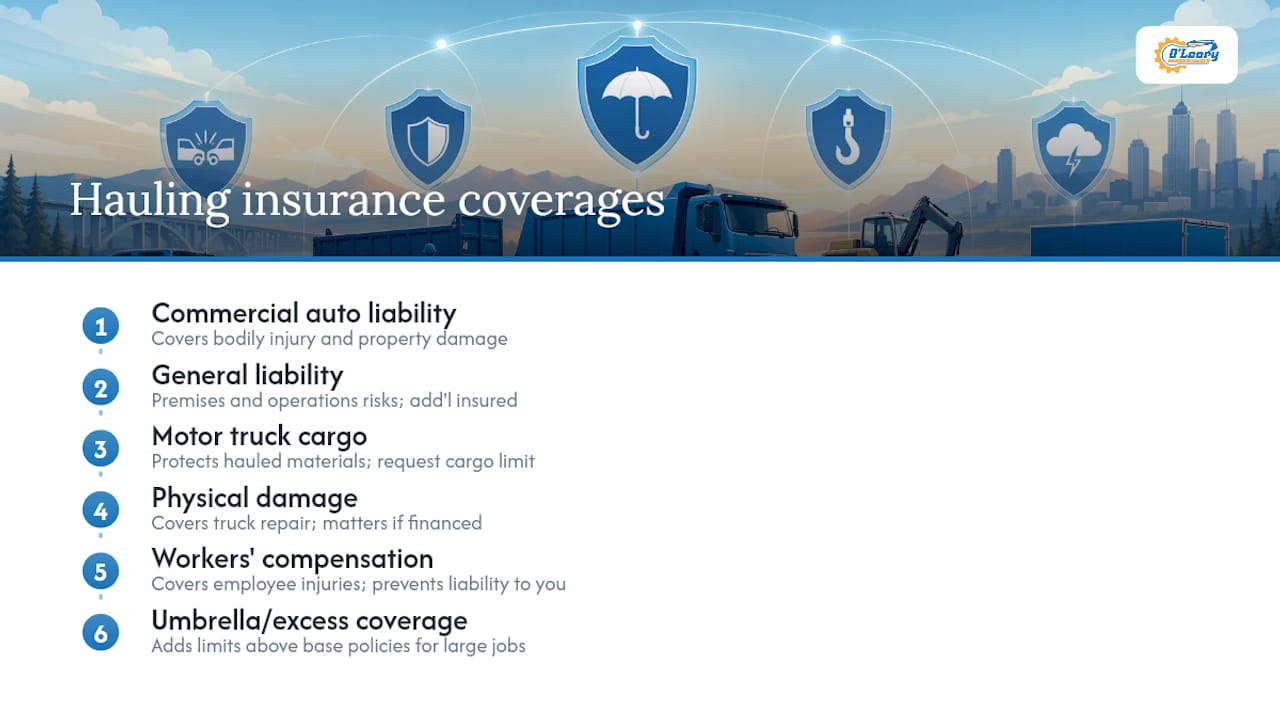
A legitimate local hauling operation carries several distinct policies, not one blanket “insurance” product. Each one covers a different failure point, and a hauler missing any of them is passing that risk straight to you.
Commercial auto liability is the baseline. It pays for bodily injury or property damage if the truck causes an accident, whether that’s on the highway or backing into your fence. Most general contractors and site managers commonly ask for combined single limit liability coverage of about one million dollars on any vehicle entering a jobsite, even though state minimums for a single dump truck can run far lower. Contract screening, not the legal floor, sets the real standard here.
General liability covers premises and operations exposures, like a driver who trips over a hose or damages a neighboring structure while positioning the truck. Contracts often require additional insured status and primary and noncontributory wording on this policy, meaning the hauler’s coverage responds first, before yours gets touched.
Motor truck cargo, or inland marine coverage, protects the material being hauled. Dump truck programs commonly combine auto liability, cargo, general liability, and physical damage into one package specifically because loose aggregate, dirt, and stone create their own claims history. Don’t accept a vague answer here. Ask for the specific cargo limit in writing.
Ready to Order?
Call Now: 210-983-8005
Same-day delivery available on most orders in San Antonio and surrounding cities
Physical damage coverage (comprehensive and collision) matters most when the truck is financed or leased, but it also matters to you if a delay or breakdown depends on that specific vehicle showing up.
Workers’ compensation applies whenever the hauler employs a driver or laborer rather than working solo as an owner-operator. Skipping this check exposes you to liability if someone gets hurt on your site.
Umbrella or excess coverage adds limits above the base policies, and it’s worth requesting on larger municipal jobs, high-traffic public roadways, or projects where the underlying contract sets limits above $1 million.
What Should You Request From the Hauler?
Ask for the document, then ask for the details on the document. A COI that just says “insured” tells you nothing.
Request these specific items before the truck is scheduled:
Insurer name, phone number, and NAIC or license number.
Policy numbers for each coverage type (auto, GL, cargo, workers’ comp).
Effective and expiration dates for every policy listed.
A description of operations that includes your project address.
Additional insured endorsement on auto and/or GL, if your contract requires it.
Waiver of subrogation and primary and noncontributory language, if applicable.
A Certificate of Insurance is a summary, not a policy. If the certificate doesn’t match your contract’s exact wording, a job site gate or a GC’s compliance officer can reject it on the spot, even when real coverage exists behind it.
Sample language you can copy into an email or purchase order:
Keep it that short. Agents move faster when the ask is precise instead of a paragraph of legal boilerplate.
How Do You Verify a Certificate of Insurance Is Valid?
A COI you haven’t verified is just a claim. Here’s the sequence that turns it into confirmed coverage.
Check the document first. Confirm the insurer name, policy numbers, and effective/expiration dates are filled in, not blank or generic. Match the certificate holder line to your exact legal entity name.
Call the insurer. Use the phone number printed on the COI, ask for the agent if it’s missing, and confirm the policy number, the coverage types, and that any additional insured or waiver endorsement was actually issued on the policy, not just written into the certificate.
Document the call. Save a dated copy of the COI and note who you spoke with at the insurance company. File it with the job record before the truck arrives, not after.
If the phone number is missing, the policy number looks generic, or the insurer can’t confirm the endorsement wording over the phone, don’t let the truck on site until it’s fixed.
Pro Tip:Write a one-line verification script for your dispatch team: “Confirming policy [number] for [hauler name], additional insured status for [project], and endorsement effective as of today.” Reading the same line every time keeps every subcontractor check consistent.
When Should You Require Higher Limits or More Coverage?
The standard checklist covers most residential and small commercial deliveries. Certain situations call for more.
No COI, or one that’s clearly incomplete: refuse the load until it’s fixed.
Mismatched insurer name or policy number between what the hauler tells you and what the certificate shows.
Expired dates, even by a day. Insurance lapses are common at renewal time.
Missing endorsements your contract specifically requires, like additional insured or primary/noncontributory wording.
Refusal to let you call the insurer. A legitimate operation has nothing to hide here.
Raise your required limits above $1,000,000 for high-value material, jobs near schools or hospitals, municipal or public works contracts, or any project where the owner’s contract sets a higher floor. Loads involving contaminated soil or debris may call for pollution liability. Loose aggregate hauling sometimes needs broader cargo wording than a standard policy provides. Some states also treat intrastate proof differently. Kentucky, for example, uses a Form E filing that isn’t interchangeable with a standard COI, so confirm state-specific rules when a job crosses that line. When in doubt, default to whatever your prime contract requires rather than the lowest legal minimum.
Schedule Delivery in Minutes
Get Your Free Quote Today
Tell us your location, access, and estimated yardage — we’ll handle the rest
How O’Leary Development Group Handles Hauler Verification
On a recent same-day aggregate delivery, our dispatch team confirmed the subcontracted hauler’s COI, called the insurer directly, and had an additional insured endorsement added within the hour, so the truck rolled without the client losing a day of site work.
Our internal checklist before any load leaves the yard:
COI on file and matched to the correct legal entity.
Insurer contacted and coverage confirmed by phone.
Additional insured endorsement issued, not just requested.
Vehicle VIN and driver CDL logged against the job.
Signed COI saved to the job folder before dispatch.
Pro Tip:Build your verification packet before you request the COI. Exact legal names, the project address, and the endorsement wording up front cut most turnaround delays to same-day.
Why we require documented coverage on every load
We require documented coverage, not just a promise, because a site denial costs more than the five minutes it takes to verify. Confirmed COIs and quick insurer callbacks keep trucks moving and invoices clean.
Sources
For deeper detail on coverage types and COI templates, review the dump truck insurance requirements guide, sand and gravel hauler coverage costs, and state-specific COI filing rules. A licensed agent should file any binding endorsement or state-specific form.
What Insurance Should I Ask a Hauling Company For?
Ask for commercial auto liability typically at one million dollars, general liability, motor truck cargo coverage, and workers’ compensation if the hauler sends a crew.
What Is a Certificate of Insurance and Why Do I Need One?
A Certificate of Insurance summarizes a hauler’s active policies, including limits and endorsements, and it’s the standard proof contractors request before allowing a truck on site.
How Do I Verify a Hauler’s COI Is Real?
Call the insurance company listed on the certificate, confirm the policy number and dates, and verify that any additional insured or waiver endorsement was actually issued.
What Coverage Limit Do Most Contractors Require?
Most general contractors and job sites commonly ask for commercial auto liability coverage of about one million dollars, even where state legal minimums are lower.
What Red Flags Mean I Should Refuse a Load?
Refuse the load if there’s no COI, the insurer or policy number doesn’t match, the policy is expired, or the hauler won’t let you call the insurer to confirm coverage.