That’s it. A 12 × 40 ft driveway at 4 inches works out to 5.93 cubic yards — round up to 6 to account for compaction and uneven ground. To convert cubic yards to tons, multiply by 1.2–1.5 depending on the material. Most standard driveway gravel runs about 1.36 tons per cubic yard, so those 6 cubic yards come to roughly 8 tons.
How much gravel does a driveway need? Step-by-step calculation
Two formulas do the same job. Use whichever fits the numbers you have on hand.
Formula A (depth in inches): Length (ft) × Width (ft) × Depth (in) ÷ 324 = cubic yards
Formula B (depth in feet): Length (ft) × Width (ft) × Depth (ft) ÷ 27 = cubic yards
Formula A is faster for most homeowners because driveway depth is almost always described in inches. Formula B is what contractors use when they’re already working in decimal feet.
Step 1: Gather your measurements
Before you calculate, collect these inputs:
Length in feet (measure the full driveway run)
Width in feet (measure at the widest point; average if it tapers)
Depth in inches (4" for standard residential; 6" for trucks or poor soil)
Slope adjustment: add 5–10% to your square footage on grades steeper than 10%
Step 2: Calculate cubic yards
Plug your numbers into Formula A. A 12 × 100 ft driveway at 4 inches:
Pea gravel / clean stone: ~1.2 t/yd³ (lighter, rounder)
Standard crushed gravel (#57, #67): ~1.36 t/yd³
Crusher run / road base: ~1.4–1.5 t/yd³ (denser, angular)
So 15 cubic yards of crusher run = 15 × 1.45 = 21.75 tons
Step 4: Convert to 50-lb bags (small repairs only)
One cubic yard equals 27 cubic feet. A 50-lb bag of gravel covers roughly 0.5 cubic feet at 2 inches deep. For anything larger than a patch repair, bags become expensive and impractical fast:
1 cubic yard ≈ 54 bags (50 lb each)
6 cubic yards ≈ 324 bags — that’s why bulk delivery wins for full driveways
What depth of gravel does a driveway actually need?
Depth is where most homeowners under-build. The right answer depends on what’s driving over it and what’s underneath.
Recommended compacted depths by use
Passenger cars, light SUVs: 4 inches compacted total (minimum)
Trucks, RVs, heavy equipment: 6–8 inches compacted
Frost-prone climates: 6–8 inches to prevent heaving
Poor or clay-heavy soil: add a 4-inch compacted sub-base before your gravel layers
Layer structure: base, intermediate, and top dressing
A well-built gravel driveway uses at least two layers, not one thick dump of the same material. The road base layer goes down first:
Ready to Order?
Call Now: 210-983-8005
Same-day delivery available on most orders in San Antonio and surrounding cities
Base layer (3–4"): Crusher run or road base (#2 base). Angular, compacts tightly, locks in place. This is the structural layer.
Top dressing (2–4"): #57 or #67 crushed stone. Cleaner sized, drains well, and gives the surface a finished look.
Optional intermediate layer: On soft or wet ground, a 2–3" layer of larger stone (#2 or #3) between the sub-base and crusher run improves drainage and prevents the base from sinking.
Geotextile fabric between the sub-base and base layer is worth the cost on any site with clay or organic soil. It prevents the layers from mixing over time, which is one of the main reasons gravel driveways develop soft spots after a few years.
Pro Tip:Order 15–25% more than your calculated volume for any layer you plan to compact. Loose gravel compacts down significantly — what looks like 4 inches spread loose often ends up at 3 inches after a plate compactor runs over it. Contractors consistently add this compaction factor on top of a 10% waste allowance, so build both into your order.
Coverage cheat sheet: how far does 1 cubic yard or 1 ton go?
These numbers assume standard driveway gravel at approximately 1.36 tons per cubic yard. Crusher run is denser and will cover slightly less area per ton; pea gravel is lighter and covers slightly more.
The ton-based figures come from standard coverage guidance used across most gravel calculators: one ton covers roughly 120 sq ft at 2 inches and about 60 sq ft at 4 inches.
How to use the table
Measure your driveway’s square footage (length × width).
Pick your target depth from the left column.
Divide your square footage by the coverage figure to get the number of cubic yards or tons needed.
Example 1: 480 sq ft driveway (12 × 40 ft) at 4 inches → 480 ÷ 81 = 5.9 cubic yards → order 6.
Example 2: Same driveway in tons → 480 ÷ 60 = 8 tons.
For irregular driveways, divide the plan into rectangles, calculate each section separately using a gravel calculator, and add the totals. A tapered driveway that’s 10 ft wide at the street and 16 ft wide at the garage averages to 13 ft — use that average width for the full length.
Which type of gravel works best for driveways?
Material choice affects how much you need (density changes your ton calculation), how the driveway performs, and what it costs per load. Here’s how the main options stack up:
Crusher run / road base: The go-to base layer material. Angular particles lock together under compaction and create a stable, load-bearing surface. Tracks into the garage more than clean stone. Dense, so expect ~1.45 t/yd³. Check out #2 road base for a common option.
#57 crushed stone: A clean, 3/4-inch angular stone that drains well and works as a top dressing or intermediate layer. Doesn’t compact into a solid mass, so it stays loose enough to shift under heavy loads without a base layer underneath.
#67 crushed stone: Slightly smaller than #57, similar uses. Good for top dressing on residential driveways with light traffic.
Pea gravel: Round, smooth, and attractive — but it rolls under tires and migrates to the edges over time. Fine for decorative borders or foot paths; not recommended as the main driving surface for vehicles.
Decomposed granite (DG): Packs firm and looks natural. Works well in dry climates. Gets muddy and soft when saturated, so it’s a poor choice in areas with heavy rainfall.
Recycled concrete: Budget-friendly and surprisingly durable as a base layer. Irregular sizing means density varies, so get a ton estimate from your supplier rather than relying on standard conversion tables.
For most residential driveways, the winning combination is crusher run or road base for the bottom layer and washed, crushed gravel for the top.
How to estimate cost and how much to order
Gravel pricing varies significantly by region, so treat any number here as a starting point, not a quote. Material costs depend on stone type, haul distance from the quarry, and local market conditions. Always get a local price before budgeting.
That said, here’s what to expect in broad terms:
Crushed stone and limestone typically run in the range of $25–$45 per ton for the material itself, before delivery
Delivery fees vary by load size and distance — check the cost per load for local rates
Buying by the dump-truck load is almost always cheaper per ton than ordering partial loads
Dump-truck load sizes
A standard single-axle dump truck carries roughly 7–10 cubic yards (10–14 tons). A tandem-axle or tri-axle truck holds 14–16 cubic yards (19–22 tons). Most residential driveway projects fall in the 1–3 load range.
Ordering rules that prevent waste and shortfalls
Round up to the next half-yard when your supplier sells in half-yard increments
Add 10% for waste (spread loss, grading, and edge spillage)
Add 15–25% for any layer you’re compacting — loose volume shrinks under a plate compactor
Order both layers separately if you’re doing a two-layer install; base and top materials have different densities
Quick budget example: A 12 × 100 ft driveway with a 4" base of crusher run and a 4" top of #57 stone needs about 30 cubic yards total, or roughly 42 tons across both layers. At two truckloads of material, you’re looking at a meaningful but manageable delivery schedule — base layer first, compact, then top layer.
Suppliers sometimes quote in tons, sometimes in cubic yards. When you call, ask for both units so you can cross-check the order against your calculations.
Site preparation and installation basics
Getting the gravel calculation right is only half the job. Poor prep is the reason most gravel driveways fail early.
Prep checklist before the first load arrives
Clear all vegetation, roots, and organic material from the driveway footprint
Grade the surface to slope away from structures (minimum 1–2% grade, or about 1/8" per foot)
Establish drainage channels or culverts before gravel goes down
Install edging (timber, steel, or concrete) to keep gravel from migrating laterally
Lay geotextile fabric on clay or soft soil before the base layer
Compact the native subgrade with a plate compactor or roller before any gravel is placed
Installation sequence
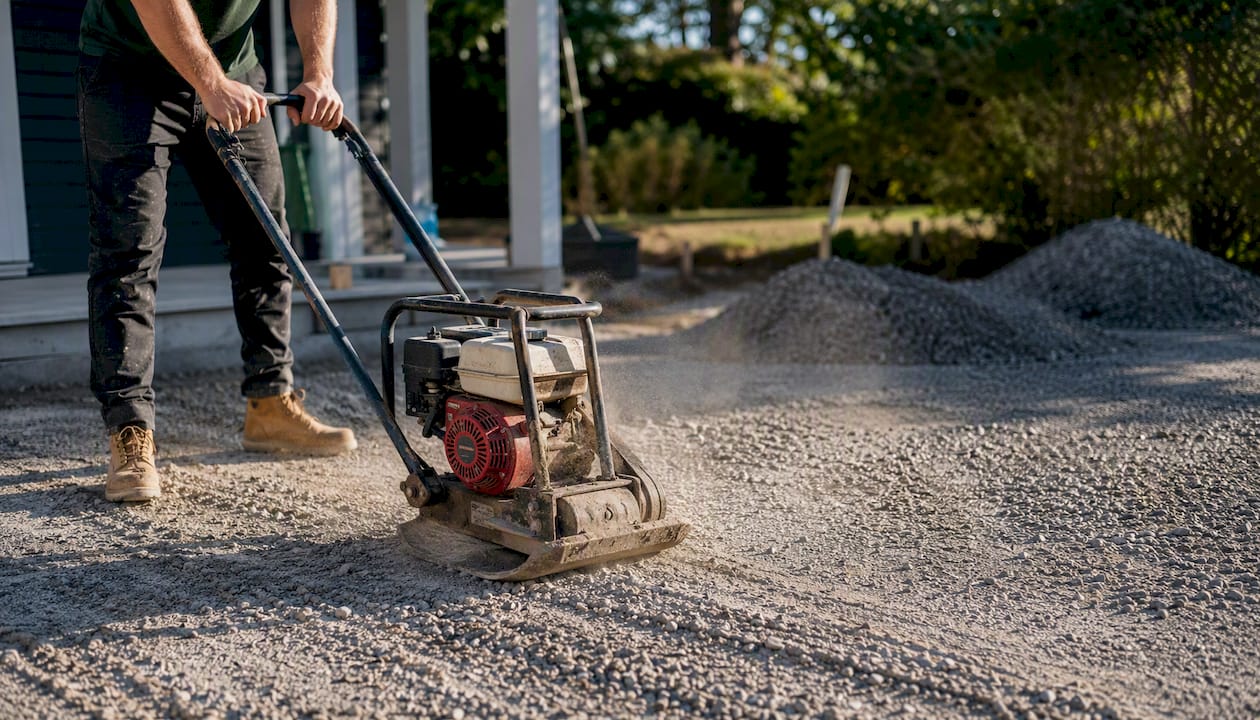
Spread the base layer (crusher run or road base) to a loose depth of 5–6 inches, which compacts to roughly 4 inches.
Compact in two passes with a plate compactor, working from the edges toward the center.
Check depth and add material where needed, then compact again.
Spread the top dressing layer (2–4" loose) and compact lightly — enough to seat the stone without crushing the surface texture.
Allow 24–48 hours before regular vehicle traffic.
Common mistakes that cost money
Skipping compaction on the subgrade: Gravel placed on loose or soft native soil will sink and shift within one season.
Ignoring drainage: Water pooling under a gravel driveway is the fastest way to create soft spots and ruts.
Single-layer installs on poor soil: One thick layer of the same material doesn’t perform as well as two thinner, differentiated layers.
For measuring an irregular or tapered driveway, divide the shape into rectangles, calculate each section, and sum the areas. Use the average width for any section that tapers gradually.
Worked examples for common driveway sizes
Example 1: Small single-car driveway (12 × 40 ft, 4" depth)
Convert to tons: 70 × 1.45 (road base density) = 101.5 tons
Delivery: 5–7 truckloads depending on truck size; stage loads at the road end and spread progressively toward the structure
For partial resurfacing or repairs, measure only the affected area and target a 2-inch top-up depth. Apply the same formula, skip the compaction factor (you’re not building a base), and add 10% for waste.
Practical delivery and ordering tips
Knowing your cubic yards is only useful if the delivery goes smoothly. A few logistics details make the difference between a clean drop and a damaged lawn.
Schedule Delivery in Minutes
Get Your Free Quote Today
Tell us your location, access, and estimated yardage — we’ll handle the rest
Truck capacities at a glance
Truck Type
Typical Capacity (cubic yards)
Approximate Tons
Single-axle dump
7–10 yd³
10–14 tons
Tandem-axle dump
14–16 yd³
19–22 tons
Tri-axle dump
16 yd³
22–25 tons
Before you place the order
Confirm your driveway or access road can support a loaded dump truck (typically 60,000–80,000 lbs gross)
Identify a clear staging area at least 20 ft long for the truck to maneuver and tip
Measure any overhead clearance (trees, power lines) along the delivery path
Communicate your measurements in both cubic yards and tons when you call — suppliers sometimes quote in one unit and deliver in another
Request a specific delivery window and have someone on-site to direct placement
On-site during delivery
Stand well clear of the truck’s rear during tipping — material can shift unexpectedly
Use plywood sheets under the truck’s rear wheels if the ground is soft or you’re protecting an existing surface
Have a rake and a helper ready to spread material immediately after each drop, especially if you’re staging multiple loads in sequence
For hauling logistics and staging tips on larger projects, planning the sequence of loads before the first truck arrives saves significant time.
Bulk delivery vs. bagged gravel: which actually makes sense?
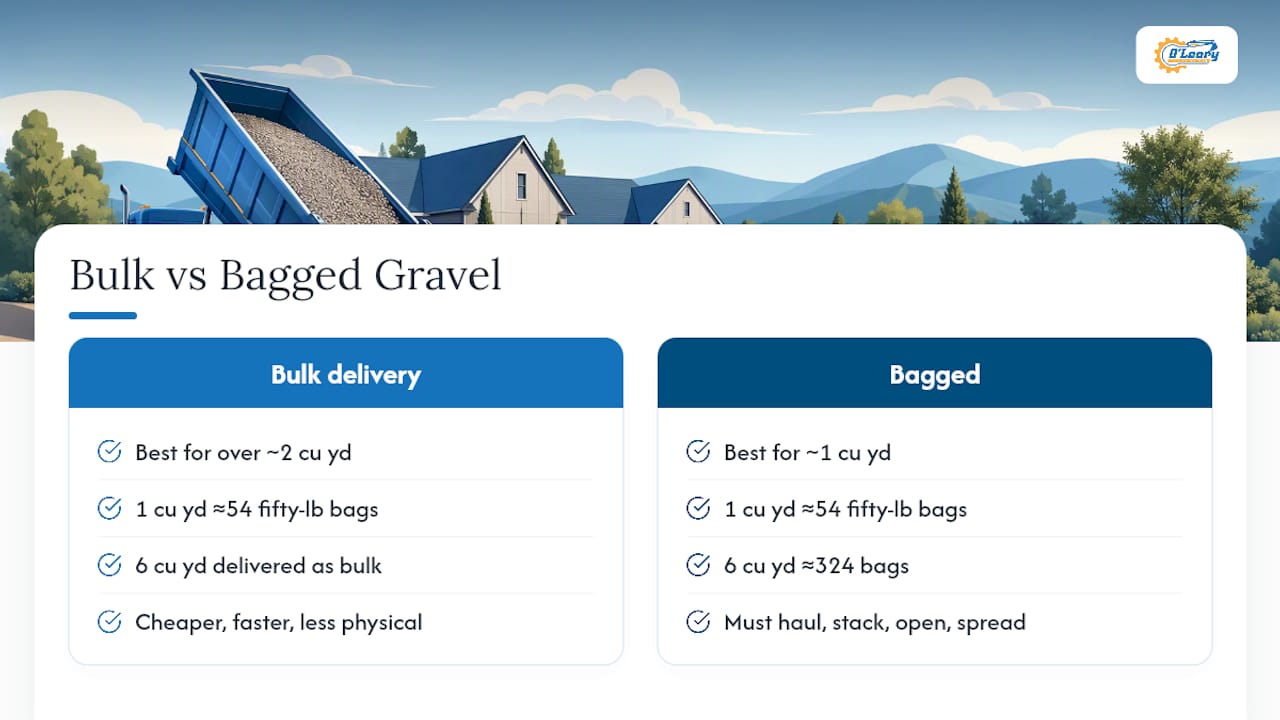
Bags look convenient at the hardware store, but the math turns against them quickly. A single cubic yard of gravel requires roughly 54 fifty-pound bags. For a 6-cubic-yard driveway, that’s 324 bags to haul, stack, open, and spread — plus the per-bag premium that makes bulk delivery the obvious choice for any project over about 2 cubic yards.
Where bags do make sense: patching a 10-square-foot pothole, adding a thin decorative top dressing to a small section, or touching up a border area where a truck can’t access. For anything that needs a full layer across the driveway’s width, bulk is cheaper, faster, and less physically demanding.
The one nuance worth knowing: some suppliers sell bulk in half-yard increments with a minimum order of 2–3 yards. If your repair genuinely needs only 1 yard, bags might be the only practical option unless a local supplier will do a small partial load. Call ahead and ask — minimum order policies vary widely.
Ready to order bulk gravel for your driveway?
Once your calculations are done, the next step is getting the right material delivered to your site without the hassle of multiple trips to a hardware store.
Olearydevelopmentgroup offers dump truck hauling and bulk material delivery across Greater San Antonio, with same-day and next-day scheduling, transparent per-load pricing, and GPS-tracked trucks so you know exactly when your material arrives. Whether you need crusher run for a base layer, #57 stone for a top dressing, or a full two-layer delivery staged across two days, the team handles the logistics.
Before you call or submit an online quote request, have these ready:
Driveway dimensions (length × width in feet)
Target depth and number of layers
Material preference (road base, crushed stone, limestone)
Site access notes (overhead clearance, soft ground, gate width)
One ton covers approximately 120 sq ft at 2 inches deep and about 60 sq ft at 4 inches deep, based on standard driveway gravel at roughly 1.36 tons per cubic yard.
How much does a 100 ft gravel driveway cost?
A 12 × 100 ft two-layer driveway needs roughly 30–42 tons of material total. Material costs vary by region and stone type, so get a local quote — delivery fees and per-ton pricing differ significantly from one market to the next.
How much does a dump truck load of gravel cost?
A single-axle load (7–10 cubic yards) and a tandem-axle load (14–16 cubic yards) are the two most common sizes. Pricing depends on material type, haul distance, and local market rates. Olearydevelopmentgroup offers transparent per-load pricing for bulk gravel delivery across Greater San Antonio — request a quote for a current figure.
How much does a 20 × 20 gravel driveway cost?
A 20 × 20 ft pad at 4 inches needs about 5 cubic yards. Material cost depends on stone type and your region, add delivery fees on top of the material price when budgeting.
Do I need geotextile fabric under my gravel driveway?
On clay-heavy or soft soil, geotextile fabric between the subgrade and base layer prevents the layers from mixing over time and significantly extends the driveway’s life. It’s optional on firm, sandy, or well-draining native soil.