Topsoil vs. Fill Dirt: Order the Right Material for the Job
O'Leary Development GroupOctober 15, 2026
Topsoil and fill dirt serve completely different purposes in construction and landscaping projects. Understanding the physical differences between these materials will save you time, money, and headaches on your next San Antonio-area project.
San Antonio’s Go-To Material Supplier
Get a Free Per-Load Quote Today
Same-day delivery available · Transparent pricing · Licensed & insured
Topsoil vs. Fill Dirt: Order the Right Material for the Job
Last month, we delivered 15 yards of material to a homeowner in Bulverde who was excited to start a new backyard garden. The problem? He’d ordered fill dirt instead of topsoil. When our driver arrived and the customer realized the mistake, we had an honest conversation about the difference between these two materials. He thought all “dirt” was the same. By the end of that conversation, he understood why his tomatoes wouldn’t grow in compacted subsoil—and we scheduled a second delivery of proper topsoil the next day. That simple mix-up cost him time and an extra delivery fee, but it taught us something important: most people don’t know the difference between topsoil and fill dirt until it’s too late.
We see this confusion constantly across San Antonio, New Braunfels, and the surrounding Hill Country. Contractors, homeowners, and even some landscapers order the wrong material because they assume dirt is dirt. But topsoil and fill dirt are fundamentally different products with completely different purposes. Using fill dirt where you need topsoil—or vice versa—can derail your project, waste money, and create problems that take months to fix.
In this guide, we’ll walk through the real differences between topsoil and fill dirt, explain exactly when to use each material, and show you how to order the right amount for your project. Whether you’re building a foundation in Boerne, leveling a driveway in Seguin, or installing garden beds in New Braunfels, understanding these materials will help you get the job done right the first time.
Understanding the Difference: Topsoil vs. Fill Dirt for Your Project
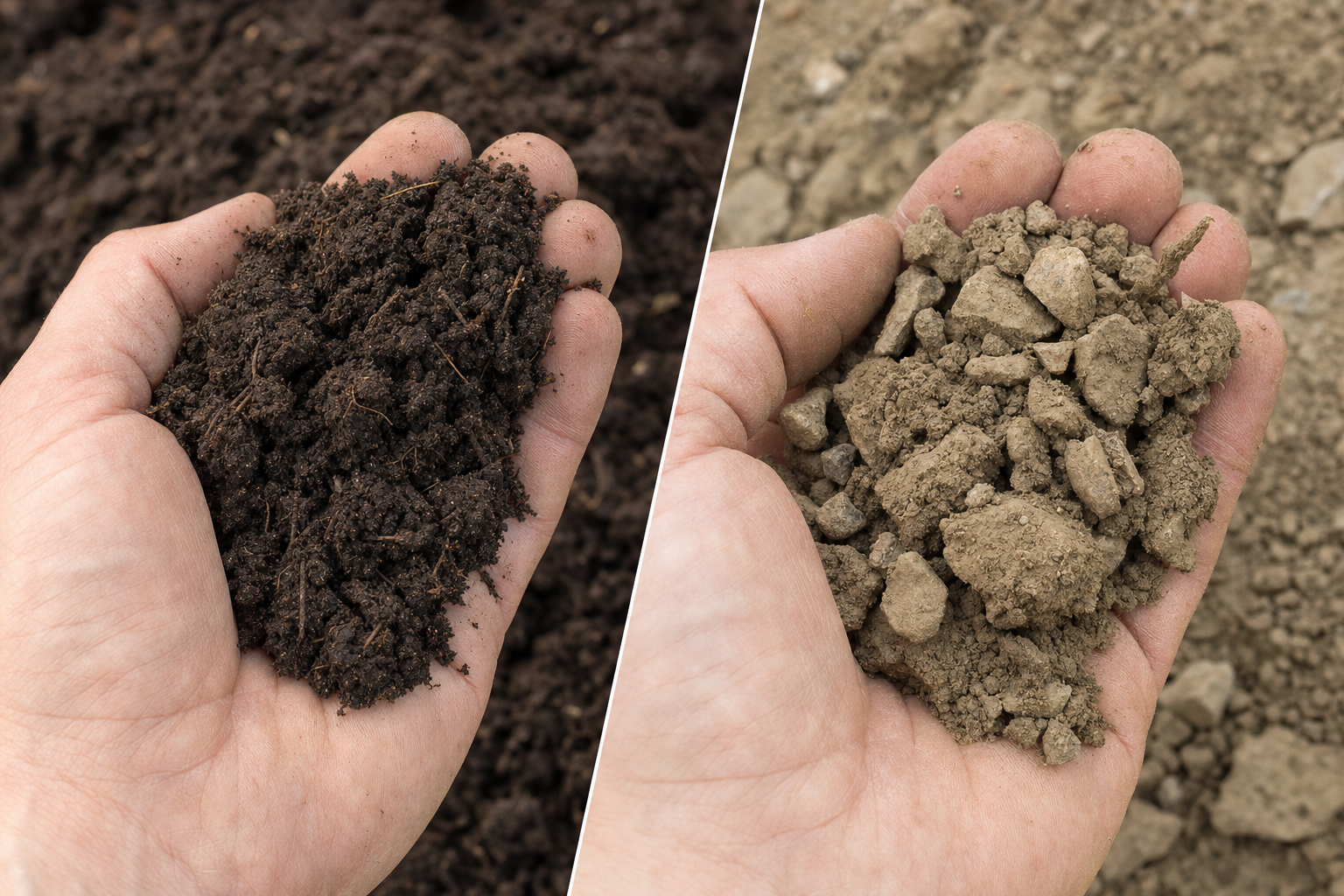
The difference between topsoil and fill dirt comes down to where each material originates and what it contains. Topsoil is the uppermost layer of earth—usually the top 2 to 8 inches of ground. This layer contains organic matter, decomposed plant material, microorganisms, and nutrients that support plant growth. When you dig into topsoil, you’ll see a darker color, a looser texture, and sometimes visible organic material like roots or decomposed leaves.
Fill dirt, on the other hand, comes from deeper layers below the topsoil. This subsoil contains little to no organic matter. It’s primarily composed of clay, sand, and broken-down rock. Fill dirt is denser and more stable than topsoil because it lacks the organic content that breaks down and shifts over time. In the San Antonio region, fill dirt often contains caliche—a hardened calcium carbonate layer common in South and Central Texas—which makes it especially useful for compaction and structural support.
Physical Composition and Properties
Topsoil is biologically active. It drains well, retains moisture, and provides the environment plants need to establish roots and access nutrients. Quality topsoil should be screened to remove large rocks and debris, but it should retain organic content. When you grab a handful of good topsoil, it should hold together slightly when squeezed but crumble easily. You’ll often see earthworms, insects, and small root fragments—all signs of healthy, living soil.
Fill dirt is geologically stable. It compacts tightly, doesn’t shift or settle significantly, and provides a solid base for construction. Because it contains almost no organic material, fill dirt won’t decompose, shrink, or create voids over time. This stability makes it ideal for supporting structures, but it also makes it terrible for growing anything. Fill dirt in the Hill Country is often heavy clay mixed with limestone fragments, which compacts into an almost concrete-like surface when properly graded and compacted.
Property
Topsoil
Fill Dirt
Organic Content
High (5-10% or more)
Minimal to none
Nutrient Level
Rich in nitrogen, phosphorus, potassium
No significant nutrients
Compaction
Poor (settles and shifts)
Excellent (stable and dense)
Drainage
Good (retains moisture but drains excess)
Variable (clay-heavy fill drains poorly)
Color
Dark brown to black
Tan, red, gray, or light brown
Primary Use
Landscaping, gardening, planting
Foundations, grading, structural fill
Cost Per Yard
Higher (more processing required)
Lower (abundant and minimal processing)
Common Misconceptions About Dirt
Many people assume that if material comes out of the ground, it’s all basically the same. We’ve had customers ask for “cheap dirt” without specifying what they need it for, then get frustrated when we ask follow-up questions. But the wrong material creates expensive problems. Fill dirt used in garden beds will compact into a hardpan that roots can’t penetrate. Topsoil used under a concrete slab will compress and settle, cracking the foundation. Each material has specific engineering and biological properties that make it right for certain applications and completely wrong for others.
Another misconception is that you can just add fertilizer to fill dirt and turn it into topsoil. That doesn’t work. Organic matter isn’t just about nutrients—it’s about soil structure, microbial life, drainage, and root development. You can’t replicate years of natural decomposition and biological activity by dumping some fertilizer on subsoil.
Topsoil vs. Fill Dirt: How to Choose the Right Material for San Antonio Landscaping
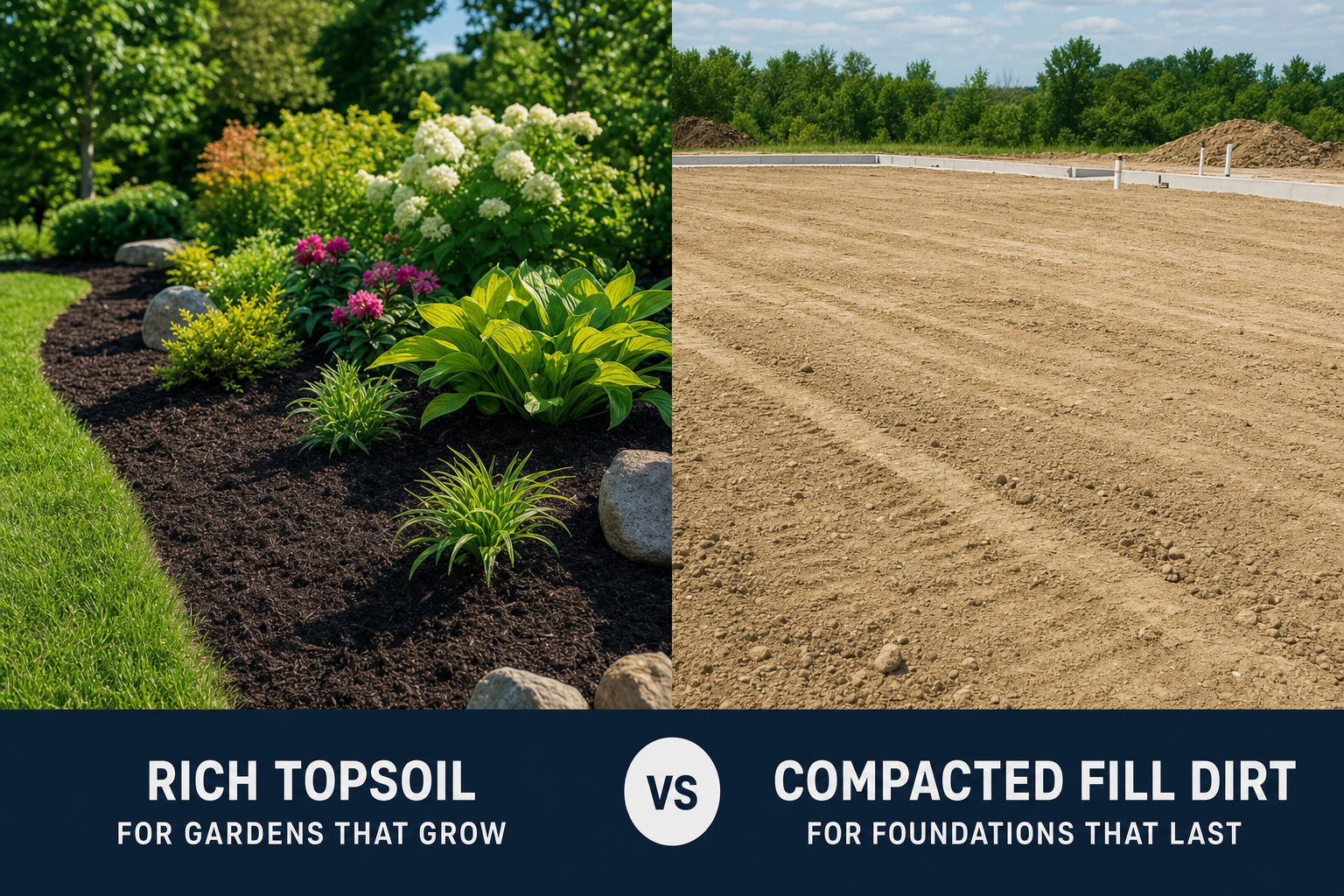
Choosing between topsoil and fill dirt starts with one simple question: what are you trying to accomplish? If you need to grow something, you need topsoil. If you need to support something, you need fill dirt. Understanding your project’s purpose will immediately point you toward the right material.
When to Use Topsoil
Topsoil is the material of choice for any project where plant growth is the goal. We deliver topsoil across New Braunfels, San Marcos, and the Hill Country for landscaping installations, garden bed construction, lawn establishment, and anywhere customers want vegetation to thrive.
Common topsoil applications include:
Building raised garden beds for vegetables or flowers
Topdressing existing lawns to improve soil quality
Creating planting areas around new homes or commercial properties
Amending poor-quality native soil before landscaping
Filling in low spots in yards where grass won’t grow
Establishing new lawns from seed or sod
Planting trees, shrubs, and ornamental plants
In the San Antonio area, native soil is often caliche-heavy with very low organic content. Most residential landscaping projects require imported topsoil to create an environment where plants can actually establish. We see this especially in new construction developments around Boerne and Bulverde, where builders strip away the existing topsoil during grading and homeowners need to bring in quality topsoil to start their yards.
When to Use Fill Dirt
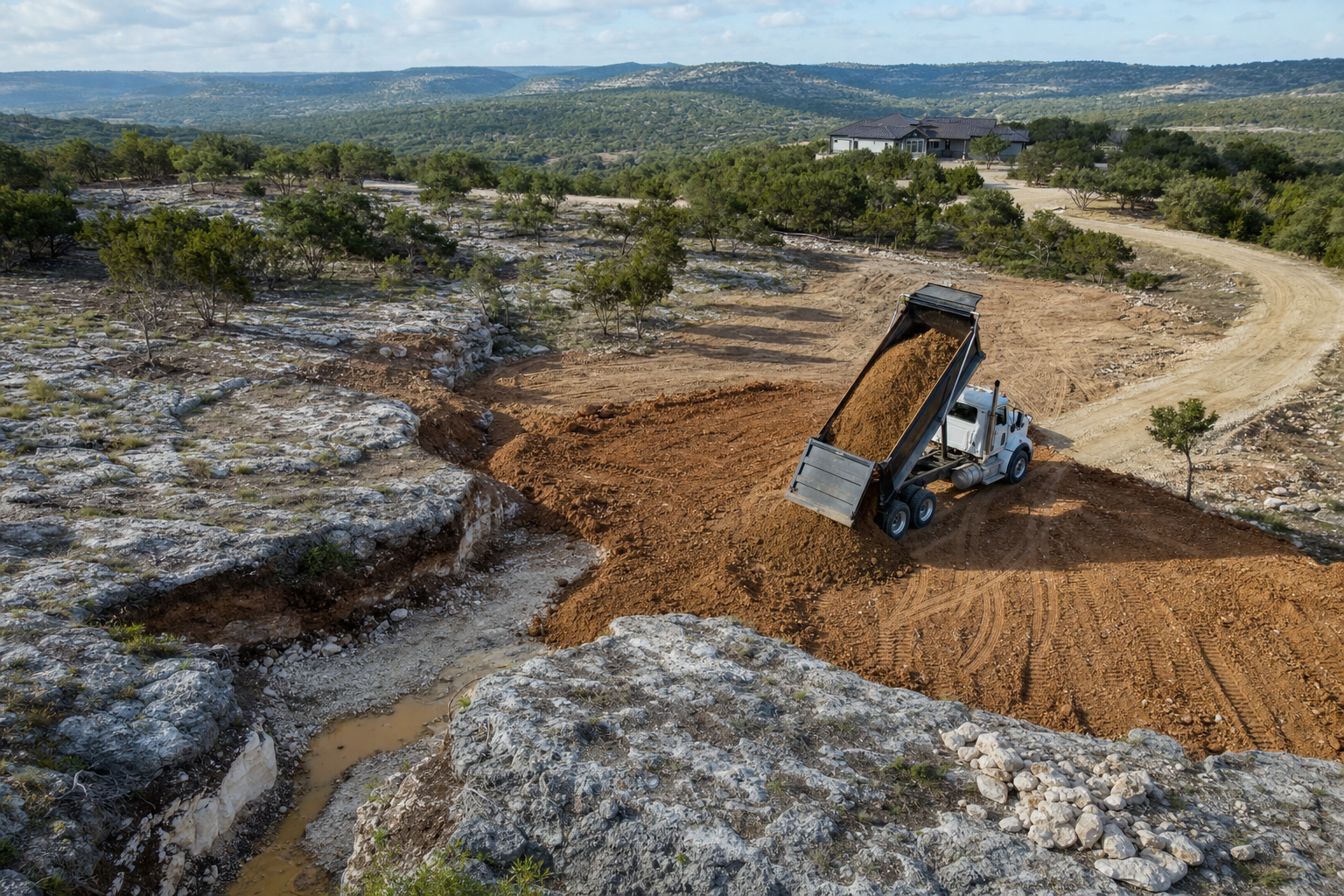
Fill dirt is the backbone of construction and site preparation work. Any time you need to change elevation, create a stable base, or support a structure, fill dirt is the right choice. We haul fill dirt for foundations, driveways, drainage corrections, and land leveling throughout the I-35 corridor.
Common fill dirt applications include:
Building up foundation pads before concrete pours
Filling holes, trenches, or excavated areas
Leveling lots before construction begins
Creating berms for drainage or erosion control
Backfilling around foundations, retaining walls, or utilities
Raising grade to improve drainage away from structures
Extending driveways or creating parking areas
Filling low-lying areas prone to standing water
The key advantage of fill dirt is stability. Because it compacts tightly and doesn’t decompose, it won’t settle significantly over time. This makes it essential for any load-bearing application. We regularly deliver fill dirt to contractors in Seguin and Floresville who are preparing building sites, where even a few inches of settlement could cause serious structural problems.
Ready to Order?
Call Now: 210-983-8005
Same-day delivery available on most orders in San Antonio and surrounding cities
Many projects require both fill dirt and topsoil in sequence. The most common scenario is site preparation for new landscaping. You use fill dirt to establish the correct grade and elevation, then spread topsoil on top as the planting layer. This approach gives you structural stability where you need it and growing conditions where you want them.
For example, if you’re building a new backyard landscape in New Braunfels and the existing grade slopes toward your house, you’d first bring in fill dirt to raise the grade and create positive drainage away from the foundation. Once that fill dirt is compacted and graded correctly, you’d add 4 to 6 inches of topsoil across the planting areas. The fill dirt provides stability and drainage correction; the topsoil provides the environment your plants need.
We see this layering approach constantly in residential construction. Builders use fill dirt to create level building pads and establish proper drainage, then landscapers come behind them with topsoil to create functional yards. Both materials are necessary, but they serve completely different purposes in the project sequence.
Why Site Preparation Matters: Handling Hill Country Soil Conditions
San Antonio and the surrounding Hill Country present unique soil challenges that affect how we approach material delivery and site preparation. Our native soils are predominantly clay-based with high calcium carbonate content. The infamous “Houston Black” clay that dominates Bexar County is expansive, meaning it swells when wet and shrinks when dry. This creates movement that can crack foundations, buckle driveways, and disrupt landscaping.
The limestone geology of the Hill Country adds another layer of complexity. In Boerne, Bulverde, and out toward Blanco, you’ll often hit solid rock within a few feet of the surface. This makes excavation expensive and creates pockets of extremely poor soil where nothing will grow without significant amendment. Caliche layers can form an impermeable barrier that prevents water drainage and root penetration.
Drainage Challenges in Hilly Terrain
Proper drainage management is critical throughout the region, but especially in the hilly areas north and west of San Antonio. Boerne and Bulverde sit in rolling terrain where runoff can move quickly across properties, causing erosion, flooding, and foundation problems. According to regional planning data, the San Antonio-New Braunfels Metropolitan Statistical Area consistently ranks among the fastest-growing regions in the United States, which means thousands of new homes are being built each year in areas with challenging topography.
Fill dirt plays an essential role in managing these drainage challenges. We deliver fill dirt for projects that regrade lots to direct water away from structures, fill low-lying areas that collect water, and create swales or berms that control runoff. In areas with heavy clay soil, we often recommend specific fill dirt compositions that provide better drainage characteristics than the native material.
The key is understanding how water moves across your property and using fill dirt strategically to direct that flow. A few loads of properly placed fill dirt can prevent thousands of dollars in future foundation repairs or erosion damage. We work with customers throughout the Hill Country to develop grading plans that use fill dirt to solve drainage problems before they cause structural issues.
Working with Caliche and Clay
If you’ve tried to dig a hole anywhere in San Antonio, you’ve probably hit caliche. This hardened calcium carbonate layer forms naturally in our soils and can be anywhere from a few inches to several feet thick. Caliche is a challenge for planting—roots can’t penetrate it—but it’s actually valuable for certain construction applications because it compacts extremely well.
When we deliver fill dirt in the San Antonio area, it often contains caliche content. For structural fills, foundation pads, and road base applications, caliche-heavy fill dirt is ideal because it creates a stable, dense surface. But for areas where you plan to plant, you’ll need to either break through the caliche layer or build up planting areas with topsoil above it.
Clay soil presents different challenges. Heavy clay drains poorly, expands and contracts with moisture changes, and becomes concrete-hard when dry. Professional-grade topsoil is in high demand along the I-35 corridor specifically because local soils have such low organic content. Homeowners and landscapers need imported topsoil to create functional planting areas that drain properly and support healthy plant growth.
Calculating Your Needs: How Much Material Should You Order?
One of the most common mistakes we see is ordering the wrong quantity of material. Customers underestimate how much they need and face project delays waiting for additional deliveries. Or they overestimate and end up with excess material they don’t know what to do with. Getting the quantity right saves money on delivery fees and keeps your project on schedule.
Understanding Cubic Yards
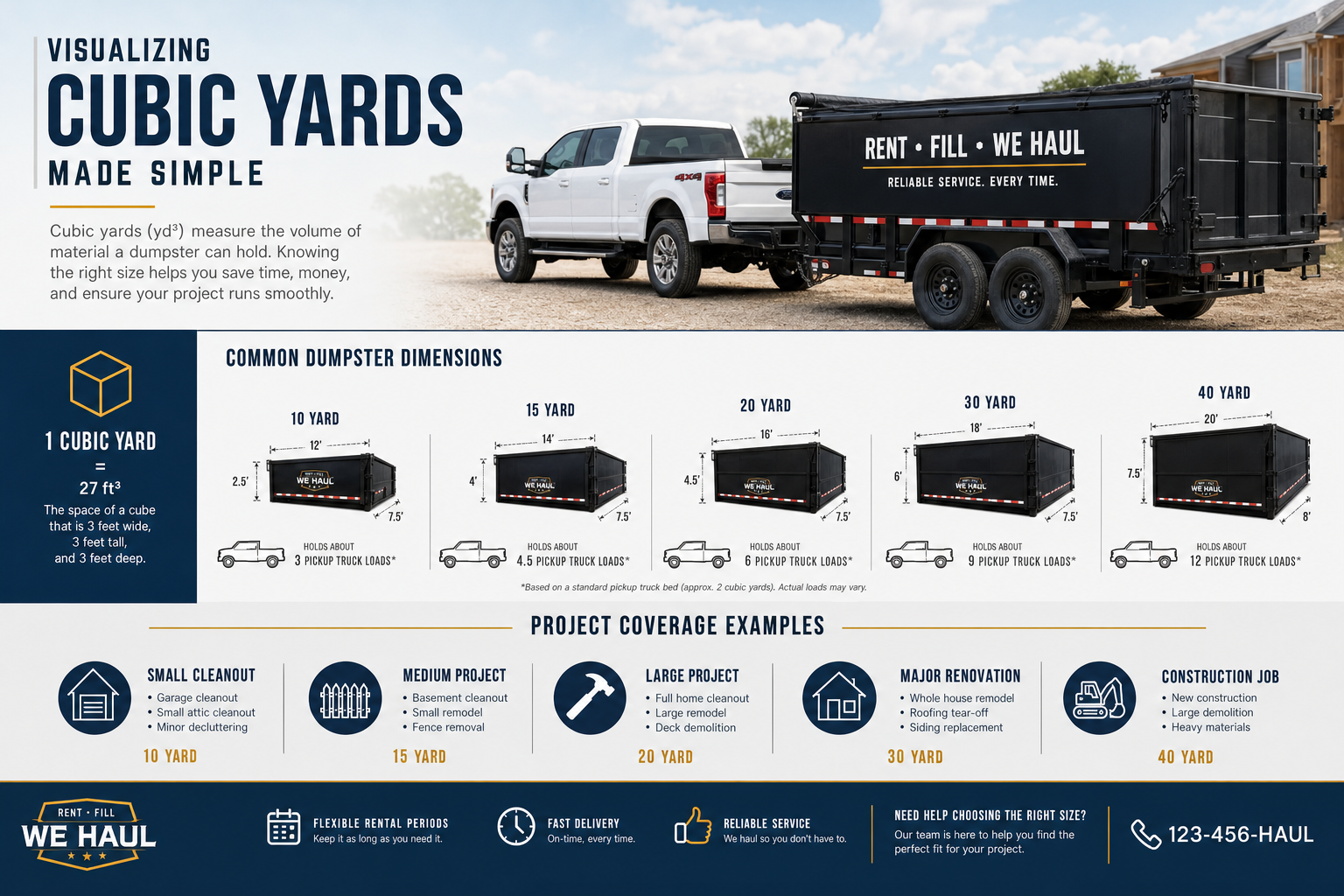
Bulk materials are sold by the cubic yard. One cubic yard is a cube measuring 3 feet on each side—3 feet wide, 3 feet long, and 3 feet deep. That’s 27 cubic feet of material. Most people have trouble visualizing cubic yards, which is why they struggle with quantity estimates.
Here’s a practical reference: one cubic yard of material will cover approximately 100 square feet at a depth of 3 inches. If you need to cover a larger area or need greater depth, you’ll need more material. A standard pickup truck bed holds about 2 to 3 cubic yards depending on the truck size, but that’s a loose estimate—compacted material takes up less space.
Calculating Fill Dirt Quantities
For fill dirt projects, calculate the volume of the area you need to fill. Measure the length and width in feet, then determine how deep you need the fill to be. Multiply length × width × depth (in feet) and divide by 27 to get cubic yards.
Example: You need to fill a low area in your backyard that’s 20 feet long, 10 feet wide, and needs to be raised 1 foot.
20 × 10 × 1 = 200 cubic feet
200 ÷ 27 = 7.4 cubic yards
Round up to 8 yards to account for compaction
Always add 10-20% to your calculated amount when ordering fill dirt because it will compact as it settles. If you calculate that you need 10 yards, order 11 or 12 yards to ensure you have enough material to reach your target grade after compaction.
Calculating Topsoil Quantities
Topsoil calculations follow the same formula, but typical applications use shallower depths. Most landscaping projects require 4 to 6 inches of topsoil for planting beds and 6 to 8 inches for new lawn establishment.
Example: You’re building garden beds that total 300 square feet and want 6 inches of topsoil depth.
Schedule Delivery in Minutes
Get Your Free Quote Today
Tell us your location, access, and estimated yardage — we’ll handle the rest
Convert 6 inches to feet: 6 ÷ 12 = 0.5 feet
300 × 0.5 = 150 cubic feet
150 ÷ 27 = 5.6 cubic yards
Round up to 6 yards
Topsoil doesn’t compact as much as fill dirt, but it’s still wise to order slightly more than your calculation suggests. It’s much easier to spread excess topsoil than to schedule another delivery because you came up short.
Account for Access and Delivery Logistics
Ordering the right quantity also means considering how material will be delivered. Our dump trucks need adequate access to unload material where you need it. If we can’t reach your project area, you’ll need to factor in time and labor to move material from the drop point to where you’ll use it.
We deliver across San Antonio, New Braunfels, San Marcos, Seguin, Floresville, Boerne, and Bulverde, but every property is different. Narrow gates, overhead obstacles, soft ground conditions, and steep grades all affect where we can unload. When you place an order, think through the delivery logistics. The closer we can get to your work area, the less labor you’ll spend moving material around.
Also consider project timing. If you’re working on a multi-phase project that requires several loads, schedule deliveries to match your work sequence. There’s no point having 20 yards of topsoil delivered if you’re still working on rough grading with fill dirt. Coordinate material deliveries with your project timeline to avoid having piles sitting on your property for weeks.
Streamline Your Construction: Order Quality Materials Online in San Antonio
We’ve spent years hauling materials across Central Texas, and we understand that construction and landscaping projects run on tight schedules. Delays waiting for material deliveries cost time and money. That’s why we built our online ordering system to make material delivery as straightforward as possible.
Whether you’re a contractor managing multiple jobsites in New Braunfels or a homeowner tackling a weekend driveway project in Seguin, you can browse our materials, calculate quantities, get pricing, and schedule delivery directly through our website. No phone tag, no waiting for quotes—just straightforward ordering that keeps your project moving.
Browse Materials and Calculate Costs
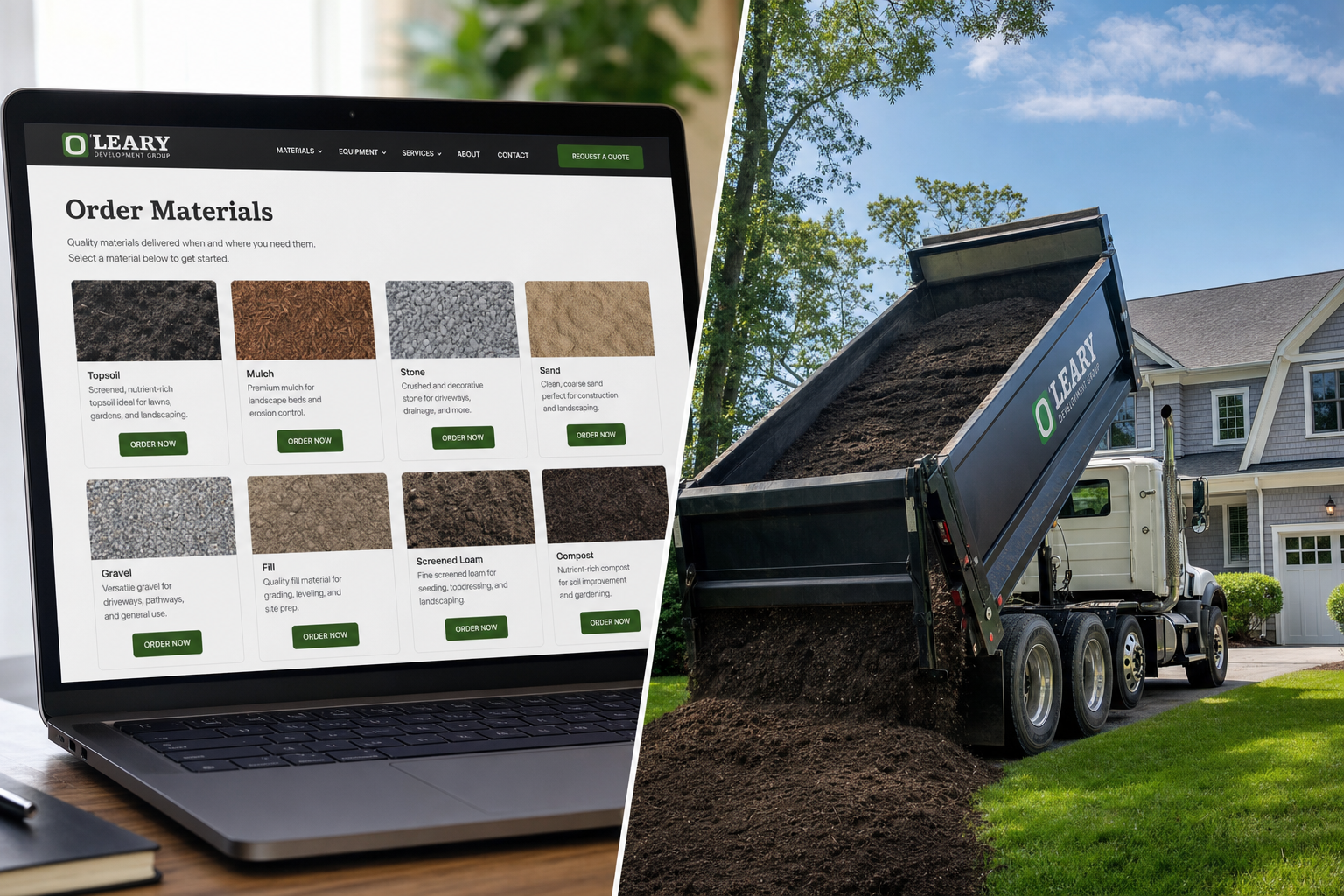
Our online material catalog shows exactly what we have available, including topsoil, fill dirt, road base, gravel, crushed limestone, sand, and more. Each material listing includes a description of the product, typical uses, and delivery information. You can calculate how much material you need using the quantity guidelines we provide, then add it to your cart and schedule a delivery time that works for your project.
Pricing is transparent. You see the material cost and delivery fee before you place the order. No surprises, no hidden charges. If you’re comparing options or planning a budget, you have all the information you need to make decisions without waiting for someone to call you back with a quote.
Schedule Delivery Across Our Service Area
We deliver throughout the San Antonio metro and surrounding communities including New Braunfels, San Marcos, Schertz, Cibolo, Seguin, Bulverde, Garden Ridge, Selma, Boerne, and Floresville. Our service area covers Bexar, Comal, and Guadalupe Counties, and we regularly make deliveries as far as San Marcos, Blanco, and the Canyon Lake area.
When you order online, you select your delivery location and preferred time frame. We coordinate schedules to get material to your site when you need it—not just when it’s convenient for us. Same-day and next-day delivery options are often available depending on your location and order size. For larger projects requiring multiple loads, we can schedule sequential deliveries to keep material flowing as you work.
Support for Contractors and Bulk Orders
Contractors working across multiple sites in the San Antonio area can use our online system to coordinate material deliveries to different locations. If you’re managing jobs in Boerne, New Braunfels, and Seguin simultaneously, you can schedule separate deliveries to each site, track order status, and keep your projects supplied without constant phone calls or site visits.
For bulk orders or ongoing supply arrangements, contact our team directly. We work with builders, developers, and excavation contractors who need reliable material supply over weeks or months. While our online system handles most residential and small commercial orders, larger projects often benefit from direct coordination with our logistics team to optimize delivery schedules and ensure material is always available when you need it.
Why Online Ordering Improves Project Efficiency
Traditional material ordering means playing phone tag, waiting for quotes, and hoping deliveries happen when promised. Our online system eliminates those friction points. You control the timeline, confirm pricing immediately, and schedule deliveries that match your work plan. This is especially valuable when you’re managing tight construction schedules or working around weather windows.
We built this system because we got tired of hearing customers say they lost half a day trying to get material delivered. Construction projects have enough unpredictable variables—material delivery shouldn’t be one of them. Whether you need 5 yards of topsoil for a garden project in Bulverde or 50 yards of fill dirt for site prep in Floresville, you can place that order online and get back to work.
Visit our materials page at olearydevelopmentgroup.com/materials to browse available products, calculate your needs, and schedule delivery. If you have questions about which material is right for your project or need help estimating quantities, our team is available by phone or email to provide guidance before you order.
Summary: Making the Right Choice for Your San Antonio Project
Fill Dirt · Gravel · Road Base · Sand · Topsoil · Asphalt Millings
Need Materials Delivered in San Antonio?
Call O’Leary Development Group for a fast quote on fill dirt, gravel, road base, sand, topsoil, or asphalt millings delivered in San Antonio.